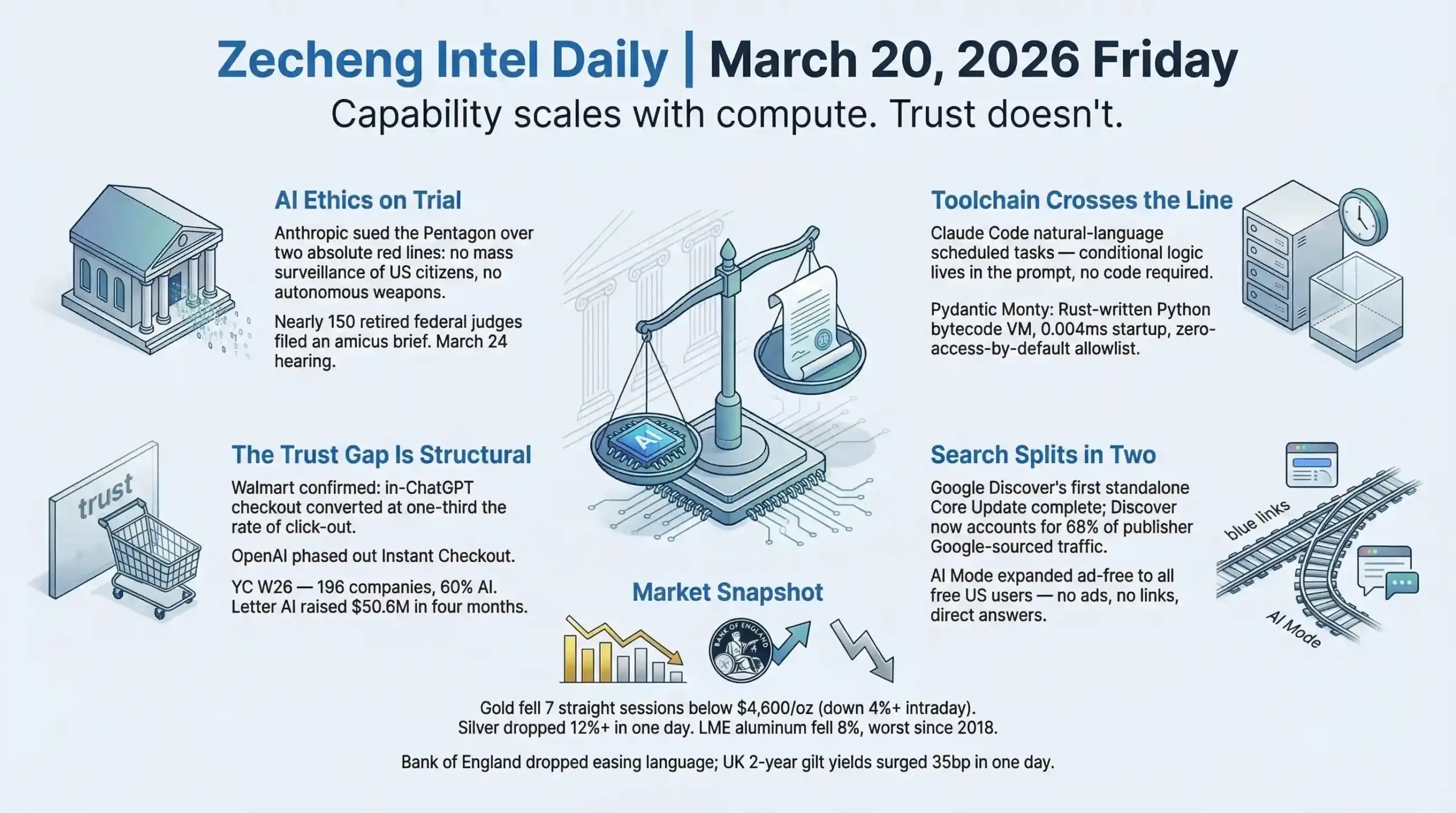
Quick Overview
- AI & Builders: Anthropic sued the Pentagon over two absolute ethical red lines — no mass surveillance of US citizens, no autonomous weapons — with the March 24 court hearing set to determine whether AI companies can legally enforce ethical limits on government contracts; OpenAI completed the Astral acquisition (uv hit 126M monthly downloads), and Claude Code's natural-language scheduled tasks give builders a real early-mover window before the feature goes mainstream.
- SEO & Search: Google Discover completed its first-ever standalone Core Update (February 5-27), with Discover now accounting for 68% of publisher Google-sourced traffic — it's already the dominant channel, not a secondary one; Google expanded ad-free Personal Intelligence AI Mode to all free US users, splitting search into two structurally separate tracks.
- Startups & Reddit: Walmart confirmed on record that in-ChatGPT checkout converted at one-third the rate of its own website — AI commerce is a discovery and handoff model, not an end-to-end one; YC W26 Demo Day runs March 24 with 196 companies (60% AI, up from 40% in W24), Letter AI closed a $40M Series B led by Battery Ventures, and the European Commission launched EU Inc on March 19 offering 48-hour, ~€100 pan-EU startup registration.
AI & Technology
Anthropic sued the Pentagon on March 9, 2026, establishing two absolute ethical red lines — no mass surveillance of US citizens, no autonomous weapons — and the March 24 court hearing will determine whether AI companies can legally enforce those boundaries against government contracts.
Headline: Anthropic vs. Pentagon — The First Courtroom Test of AI Ethics as Contract Terms
The lawsuit stems from a breakdown in contract negotiations. The Pentagon, after talks failed, designated Anthropic a "supply chain risk." The Department of Justice's position: Anthropic's terms are "unacceptable to the executive branch." Anthropic's response was to sue.
The two red lines Anthropic refused to cross: Claude cannot be used for mass surveillance of US citizens, and Claude cannot be deployed for autonomous weapons systems. These aren't vague policy preferences — they're contractual conditions Anthropic insists on for any government deployment.
The support lined up for Anthropic is notable. Nearly 150 retired federal and state judges filed an amicus brief. Microsoft, tech industry organizations, and former national security officials have backed Anthropic's position. March 24 is the date for the temporary relief hearing.
The HN community reaction captures the real stakes well. One comment: "This agent stuff is really making me lose respect for our industry." Another: "It is at our peril that we deem it acceptable to blame a black box for an error, especially at scale." The technical community isn't arguing about who's right — it's increasingly alarmed by the speed at which AI is being integrated into systems where accountability is unclear.
What makes this landmark is the mechanism, not just the position. AI safety arguments have always happened in policy papers, model cards, and internal governance discussions. Anthropic is taking those arguments into a courtroom. If the court upholds Anthropic's right to impose ethical conditions on government contracts, every other AI company gains a legal precedent to do the same. If it doesn't, the conversation shifts fundamentally — and the implicit assumption that AI companies can refuse government contracts on ethical grounds becomes legally contested territory.
Competitive context: the Pentagon contract Anthropic walked away from has largely shifted to OpenAI. This isn't just an ethics story — it's also a competitive one. OpenAI's Codex team meanwhile completed the acquisition of Astral this week: the creators of Ruff (Python linter), uv (package manager), and ty (type checker). Astral's tools grew from zero to hundreds of millions of monthly downloads. uv reached 126 million monthly downloads since its February 2024 launch (source: astral.sh/blog/openai). The open source community concern — raised directly on HN — is legitimate: "Structurally, [the startup model] offloads the costs onto the community that eventually comes to depend on you. By the time those costs come due, the founders have either cashed out or the company is circling the drain." Ruff and uv use permissive licenses and are forkable. But the pattern of AI labs acquiring developer tooling — Anthropic acquired Bun (JavaScript runtime) in December 2025, OpenAI now acquires Astral — is a structural shift worth tracking.
Builder Insights
Claude Code Scheduled Tasks: The Underreported Feature That's About to Explode
Claude Code now has scheduled tasks — essentially a natural-language cron-job system — and Authority Hacker is right that almost nobody is talking about it yet.
The mechanism: write a prompt, set a time, and it runs. Conditional logic lives in the prompt itself. "If X happens, do Y. If it doesn't happen, do nothing." Complete branching logic in natural language, no code required.
The use cases Authority Hacker identifies are immediately practical: monitor competitor pricing changes and flag them, run daily SEO audits and email summaries, detect specific keywords in Slack and draft responses, check a feed and trigger downstream actions conditionally.
"In two months, when the use cases get figured out, everyone's going to go crazy over this." The window where most builders haven't touched this yet is real. The builders who map out their highest-value monitoring and automation workflows now — before scheduled tasks become table stakes — get meaningful compounding advantage. Unlike most AI features where the ceiling is the model's capability, this one's ceiling is limited by workflow imagination. The conditional logic architecture means you can build fairly sophisticated automations entirely in prompt space.
The Claude Code scheduled tasks feature aligns with Anthropic's broader trajectory this week: the double usage promotion (March 13-27) ends soon, and bills will rise after March 27. Mapping highest-usage automation workflows now — before the limits revert — is where the early-mover compounding actually starts.
Pydantic Monty: A Rust-Written Python Interpreter Built for Agent-Era Code Execution
Samuel Colvin (Pydantic) presented Monty at Latent Space — a minimal, secure Python bytecode VM written in Rust specifically for safely executing AI-generated code. Released February 27, 2026.
The problem it solves is precise. LLMs are significantly more efficient when generating Python code (what Colvin calls "CodeMode") rather than making sequential tool calls. But you can't give an AI unrestricted system access to execute arbitrary code. Current alternatives are all too slow: Docker takes 195ms to start, sandbox services take 1000ms or more. For an agent workflow making dozens of decisions per task, that latency compounds badly.
Monty's architecture: a from-scratch bytecode VM using Ruff's parser. Startup latency: 0.004ms. Footprint: 4.5MB, no external dependencies. Runs on Linux, macOS, Windows, and embedded systems. Callable from Python, JavaScript/TypeScript, or Rust.
The security model is the interesting part. Zero access by default — every capability requires explicit developer opt-in via allowlist, not blocklist. You don't start with everything and remove the dangerous stuff. You start with nothing and add what you specifically need.
Measured impact: tasks that required multiple sequential LLM calls now complete in 2 LLM calls using CodeMode and asyncio.gather(). The latency and cost reduction for agent workflows is substantial.
Colvin's self-aware take: "I basically was slightly laughing at anyone who said they weren't reading all their code — and now here I am building what you could call a slop fork of Python, mostly with AI. I wrote 30,000 lines of Rust over Christmas." The meta-point: he built a major infrastructure tool for AI-generated code execution primarily using AI to generate the code. The capability spectrum it unlocks: Tool calling (safe, slow) → Monty CodeMode (controlled Python, the right balance) → Full computer use. (Source: pydantic.dev/articles/pydantic-monty)
Felix Rieseberg, Anthropic: AI Needs the Full Local Computer, Not a Sandboxed API
Felix Rieseberg (Anthropic, Member of Technical Staff working on Claude Cowork and Claude Code) made a counterintuitive argument at Latent Space that's worth taking seriously: "I actually don't think the future is going to be hyper-personalized software where everyone runs their own version."
His core argument: for Claude to be genuinely useful, it needs access to all the same tools you have access to — file system, browser, applications, the full desktop environment. A sandboxed API call can only do what it's been given permission to do, which is always less than what the task actually requires.
This is Anthropic's stated rationale for investing in Claude having its own computer. Claude Cowork — persistent agent threads via Claude Desktop that maintain context across sessions — is the concrete product. Available on Max plan now, coming to Pro. The design goal: not a one-shot chatbot but a persistent collaborator that knows what you're working on.
The practical implication for builders: the most powerful AI integrations right now are the ones that give AI agents genuine local tool access, not sandboxed API calls. The gap between "Claude via API" and "Claude with access to the actual machine" is larger than most current integrations acknowledge.
The reference point Rieseberg uses: "How come we're all using MacBooks and not iPads or Chromebooks?" The local computer remains the most capable working environment — AI should inhabit it, not operate through a window into it.
GPT-5.4 Mini and Nano: The Subagent Architecture Becomes Explicit
Cole Medin (YouTube) laid out the significance of GPT-5.4 mini and nano clearly: for the first time, OpenAI explicitly marketed these models as built for subagents. This isn't just a capability update — it's a public architectural signal.
The numbers: GPT-5.4 nano at 188 tokens/second on OpenRouter, priced at roughly one-fifth of Claude Haiku 4.5, with higher benchmark performance. GPT-5.4 mini cheaper than Haiku, very fast, approaches GPT-5.4 performance on SWE-Bench Pro.
The subagent architecture this enables: a large model handles planning, coordination, and final judgment. Mini/nano subagents handle parallel subtasks — searching codebase, reviewing large files, processing documents. This directly addresses context rot — the well-documented performance degradation when you load a large language model with more context than it can effectively use.
Claude Code is already building around subagents. Gemini 3.1 Flash Light was explicitly released for "intelligence at scale." The competitive dynamic is clear: the race isn't just about the largest, most capable models. It's about which ecosystem can run the most cost-efficient, high-throughput subagent architectures.
Traversy Media on Vibe Coding: The Architectural Debt Warning
Brad Traversy's 16-hour AI workflow course is built around a distinction worth internalizing. "Vibe coding" — his term for letting AI make all architectural decisions while the developer stops understanding their own codebase — is a real problem. Companies are now requiring developers to use AI tools, but the structured workflow approach (AI accelerates your work, you remain the architect) and vibe coding have fundamentally different risk profiles. The developer who vibe codes their way to a working product but can't explain the architecture is carrying technical debt they may not be able to service when the requirements change.
Other AI Updates
NanoGPT Slowrun: Community Hits 5.5x Data Efficiency in Days, 10x Projected "Short-Term"
Q Labs launched NanoGPT Slowrun — a fixed-dataset (100M tokens, FineWeb), unlimited-compute benchmark focused on data efficiency for language model training. The premise: compute is scaling far faster than data. In robotics and biology, data is the binding constraint even when compute is abundant.
Starting point: 2.4x data efficiency over the modded-nanogpt baseline. Community contributions in the first few days pushed this to 5.5x: per-epoch shuffling, SwiGLU activations replacing squared ReLU, learned value embedding projections, model ensembling. The Muon optimizer outperforms AdamW, SOAP, and MAGMA on this benchmark.
Q Labs projection: 10x data efficiency "reachable in the short term," 100x potentially feasible by end of 2026. For anyone working on model training in data-constrained domains, this is directly relevant — the playbook for squeezing more signal from fixed data is being written in real time. (Source: qlabs.sh/10x)
Google Gemini Personal Intelligence Goes Free — Universal Search Rankings Start to Dissolve
Google expanded Personal Intelligence from paid-only to free-tier US users around March 17-19, 2026 — less than two months after its January 2026 paid launch. The feature taps into Gmail, Calendar, Drive, Photos, YouTube, Search, and Maps to generate responses personalized to individual behavior patterns. Off by default, personal accounts only (not Workspace business/enterprise).
The SEO implication identified by Julian Goldie (Goldie Agency CEO): AI Overview results will increasingly personalize. Two users searching the same query may see different AI-generated summaries based on their behavioral history. "The era of universal search rankings is shifting toward personalized AI responses." The line between "personalization" and "learning from your queries" remains blurry — Google states it doesn't train directly on Gmail inbox contents, but does learn from specific prompts and model responses. (Source: blog.google/products-and-platforms/products/search/personal-intelligence-expansion/)
AssemblyAI Voice Infrastructure: 250M Hours in 2025, Now 2M Hours Per Day
AssemblyAI (YC Summer 2017, among the earliest YC AI companies) disclosed scale metrics in a YC video: 250 million voice hours processed in 2025, now running nearly 2 million hours per day — roughly 700 million hours annualized, still growing week-over-week. 1 million registered developers. 10,000 customers. Granola and Fireflies.ai run on AssemblyAI infrastructure.
Technical specs: Universal-Streaming model at roughly 300ms latency, $0.15/hour, 8.14% word error rate — lowest among major providers in independent benchmarks. Universal-3 Pro Streaming: ~150ms P50 latency.
Market context: voice AI at $18.4B in 2025, projected $61.7B by 2031 (22% CAGR). VC into voice AI: $315M (2022) to $2.1B (2024), 7x. 87.5% of builders actively building voice agents in 2026. (Source: assemblyai.com/blog/voice-ai-in-2026-series-1)
Analysis
Two structural shifts running in parallel this week, both worth tracking separately.
The first is toolchain maturity accelerating faster than most people are tracking. Pydantic Monty addresses AI code execution safety at the infrastructure level. Claude Code scheduled tasks address natural-language background automation. Felix Rieseberg's argument for local computer access points at the capability ceiling of sandboxed API architectures. These aren't headlines individually — together, they describe an AI development toolchain moving from "functional for demos" to "deployable in production with appropriate trust." That transition has real commercial implications for builders who move early.
The second is governance hardening in real time. Anthropic suing the Pentagon isn't a PR move. It's an attempt to turn ethical commitments into legally enforceable contract terms. The March 24 hearing matters beyond Anthropic's specific situation — it's testing whether AI companies have the legal standing to say no to government contracts on ethical grounds, and whether courts will protect that right. OpenAI's acquisition of Astral, layered on top of Anthropic's December acquisition of Bun, makes a different governance point: the tools that developers depend on are increasingly being absorbed into AI lab ecosystems. The open source community's concern isn't paranoid — it's structurally sound. The question is whether the permissive licenses and forkability of these tools is sufficient protection, or whether the gravity of AI lab ecosystems eventually makes independence impractical.
The Anthropic Pentagon lawsuit hearing on March 24 and YC W26 Demo Day fall on the same date — an odd pairing that's more connected than it looks. On one side, a test of AI ethical boundaries in government procurement. On the other, 196 companies — 60% AI — presenting the next generation of AI applications to investors. Both conversations are running in the same week for reasons that aren't coincidental.
Business & Startups
The most important data point in e-commerce this week is not a funding round or a product launch. It is a single conversion number that Walmart put on record: in-ChatGPT checkout converted at one-third the rate of click-out to Walmart's own website.
Walmart ChatGPT Checkout Conversion: The Real Number Is Out
Walmart's partnership with OpenAI began in November 2025. The setup was straightforward: roughly 200,000 products available through OpenAI's Instant Checkout, users could complete purchases inside ChatGPT without ever visiting Walmart.com. The pitch was frictionless commerce — no redirects, no tab switching, just ask and buy.
Daniel Danker, Walmart's EVP of Product and Design, has since gone on record calling the experience "unsatisfying." The conversion rate for in-chat purchases was one-third that of click-out transactions to Walmart's own site (source: Danker public statement, TechCrunch March 19, 2026). OpenAI confirmed this month it is phasing out Instant Checkout.
That number deserves a serious look. Checkout conversion is the most scrutinized metric in e-commerce — companies spend months A/B testing button colors to move it by half a percentage point. A 3x gap is not a rounding error. It is a structural signal.
What does that gap actually represent? Not the product catalog. Not the pricing. The gap is trust infrastructure. When someone arrives at checkout on a brand's own domain, they are inside a system that holds their order history, their loyalty points, their saved payment methods, the return policy they already read, and the live chat button they know will work if something goes wrong. A chatbot plugin, however well-integrated, cannot replicate that accumulated trust in a single session.
Walmart's updated approach is more architecturally honest: embed Sparky (Walmart's own AI) inside ChatGPT for discovery and cart-building, but route the actual transaction back to Walmart's checkout system. The same integration is coming to Google Gemini next month. This is the model that makes sense — AI as the front door, brand-owned checkout as the closing room.
For independent store operators and DTC brands, this is clarifying rather than discouraging. The pattern that's emerging across multiple platforms is that AI agents are excellent at collapsing the discovery-to-intent phase. They surface relevant products faster than search, handle comparison queries naturally, and reduce the cognitive load of browsing. Where they consistently underperform is at the moment of financial commitment. That handoff — from AI conversation to brand checkout — is not a failure of AI. It is how trust actually works.
The practical implication: investing in the quality of your own checkout experience and post-purchase communication matters more than ever, precisely because AI is sending more pre-qualified intent to your door. The stores that win the next phase of agentic commerce will be the ones that convert that intent efficiently once they have it.
YC W26 Demo Day March 24: What This Batch Tells Us About Where Money Is Going
YC W26 Demo Day runs March 24. The batch has 196 companies, with 60% AI-focused — up from roughly 40% in the W24 cycle — and about 64% B2B (source: YC official data). A few companies in this batch are worth examining beyond the headline statistics.
Letter AI (formerly Trackus) closed a $40M Series B led by Battery Ventures four months after a $10.6M Series A, with YC, Lightbank, Northwestern Mutual Future Ventures, and Stage 2 Capital participating (source: Letter AI announcement). Customers include Lenovo, Adobe, Novo Nordisk, Plaid, and RingCentral. The product — Letter Compass — consolidates CRM data, sales content, and deal-level insights into one interface. The problem it addresses is well-documented: sales reps spend less than 30% of their time on actual customer interaction, with the rest lost to tool-switching and content assembly. The pace of this fundraise (two rounds in four months, two and a half years after initial YC investment) suggests the product found meaningful retention before the capital arrived.
Onshore targets accounting and tax automation. The Big Four charge $500 to $2,000 per hour for work that Onshore estimates is 80% pattern-matching — data entry, format conversion, reconciliation. Early customer results show 70-80% reduction in time spent on standard tax workflows (source: Onshore team disclosure). If those numbers hold at scale, the business model of charging professional-service rates for clerical-speed work becomes hard to defend.
Pocket is the statistical outlier: seed stage, $27M ARR, 50% month-over-month growth, 30,000-plus hardware units shipped (source: YC Demo Day materials). No further detail available at this stage — those numbers are either extraordinary traction or extraordinary rounding, and the Demo Day will clarify.
Voltair is doing something unglamorous and structurally interesting: wireless charging pads for drones mounted on power lines. The unit economics are stark — roughly $2,000 per charging pad versus $250,000 for existing alternatives. American infrastructure context: 7 million miles of transmission lines, more than half of transformers aging past 30 years (source: U.S. Department of Energy public data). First paid contract signed, first paid flight scheduled for mid-April.
The thread connecting the strongest companies in W26 is consistent: they are targeting industries where high billing rates have historically been justified by credentialing barriers rather than actual cognitive complexity. Accounting, enterprise sales, legal document processing. AI is entering through the cost structure, not the product roadmap.
Reddit Pain Point Analysis
The conversation on r/Entrepreneur and r/startups this week centers on a question that keeps surfacing in different forms: what actually happens when AI handles more of the work?
The Letter AI story prompted extended discussion about sales tool fragmentation. The recurring complaint from founders and sales-led teams is not that any single CRM or sales tool is bad — it is that maintaining five or six tools in parallel, keeping data synchronized, and switching context constantly has become its own full-time job. The complaints aren't about individual tools failing — they're about the overhead of keeping five or six synchronized while actually trying to do the work.
On the e-commerce side, the Walmart ChatGPT data landed in DTC communities with more nuance than the headline suggests. The prevailing read from experienced operators was not "AI commerce is dead" but rather "this confirms what we suspected about checkout trust." Several threads noted that Walmart's failure mode — building checkout inside someone else's platform — is structurally identical to the early Facebook Shops experience, where brands discovered that owning the transaction required owning the real estate.
The BASED Act announcement generated its own thread cluster, particularly among indie developers who have been affected by App Store policies. The private right of action provision drew the most discussion — the argument being that regulatory complaints filed through official channels have historically moved too slowly to matter for small developers, while the ability to sue directly changes the risk calculus for platforms.
Builder Updates
Brad Traversy published a 16-hour course on building full-stack SaaS applications with AI workflows (source: Traversy Media YouTube). The technical content is secondary to the framing: Traversy explicitly criticizes "vibe coding" — the practice of delegating all architectural decisions to AI and treating the output as production-ready. His position is that AI tools have become mandatory for competitive development velocity, but the developer's role as the system's architect is non-negotiable. This is a minority opinion in YouTube tech content right now, which usually trends toward "AI can do everything" positioning. It is also almost certainly correct. Codebases built without architectural intent accumulate debt that surfaces at the worst possible moment — usually when the product is actually getting traction.
@blvckledge shared an analysis of ten high-converting e-commerce landing page systems, citing $0.07 cost-per-click and 2-3x reduction in CPA (source: @blvckledge on Twitter/X). The specific systems require following the original thread, but the underlying signal is worth noting: at a moment when paid traffic costs have been compressing margins across DTC, landing page structure optimization has a higher return on invested time than incremental increases in ad spend. Conversion happens after the click.
A separate DTC creator shared a workflow for accelerating creative production without sacrificing conversion performance, including the AI prompts used. The bottleneck they are solving — the distance between a creative concept and a deployable ad asset — is one of the most consistent friction points reported by operators running multiple SKUs across multiple channels.
EU Inc Startup Registration: 48 Hours, ~€100, All Member States
The European Commission launched EU Inc on March 19, 2026, offering registration in 48 hours for approximately €100, with a single registration covering all EU member states (source: European Commission official announcement).
The direct comparison is Delaware incorporation in the United States: minimal bureaucracy, low cost, strong legal infrastructure. The EU's fragmented regulatory landscape has historically pushed early-stage teams toward UK or Irish registration for European operations, even post-Brexit, because the administrative overhead of operating across member-state jurisdictions was prohibitive.
Whether EU Inc delivers on the execution is a separate question from whether the intent is correct — the intent clearly is. For bootstrapped founders building products with European audiences, the cost of proper legal structure has been disproportionate to the stage. Reducing that friction does not guarantee more European startups succeed, but it removes one legitimate barrier that did not need to exist.
ProductHunt and Indie Highlights
The DoorDash Tasks app launched this week — a separate product that pays gig workers to complete structured tasks for AI training data, including recording daily activities on video and recording audio in multiple languages (source: TechCrunch). The revenue model is straightforward and the addressable labor pool is the existing DoorDash driver network. What is interesting is the positioning: DoorDash is effectively monetizing its logistics network in a second vertical without adding delivery infrastructure. The unit economics of AI training data acquisition through an existing gig network versus purpose-built data collection are worth watching.
Cardboard, an AI video editor in the YC W26 batch, posted the highest Hacker News score in this batch at 131. No detailed coverage available — TITLE_ONLY at this stage — but the community signal on HN for a video editing tool is notable given how crowded that category is.
AssemblyAI, a YC 2017 alumnus, reported processing 2.5 billion hours of voice in 2025, with current daily volume approaching 2 million hours (source: AssemblyAI, via YC video). The voice AI market is projected at $18.4 billion in 2025, growing to $61.7 billion by 2031 at a 22% CAGR (source: market research cited in YC materials). 87.5% of builders surveyed in 2026 are actively building voice agents. The infrastructure layer of voice AI — transcription, understanding, generation — is becoming a commodity faster than most people expected, which compresses margins at the API level but expands the addressable surface for application-layer products built on top.
The Walmart number is the anchor data point this week. Three-times worse conversion inside ChatGPT versus on-site is not a temporary technical limitation — it reflects how trust gets allocated in commercial transactions. AI commerce infrastructure is evolving toward a discovery-and-handoff model rather than an end-to-end model. The YC W26 batch reinforces this with a separate signal: the most fundable AI applications right now are not the ones replacing the most cognitively complex work. They are the ones replacing the most expensive work that is actually low-complexity pattern-matching. That distinction matters for anyone thinking about where AI products can charge real money versus where they will be commoditized before they reach scale.
SEO & Search Ecosystem
Google AI Mode Is Now Ad-Free for Millions — and That Changes Everything About Search Monetization
Google's Personal Intelligence is now free for all U.S. users across AI Mode in Search, the Gemini app, and Gemini in Chrome — expanded from paid AI Pro and AI Ultra tiers on March 17 (Search Engine Land, March 17, 2026). The feature connects Gmail, Google Photos, Google Drive, and Calendar to deliver context-aware answers based on a user's own data. Not generic results. Answers tied to their actual schedule, emails, and files.
The detail that matters most for anyone thinking about search traffic: users with Personal Intelligence enabled in AI Mode see no ads. Google confirmed this policy explicitly, and said it is not changing — for now.
Search is now running two parallel tracks. The traditional blue-link SERP remains ad-supported. AI Mode operates on a fundamentally different model: no ads, no links, direct answers. By making Personal Intelligence free, Google is accelerating adoption of a search experience where the publisher as a traffic destination is largely absent. When monetization eventually follows — and it will — the insertion point for advertising won't look anything like a traditional SERP.
For content site operators: this isn't today's emergency, it's tomorrow's structural shift. As more users migrate to AI Mode for informational queries, the click-through model for content monetization faces compression from a second direction. AI Overviews already reduced position-1 CTR to 1.6% from 7.3% over two years (Ahrefs, December 2025 data). AI Mode removes even that remnant click opportunity for users who are logged in and have Personal Intelligence enabled.
The playbook of "rank for informational queries → capture ad impressions" is being dismantled from two ends simultaneously.
Google Discover Gets Its First-Ever Standalone Core Update — Publishers Are the Ones Who Need to Pay Attention
Google's February 2026 Discover Core Update ran from February 5 to February 27 and is now complete — the first update Google has ever run specifically for the Discover feed, independent of Web Search (Search Engine Land, Search Engine Journal, Google Developer Blog). Previously, Discover and Web Search shared the same core update cycle. They now run separate algorithms.
The traffic data behind this matters. An analysis of 400+ news publishers found Discover's share of Google-referred traffic rose from 37% in 2023 to approximately 68% now (Search Engine Land). For many content publishers, Discover has quietly become the dominant Google channel — not search. If you're treating Discover as a secondary consideration, you're misreading where your Google traffic is actually coming from.
What the update targeted: sensationalist framing, clickbait headlines, and surface-level content packaged for engagement. Original, depth-first reporting gained visibility. The practical implication is that Discover can now be optimized as a standalone channel — separate signal sets, separate timeline, separate behavior from Web Search rankings.
The move toward a first-ever Discover-specific update also signals Google's long-term intent: as AI Mode absorbs informational search, Discover becomes the primary distribution surface for editorial and content-driven publishing. Google is investing algorithmic attention accordingly.
Builder Insights
Authority Hacker: Your AI Tool Bills Are About to Spike
Mark Webster at Authority Hacker flagged something that caught many operators off guard in a March 18 video: Claude and Code have been running hidden double-usage promotions throughout February and March. Anyone using Claude or Claude Code during this period has been consuming twice the normal token limits without realizing it — the system just gives you more without marking it clearly. That promo ends at the end of March (Authority Hacker, YouTube, March 18, 2026).
The practical impact: SEO operators and content teams who migrated to Claude Code in the past two months are accustomed to a usage baseline that doesn't actually exist after March. Authority Hacker's Gael Breton noted that Code is likely preparing to launch new pricing tiers when the promo expires — current $20 plan users may get roughly 30-40% more than normal limits, but at a much higher price point.
Ahrefs simultaneously launched a free web monitoring tool and opened its API broadly. The timing is intentional: when AI cost pressure rises, tools that lower the barrier to entry capture new users. Worth watching where Ahrefs takes the API.
Julian Goldie on Google Personal Intelligence as a Business Intelligence Layer
Julian Goldie walked through a concrete use case in his latest video: ask Google's Personal Intelligence "what content have I published about AI automation this month?" and it scans Gmail, Drive documents, calendar notes, and past searches to return an answer based on your actual data (Julian Goldie, YouTube). The framing that resonated: this isn't a search engine upgrade, it's a private business intelligence system built on top of your Google activity. For SEO agencies managing client content calendars and editorial schedules, this reduces research overhead significantly.
The privacy architecture matters here: everything is opt-in, users control which Google apps connect, and the feature can be switched off. Google is betting that the usefulness outweighs the data sharing discomfort for most users.
AEO & AI Search Watch
Google AI Mode's ad-free status for Personal Intelligence users creates a valuable observation window. Google is collecting data on how users behave in a search experience with no commercial interruption — engagement patterns, follow-up queries, session depth. That data will inform the eventual monetization design. For brands, the key question is not whether AI Mode will eventually run ads, but whether your brand appears in AI Mode answers when users search your category without ads competing for attention.
Being cited in AI Mode requires the same signals as AI Overviews: structured, authoritative, first-hand content. Zero-click is the default. The only reliable traffic pathway from AI Mode right now is brand recognition that drives direct navigation — a query becomes a brand visit.
What this means: The Discover algorithm now runs independently — operators treating it as secondary to Web Search are misreading where Google traffic actually originates, given that 68% of publisher Google traffic already flows through Discover. The sensationalist packaging that built traffic in 2023 is now exactly what the update penalizes; depth-first original reporting is what gained visibility. On AI Mode: the ad-free window for Personal Intelligence users is a useful research period — checking what category queries surface in logged-in AI Mode is worth doing now, before monetization reshapes the dynamics. For Claude Code operators: the double-usage promotion ends at month's end, and the consumption baseline most teams have built up doesn't reflect actual post-March limits.
Today's Synthesis
Walmart's in-ChatGPT checkout converted at one-third the rate of its own website (source: Walmart EVP Daniel Danker, TechCrunch, March 19, 2026). On the same day, gold fell for a seventh straight session below $4,600/oz despite an active military conflict that, by every textbook, should have sent it higher. These two data points, from entirely different domains, are telling the same story: first-order logic is losing to second-order effects across markets, commerce, and AI adoption simultaneously.
Start with the Walmart number. E-commerce has operated on a simple assumption for over a decade: fewer steps between intent and purchase means higher conversion. Remove the redirect, keep the user in the conversation, and the sale completes. Walmart and OpenAI tested this assumption with 200,000 products and real transaction data. The result was unambiguous. Danker called the experience "unsatisfying." OpenAI is shutting down Instant Checkout this month.
The 3x conversion gap is not a UX problem that better design will fix. It represents a structural truth about where financial trust actually lives. When a buyer reaches checkout on Walmart.com, they are inside a system that holds their order history, loyalty points, saved payment methods, return policy, and customer service access. That accumulated trust cannot be transplanted into a chatbot plugin. The credit card moment requires not convenience but confidence — and confidence is built over years of reliable transactions, not in a single AI-mediated session.
Now look at gold. War is supposed to drive gold higher. That is first-order logic. What actually happened: the Iran conflict pushed Brent crude above $110, oil prices strengthened inflation expectations, the Bank of England dropped its easing bias entirely and markets priced in three rate hikes by year-end, US two-year Treasury yields jumped 11 basis points to 3.89% as Fed easing expectations were fully priced out, and gold — a zero-yield asset — became expensive to hold in a rising-rate environment. The transmission chain added an intermediate step that reversed the expected outcome. Silver fell 12%. LME aluminum dropped 8%, its worst day since 2018. Precious and industrial metals sold off together — a rare synchronized move that reflects both inflation fear and demand-side confidence erosion happening at once.
The pattern connecting these is the dominance of mediating variables. In commerce, the mediating variable between "AI reduces friction" and "sales increase" is trust infrastructure — and that variable runs in the opposite direction. In commodities, the mediating variable between "war creates uncertainty" and "safe havens rise" is rate expectations — and that variable also runs opposite to the naive prediction. In both cases, the intermediate link in the causal chain is strong enough to overwhelm the direct relationship.
This same dynamic plays out in AI governance. Anthropic sued the Pentagon over two contractual red lines — no mass surveillance of US citizens, no autonomous weapons. On the surface, this is an ethics story. But the mediating variable is legal precedent. If the March 24 hearing establishes that AI companies can legally enforce ethical conditions on government contracts, every future negotiation between AI labs and government agencies shifts. If it does not, the implicit assumption that companies can refuse government work on ethical grounds becomes legally contested territory. The direct relationship (company has ethics policy → company acts ethically) depends entirely on whether the legal infrastructure supports enforcement.
YC W26 Demo Day falls on the same date — March 24 — with 196 companies, 60% AI-focused. The most fundable companies in this batch are not solving the hardest technical problems. They are solving the most expensive problems that happen to be low-complexity pattern matching. Onshore cuts standard tax workflow time by 70-80%. Letter AI raised $50.6 million in four months by consolidating sales tools that enterprise reps waste 70% of their time switching between. The pattern: AI enters through cost structure, not cognitive frontier. The industries most vulnerable are those where credentialing barriers — not actual difficulty — have historically justified high billing rates.
The cross-reference between Chinese and Western data sources sharpens one point. Alibaba's Q3 earnings disclosed that its cloud division crossed 100 billion yuan in external revenue, with a five-year target of $100 billion in annual cloud and AI revenue. Its chip unit shipped over 470,000 AI chips with 60% going to external customers. Meanwhile, in the US, the AI toolchain is maturing fast — Pydantic Monty launches at 0.004ms startup latency for secure AI code execution, Claude Code adds natural-language scheduled tasks, and Anthropic's Felix Rieseberg argues that AI needs full local computer access rather than sandboxed APIs. The infrastructure race is happening on both sides of the Pacific, but the commercialization paths diverge: Chinese AI infrastructure is scaling through cloud and chip revenue within an existing enterprise ecosystem; Western AI infrastructure is scaling through developer tooling and agent architectures that assume local-first computing. Both are building trust infrastructure — just in structurally different ways.
Efficiency is a tooling problem. Trust is an infrastructure problem. The data from today — Walmart's 1/3 conversion, gold's inverted safe-haven behavior, Anthropic's courtroom gambit — all point to the same conclusion: the bottleneck in every domain is no longer capability. It is the trust layer that sits between capability and adoption. And that layer does not scale with compute.
This report was generated by IntelFlow — an open-source AI intelligence engine. Set up your own daily briefing in 60 seconds.
Comments on "Zecheng Intel Daily | March 20, 2026 Friday": 0