Your birth moon phase is the Moon’s geocentric phase at your birth instant, defined by the Moon–Sun angle and the Earth-facing illuminated fraction.
Astronomically, this identifies the Moon’s position in its cycle at that moment. In astrology, the phase name is also used as a symbolic vocabulary, but those interpretations are cultural or spiritual rather than scientifically established traits. The Birthday Moon Phase Calculator therefore calculates the astronomical result without inferring personality, compatibility, luck, fate, or life advice.
That distinction makes the result useful in two ways: it gives you a factual phase label, and it shows whether your birth moment was close enough to a boundary that a more precise birth time would matter.
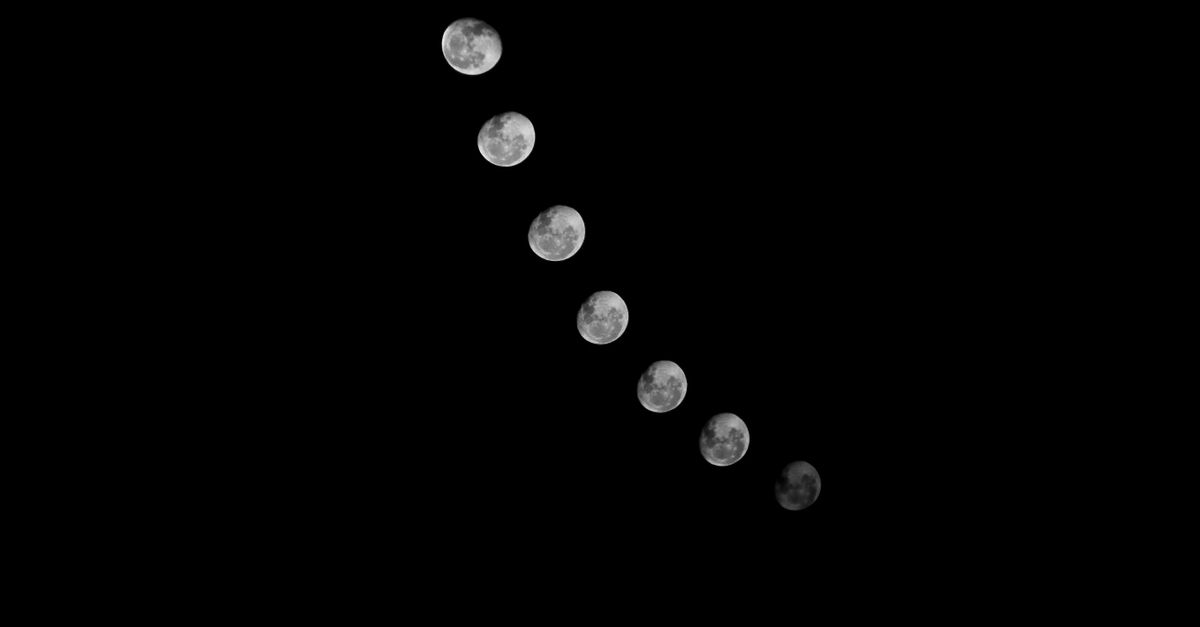
What the phase calculation actually records
“Geocentric” means the calculation is made from the center of Earth, not from the viewpoint of an observer at your birthplace. It does not calculate moonrise, a local horizon position, weather, or whether you could actually see the Moon. A phase is therefore an Earth-centered angular measurement rather than a location-specific sky view.
The result combines several pieces of information: the normalized calculation instant, the difference between the Moon’s and Sun’s ecliptic longitudes, the illuminated fraction, an eight-stage display label, and nearby primary phase events. Those fields answer different questions. The angle identifies the phase position, illumination describes the lit portion of the Moon’s apparent disk, and the event list establishes whether the birth instant occurred just before or just after a principal phase.
Four primary events divide the cycle at defined angles: New Moon at 0 degrees, First Quarter at 90 degrees, Full Moon at 180 degrees, and Last Quarter at 270 degrees. A birth-time label is broader than those exact events, so a person born in the “First Quarter” band was not necessarily born at the precise First Quarter instant.
Read the eight display labels correctly
The calculator uses eight equal-width, 45-degree display bands. These are a disclosed Lizely convention, not an official USNO or NASA classification. The following table explains what each label describes without turning it into a personal prediction.
| Display label | Angle band | Plain-English meaning |
|---|---|---|
| New Moon | 337.5–22.5 degrees, wrapping across 0 | The Moon is near the New Moon angle, with little illumination around the exact event and waxing brightness after it. |
| Waxing Crescent | 22.5–67.5 degrees | The Moon is between New Moon and First Quarter, with illumination increasing. |
| First Quarter | 67.5–112.5 degrees | The Moon is around the 90-degree primary event, where illumination is approximately one-half at the exact quarter. |
| Waxing Gibbous | 112.5–157.5 degrees | The Moon is between First Quarter and Full Moon, becoming more illuminated as it approaches 180 degrees. |
| Full Moon | 157.5–202.5 degrees | The Moon is near the 180-degree primary event, where the Earth-facing disk is almost fully illuminated. |
| Waning Gibbous | 202.5–247.5 degrees | The Moon is moving from Full Moon toward Last Quarter, with illumination decreasing. |
| Last Quarter | 247.5–292.5 degrees | The Moon is around the 270-degree primary event, with illumination near one-half at the exact quarter and decreasing afterward. |
| Waning Crescent | 292.5–337.5 degrees | The Moon is approaching the next New Moon, with illumination continuing to decrease. |
The important point is that every label covers a range, while each primary event occurs at one angle. For example, the First Quarter display band extends on both sides of the exact 90-degree event. A broader reading of the direction of change is covered in waxing versus waning in a birth Moon reading.
Calculate the phase at your birth instant
- Collect the civil birth details. Find the local birth date, the recorded clock time, and a documented UTC or UTC-equivalent offset that applied to that place at that moment. A time without its offset does not identify a unique instant.
- Enter the date, time, and offset separately. Use the documented offset rather than automatically trusting your browser’s current time zone. The calculator converts those civil fields into one auditable proleptic UTC-like instant.
- Check the normalized calculation time. Compare the displayed normalized instant with the local time you entered. This provides a visible conversion check instead of hiding the time-zone operation.
- Read the angle, illumination, and label together. The angle supports the phase position, illumination describes how much of the apparent lunar disk is lit, and the Lizely band supplies the broad display name.
- Review the nearby primary events. Look for the closest New Moon, First Quarter, Full Moon, or Last Quarter events around the instant. Their positions show whether the birth moment lies before or after a principal event and whether a label boundary deserves attention.
Handle nearby events and phase boundaries
A phase label alone can hide meaningful timing detail. A birth near 90 degrees may be very close to the exact First Quarter, while another birth within the same 45-degree band may be much farther from it. The nearby event list provides that context by showing the principal events surrounding the calculated instant.
Use the event list to answer “Is this an exact quarter, or am I inside the quarter band?” and “Was the principal event just before or just after my birth instant?” Do not equate a broad display label with an exact astronomical event. The angle, illumination, and event timing collectively provide the more complete reading.
This also helps when the displayed label may seem surprising. The Moon’s angle changes continuously even though the calculator condenses it into eight convenient names. A position close to a disclosed boundary may reasonably support more than one descriptive label.
Use unknown-time mode without overstating certainty
When the clock time is unavailable, the calculator has a deliberately approximate mode. It calculates local noon, compares the start and end of that local day, and places the warning Phase-boundary approximation beside the output. If the broad display label differs between the day’s endpoints, both possibilities are shown rather than presenting noon as the verified birth moment.
The mode also checks whether one of the four primary events occurred during the local day. Its presence does not reveal the unknown birth time: the birth may have occurred before or after that event. This uncertainty is the reason to read how birth time can change a Moon-phase lookup before treating an approximate result as exact.
| Mode | Time basis | Supported conclusion | Visible limitation |
|---|---|---|---|
| Exact mode | Supplied local date, clock time, and documented offset | One normalized calculation instant with angle, illumination, label, and nearby events | Inputs and the resulting instant must pass validation |
| Unknown-time mode | Local noon, day endpoints, and offset-defined local day | Possible broad labels and any primary event occurring during the day | Marked “Phase-boundary approximation”; noon is not treated as the birth instant |
Supply a reliable UTC or UTC-equivalent offset
The offset is essential because a local clock time is not a unique instant by itself. Daylight-saving rules and political changes in time-zone boundaries can also mean that a modern offset is not a reliable reconstruction of the historical one. The browser’s present setting generally cannot recover the rules that applied at a particular birth moment, so the calculator requires the conversion to be documented explicitly.
For births before standardized time zones, local mean time may not correspond cleanly to any modern civil offset. Early-date output is therefore a proleptic UTC-like estimate, and the entered convention remains visible rather than being presented as proof that a modern standard time zone existed. The tool uses deterministic civil-time arithmetic and rejects invalid dates, clock times, offsets, or normalized instants outside 1700 through 2100 before running the astronomy calculation.
Keep astronomical facts separate from fortune claims
The result can tell you the Moon–Sun angle, illuminated fraction, display band, and timing relative to principal phase events. It cannot scientifically establish that a phase causes a personality type, predicts compatibility, changes your luck, or identifies a destined life event. The calculator explicitly avoids those claims, so an exact astronomical result should not be presented as proof of an astrological interpretation.
If you use birth Moon phases as a reflection practice, the safest approach is to state the calculated fact first and treat any symbolic theme as optional personal interpretation. For example, “the Moon was in the Waxing Gibbous band at the calculated instant” is a factual conclusion; attaching a guaranteed personality result to that label is not. This preserves the entertainment or spiritual value of a reading without disguising interpretation as measurement.
Understand accuracy, privacy, and suitable uses
The calculation runs locally through the pinned Astronomy Engine 2.1.19 implementation. Once the page assets are loaded, it works without a network connection. No birth input is uploaded, stored, or sent to USNO, NASA, a CDN, or a paid service, and the page makes no runtime network or location request. Official services are not called when you use the calculator; reference material such as USNO dates of primary Moon phases is separate from the local calculation.
Accuracy is tested rather than implied. The test set contains twelve literal, minute-resolution events from the USNO service, covering all four primary phases, a leap year, year rollovers, and the 1700 and 2100 limits. The pinned implementation finds each fixture within two minutes of its USNO event. That is a bounded test result, not a promise of second-level or professional-observatory precision for every birth moment.
The final result is an astronomical estimate. It is not suitable for navigation, safety, tides, religious observance, local visibility, or other time-critical decisions. Used within those limits, it gives a clear answer to the factual part of the question: it locates the Moon’s phase at birth, quantifies its illumination, and reveals how close the recorded moment came to a principal phase or display boundary.