A waxing birth moon is one whose geocentric Moon-Sun ecliptic-longitude difference is below 180 degrees at the birth instant; a waning birth moon is one whose angle is above 180 degrees, with the Full Moon event at exactly 180 degrees marking the single boundary between the two halves. The four primary events used by the USNO define that geometry precisely: 0 degrees for New Moon, 90 for First Quarter, 180 for Full Moon, and 270 for Last Quarter. These four are instantaneous angular events, not bands, so a birth moment that lands exactly on one of them has a single, precise label. The "side" of the cycle is therefore a direct reading from the angle rather than an interpretation of personality, compatibility, or fate. A birth moment at 90 degrees sits one quarter of the way from new toward full and is waxing; a birth moment at 270 degrees sits one quarter of the way from full back toward new and is waning. Illumination rises continuously through the waxing half and falls continuously through the waning half, peaking at the Full Moon instant. The Birthday Moon Phase Calculator reports the angle, the illuminated fraction, the display band, and the four surrounding primary events together so the side can be read directly rather than inferred.
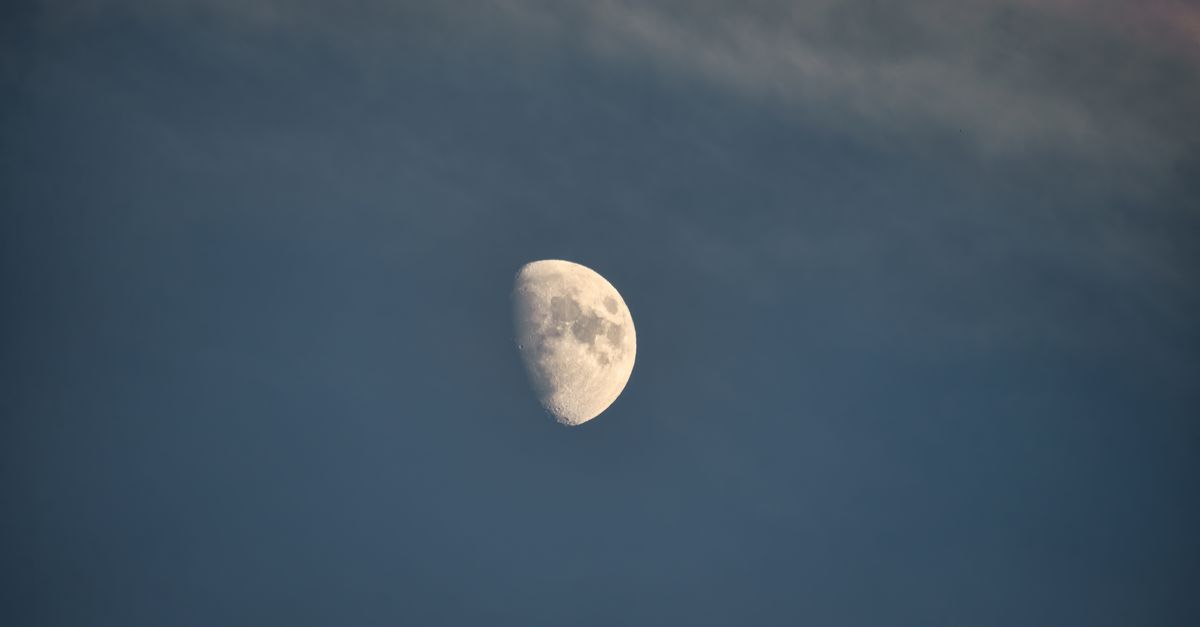
The Waxing Side: New Moon Toward Full Moon
The waxing half of the lunar month is the part where the Moon's illuminated fraction grows. It begins at the New Moon event, where the geocentric Moon-Sun ecliptic-longitude difference is 0 degrees and the illuminated fraction is essentially zero. From that instant the angle increases, and the lit fraction grows with it.
In the official four-primary-event system used by the USNO, the next marker is First Quarter at 90 degrees. That is the moment the Moon has completed one quarter of its orbit relative to the Sun since the New Moon. After First Quarter the angle continues to climb through the Waxing Gibbous band until it reaches the Full Moon event at 180 degrees, where the illuminated fraction peaks near 100%.
So the waxing side of any birth moon contains three named bands: Waxing Crescent (the early sliver), First Quarter (the exact 90-degree mark), and Waxing Gibbous (the bulging shape just before full). Each label describes a band of the angle, not a single instant. The exact name depends on where the birth moment sits between the four angular anchors.
The Waning Side: Full Moon Back Toward New Moon
The waning half starts at the Full Moon event, where the angle is 180 degrees. From there the angle continues to increase in numeric value, but the illuminated fraction begins to shrink. Visually, the bright portion retreats from a full disc toward a thinner shape on the other side.
The next anchor on the waning path is Last Quarter at 270 degrees, where the Moon has completed three quarters of its orbit since the New Moon. Beyond Last Quarter the angle keeps increasing through the Waning Crescent band and finally loops back to 360 degrees, which is mathematically the same as the next New Moon at 0 degrees.
The waning side therefore contains Waning Gibbous (the bulging shape just after full), Last Quarter (the exact 270-degree mark), and Waning Crescent (the thin sliver before the next new). The transition from waxing to waning is not gradual; it is the single Full Moon instant. Anything after that instant, by definition, is waning.
How to Find Which Side Your Birth Moon Falls On
The fastest way to answer "was my birth moon waxing or waning?" is to use the Birthday Moon Phase Calculator and read the side from the reported angle together with the four primary events around it.
- Enter the local birth date, the clock time on the birth certificate or family record, and the documented UTC or UTC-equivalent offset that applied in that place at that moment. Do not rely on the browser's current offset, which may not match historical daylight-saving or political time-zone rules.
- Submit the form to calculate the instant estimate. The tool resolves the three local civil fields plus the signed offset to one auditable proleptic UTC-like instant before any astronomy runs.
- Read the normalized calculation instant, the geocentric Moon-Sun ecliptic-longitude difference, the illuminated fraction, the eight-stage display band, and the surrounding primary events in the result block together.
- Compare the birth instant to the four reported primary events. If the nearest primary event before the birth moment is New Moon or First Quarter, and the next one after is First Quarter or Full Moon, the side is waxing. If the nearest event before is Full Moon or Last Quarter, and the next is the next New Moon, the side is waning.
- Note the angle directly. Anything below 180 degrees sits in the waxing half of the orbit; anything above 180 degrees sits in the waning half. The 0 and 360 wrap to the same New Moon instant.
The result also shows both the entered local time and the normalized calculation time, so the conversion is auditable rather than hidden. For a warm-up with the same angle-to-band reading applied to a live example, the Moon Phase Today for Watch Setting guide walks through today's angle and bands using the same convention.
When the Birth Time Is Unknown
Birth certificates do not always record a clock time, and family memories are often approximate. For that case the tool offers a deliberate approximation mode that is visibly marked as such.
In approximation mode the calculator evaluates local noon for the entered date using the documented offset. It then checks the start and end of that local day as defined by the offset. If the broad eight-stage display label differs between the day's start and end, the result shows both possibilities side by side instead of pretending noon is definitive.
The output is explicitly labelled "Phase-boundary approximation" rather than treated as an exact reading. The calculator also reports whether any of the four primary events (New Moon, First Quarter, Full Moon, Last Quarter) fell inside the offset-defined local day, and warns that the unknown birth time may sit before or after that event. This is what makes the approximation honest: it never claims a precise instant it cannot recover.
Why the UTC Offset Matters for a Birth Moment
A local clock time is not a unique instant without the offset that applied at that place in history. The browser's current offset may not match the historical daylight-saving rules, war-time changes, or political time-zone boundaries that affected the birth location. The Birthday Moon Phase Calculator therefore asks for the offset explicitly and converts deterministically rather than parsing a free-form date string.
The conversion is straightforward when modern standard time zones or documented UTC-equivalent offsets were in force. Before standard time zones, local mean time may not map to a reliable modern offset, and the tool labels those results as proleptic UTC-like estimates while keeping the entered convention visible in the output. Invalid dates, clocks, offsets, and normalized calculation instants outside the 1700 through 2100 window are rejected before the astronomy calculation runs, so a malformed entry never produces a silently wrong phase label.
Reading the Output: Angle, Illumination, and Primary Events
The result block is built around four quantities that together answer the waxing-versus-waning question.
The normalized UTC instant is the proleptic UTC-like moment the calculator actually evaluated; it is the only astronomical time the rest of the output refers to. The geocentric Moon-Sun ecliptic-longitude difference is the angle, in degrees, between 0 and 360. The illuminated fraction is the percentage of the Moon's disc that is lit by the Sun at that instant. The eight-stage display band is the Lizely label that the angle falls into.
| Primary event | Angle | Side of the cycle |
|---|---|---|
| New Moon | 0 degrees (wraps to 360) | Boundary between waning and waxing |
| First Quarter | 90 degrees | Mid-waxing |
| Full Moon | 180 degrees | Boundary between waxing and waning |
| Last Quarter | 270 degrees | Mid-waning |
Any birth angle strictly between 0 and 180 degrees is on the waxing side. Any birth angle strictly between 180 and 360 degrees is on the waning side. The exact angle of 180 is the Full Moon instant itself, and the exact angle of 0 (or 360) is the New Moon instant. The four primary events are instantaneous angular events, not bands, so a birth moment that lands exactly on one of them has a precise label.
What the Eight-Stage Display Bands Mean
The tool reports both the four primary events (from the USNO fixture set) and a separate eight-stage display band. The eight bands are a disclosed Lizely convention, not an official USNO or NASA classification. The four primary event meanings and fixture times come from the USNO; the eight equal-width angle bands are placed halfway between primary angles for a friendlier label.
Specifically, New Moon wraps across 337.5 to 22.5 degrees, then Waxing Crescent, First Quarter, Waxing Gibbous, Full Moon, Waning Gibbous, Last Quarter, and Waning Crescent each occupy a disclosed 45-degree band. The bands are equal-width by construction, which means the Waxing Crescent and Waning Crescent labels cover the same physical angle span as the gibbous bands, even though the visual crescent is much thinner than the gibbous shape.
The NASA Moon Phases reference uses the same four primary names for the physical explanation, which is why the tool's primary events match the official terminology even when the eight-stage band is a Lizely display choice. The geocentric phase used here is an Earth-center quantity, so no birthplace or location permission is needed and no local horizon, moonrise, weather, or visibility claim is made.
Limits Worth Knowing Before You Trust the Label
The accuracy is tested rather than implied. Twelve literal minute-resolution events from the official USNO service cover all four primary phases, a leap year, year rollovers, and the 1700 and 2100 limits. The pinned Astronomy Engine implementation is required to find every one of those events within two minutes of the USNO fixture. The result is an astronomical estimate, not second-level or professional-observatory precision, and it is not suitable for navigation, safety, tides, religious observance, local visibility, or other time-critical decisions.
The tool does not infer personality, compatibility, luck, fate, or life advice from a birth phase. It reports an angle, an illumination, a display band, and the surrounding primary events; it does not generate a horoscope or assign meaning to the side of the cycle. The calculation runs locally through the already pinned astronomy-engine 2.1.19 package behind a narrow Lizely adapter, so no birth input is uploaded, stored, or sent to USNO, NASA, a CDN, or a paid service. Once the page assets are loaded, the result works without a network connection.
If you're weighing options, How to Determine Your Birthstone from a Birth Month covers this in detail.