Eight commonly used Elder Futhark glyphs cannot be visually reversed: Gebo (ᚷ), Hagalaz (ᚺ), Isa (ᛁ), Jera (ᛃ), Eihwaz (ᛇ), Sowilo (ᛊ), Ingwaz (ᛜ), and Dagaz (ᛞ). Each keeps essentially the same silhouette after a 180-degree turn, so it does not create a distinct upside-down symbol.
This is a visual property, not a universal ancient rule about fortune or spirituality. Typeface details can affect near-symmetric characters, and modern rune books may still assign separate “reversed” interpretations to them. Check the exact character in the Elder Futhark reference catalogue, and keep the historical identity separate from any modern interpretive layer.
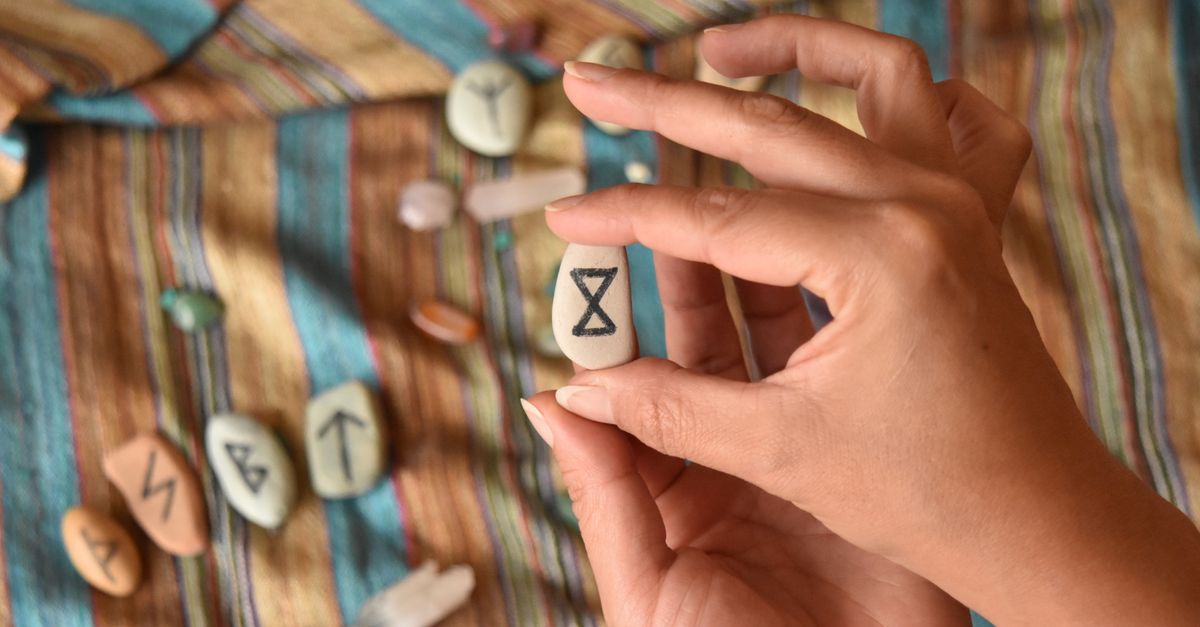
The eight runes that stay the same upside down
The most reliable method is to compare the actual glyphs. The characters below follow the forms represented in the Unicode Standard runic code chart. Their balanced shapes explain why a physical tile bearing one of them would look substantially the same after being turned.
| Rune | Character | Visual feature |
|---|---|---|
| Gebo | ᚷ | Two crossing diagonal strokes form a balanced X shape. |
| Hagalaz | ᚺ | A vertical form is crossed by balanced diagonal strokes. |
| Isa | ᛁ | A single straight vertical stroke repeats itself when rotated. |
| Jera | ᛃ | Paired angular forms occupy opposing positions. |
| Eihwaz | ᛇ | A central stem has hooks arranged in opposite directions. |
| Sowilo | ᛊ | A balanced zigzag produces the same overall form when inverted. |
| Ingwaz | ᛜ | A closed diamond-like form is rotationally balanced. |
| Dagaz | ᛞ | Two mirrored angular sections form a symmetric frame. |
The other 16 runes—Fehu, Uruz, Thurisaz, Ansuz, Raidho, Kenaz, Wunjo, Nauthiz, Perthro, Algiz, Tiwaz, Berkano, Ehwaz, Mannaz, Laguz, and Othala—have commonly used letterings that change visibly when turned. Nauthiz is particularly sensitive to the proportions used in a typeface because the placement of its diagonal crossing affects whether the form appears unchanged.
That comparison answers only the shape question. A modern author can still write that a particular rune “reversed” suggests weakness, blockage, or an inward challenge, but such wording does not demonstrate that an ancient source assigned the same opposite meaning.
Why reversed-rune meanings are modern conventions
The Elder Futhark is a historical writing system, not a single documented universal fortune-telling manual. Modern rune-reading systems differ in their layouts, symbolic associations, use of a blank rune, reversal rules, and interpretive language. Consequently, there is no one historically fixed rule saying that every upside-down rune must negate or reverse its upright meaning.
The term merkstave is often used in modern discussions for an upside-down rune. Giving that condition a name does not establish it as an ancient Elder Futhark practice. For a closer examination of the historical boundary, see Are Reversed Runes Historically Accurate? The Evidence.
Three distinctions help prevent confusion:
- Visual symmetry describes whether the character retains its shape when rotated by 180 degrees.
- Historical identity concerns the rune character, reconstructed name, transliteration, catalogue position, and reconstructed literal gloss.
- Interpretive meaning is a modern reflective layer that may assign positive, difficult, or reversed themes to a rune.
Keeping these layers distinct also protects uncertain evidence. A reconstructed name or gloss may be disputed, and its uncertainty note should remain attached to that historical field rather than being treated as a settled supernatural fact.
Check whether a rune has a distinct reversed form
Use this procedure when examining an unfamiliar rune character or comparing two rune sets:
- Find the exact character. Check the rune character in the catalogue, then work from the displayed rune rather than from memory of its name.
- Apply a 180-degree test. Imagine turning the character upside down. Do not use a mirror reflection, because a mirrored image and a rotated tile are different operations.
- Track the directional features. Look for branches, bowls, hooks, diagonal endpoints, or other elements that would move to the opposite side after the turn.
- Classify the result. If the silhouette is unchanged, report that there is no visually distinct reversed form. If it changes, classify the rune as orientation-sensitive. For a near match, the actual font takes priority over a general list.
- Record interpretation separately. Note the source-checked identity and reconstructed literal gloss first. If a modern reading system assigns a reversed meaning, label that interpretation as modern rather than as a historical fact.
This method avoids a common error: treating the absence of a distinct reversed shape as proof that every modern system must interpret the rune in only one way. Symbol geometry can be checked directly, while symbolic meaning remains a choice made by a particular interpretive system.
Draw three runes without adding a reversal rule
If your goal is a self-reflection exercise rather than a historical catalogue check, the Rune Reading provides a supported three-rune workflow. It draws three unique Elder Futhark entries, but it does not rotate cards, add a blank rune, or assign reversed meanings.
- Open the page and choose Draw three runes. The action creates a fresh local draw from the shared 24-entry Elder Futhark catalogue.
- Review the selection method. The browser performs a complete local Fisher–Yates shuffle without replacement, so one rune cannot appear twice in the same reading. The first three shuffled entries are assigned to Notice, Question, and Small step.
- Read each rune’s historical fields. Check the character, Unicode code point, common reconstructed name, transliteration, aett, catalogue position, and reconstructed literal gloss. Keep any displayed uncertainty note attached to the historical information.
- Use Notice for attention. The prompt asks what detail the historical word-image brings to attention. It does not announce a message from the rune.
- Use Question for phrasing. The prompt asks what open question the word-image helps you formulate. It does not answer the question or direct your decision.
- Use Small step for action. The prompt asks what small, reversible possibility comes to mind. Here, “reversible” means a possibility you could change or undo; it does not mean turning a rune upside down.
- Redraw if you want a different arrangement. Another draw creates a new independent shuffle. The displayed result is not saved, and refreshing or closing the page discards it.
The draw is browser-only. It uses Web Crypto random-number generation; if secure browser randomness is unavailable, the tool reports an error instead of silently falling back to Math.random or making a server request. The reading is not stored, uploaded, tied to an account, or sent to an outside service. It remains available offline after its page assets have loaded.
What the reading includes and leaves out
| Layer | Included behavior | Relevant boundary |
|---|---|---|
| Historical catalogue | Source-checked characters, Unicode code points, reconstructed names, transliterations, aett values, positions, literal glosses, and uncertainty notes | Reconstructed forms are labeled as reconstructions rather than direct transcriptions of one ancient source. |
| Random draw | A local, no-replacement shuffle of the shared 24-entry catalogue produces three unique entries. | Draw order and card assignment are modern product rules, not an ancient spread. |
| Reflection positions | Notice, Question, and Small step offer neutral prompts for self-reflection. | They are Lizely-authored and do not assign permanent spiritual meanings. |
| Orientation | The historical rune character is displayed in its normal orientation. | No blank rune, reversed card position, or reversed meaning is added. |
| Purpose | Entertainment and optional self-reflection | The reading does not predict events, reveal hidden facts, or provide medical, mental-health, legal, financial, safety, relationship, employment, or crisis guidance. |
| Data handling | Shuffling and display occur locally in the browser. | No account, storage, upload, outside service, or server processing is involved. |
The practical answer is therefore twofold: use the 180-degree test to identify runes with no distinct reversed form, and treat any upright-versus-reversed interpretation as a modern convention. When using the three-rune draw, keep its historical identities, modern positions, and reflection prompts clearly labeled so a useful exercise does not become a claim about the past or a guaranteed prediction about the future.
Related reading: What Can Go Wrong When I Use Elder Futhark Rune Meanings?.