Reversed runes are not a historically accurate feature of the Elder Futhark or of any documented runic casting practice. The surviving corpus of Elder Futhark inscriptions across Scandinavia and northern Europe, the runic poems preserved in medieval Icelandic manuscripts, and the saga accounts of rune carving and reading contain no rule that turns a rune into a different meaning when the character is physically rotated or written upside down. The 24-character Elder Futhark was a writing system used for labels, ownership marks, memorial stones, and short formulaic messages from roughly the 2nd to 8th centuries CE, and the meaning of each glyph was carried by its sound and its conventional name — never by the orientation in which a reader happened to look at it. What modern readers call a "reversed rune" is a 20th-century borrowing from tarot's upright-and-reversed convention, layered onto runic characters that predate it by more than a millennium. That distinction matters: the historical identity of a rune is one thing, and the modern entertainment rules that get added to it are another. A draw that respects the historical line keeps the catalogue intact and never rotates a card into a reversed position.
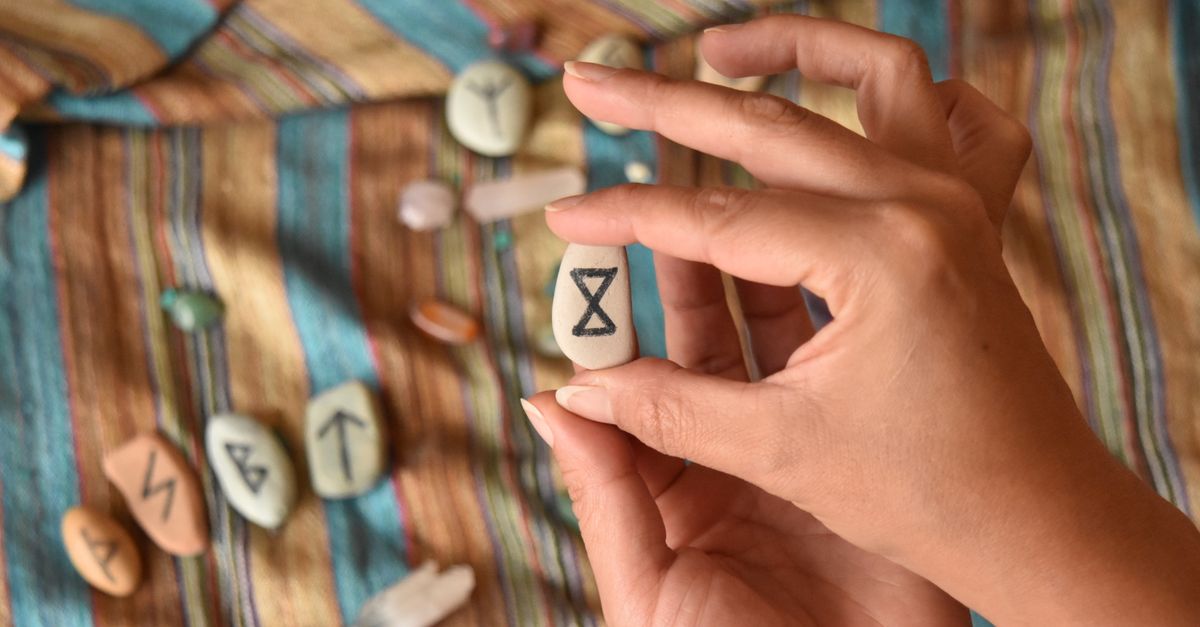
What "Reversed Runes" Actually Means in Modern Decks
In modern rune decks and rune-reading books, "reversed" means the printed character has been deliberately rotated 180 degrees from its upright position, and the reading assigns a separate, usually less favorable meaning to that rotated form. The convention was imported from tarot, where reversed cards have carried altered interpretations since the 19th century, and applied to runic characters in the late 20th century. Some modern decks also add a 25th blank rune to represent "the unknown," and many assign symbolic correspondences such as colors, deities, or astrological links to each character. None of these features come from the runic record itself. They are framing choices layered onto a historical writing system that had its own internal logic: a rune meant what its sound and conventional name said it meant, and that was the end of it. A tool that draws from a shared source-checked catalogue without adding reversal or blank-rune rules keeps that line clear — the historical identity stays historical, and the modern entertainment rules stay labeled as modern.
What the Historical Runic Record Shows
The historical record that does survive points the other direction. The Elder Futhark catalogue contains 24 characters organized into three groups of eight called aettir, and the order of those characters is preserved across a wide geographic range — from Scandinavia to the Alps to the British Isles — in artifacts dated roughly between 150 and 800 CE. The names we use today (Fehu, Uruz, Thurisaz, and so on through Othala) come from the Old English and Old Norwegian rune poems of the 8th to 11th centuries, which gloss each character with a short literal image: Fehu as "wealth," Uruz as "aurochs," Thurisaz as "thorn." Those glosses survive as historical reference data, not as a divination manual. Inscriptions themselves are short and practical — memorial formulas, owner labels, amulet phrases like "alu" — and there is no known carved sequence that marks a character as "reversed" the way a later reader is asked to. The educational overview of runes from the Viking Ship Museum treats the script as a writing system used for everyday communication rather than as a divination deck. That institutional framing matters when the question is about historical accuracy.
Where Reversed Forms Do Show Up in Inscriptions
There is one nuance worth keeping. Carvers did occasionally flip individual characters, and there are inscriptions where a glyph appears in a mirrored or rotated form. In those cases the change is decorative, a workaround for available space, or a stylistic preference on the part of the carver — it does not switch the character into a different meaning. A flipped Thurisaz is still the sound /th/ and still references "thorn," not its opposite. Penn State's reference on runic alphabets notes that variant forms and ornamental flourishes appear across the corpus without changing which character is being written. So the historical record is not entirely silent on reversed forms; it is silent on reversed meaning. That distinction is easy to lose when modern guides present "reversed rune" as if it were an ancient category, but it is the central point of the accuracy question: the shapes vary in surviving inscriptions; the meanings do not.
How to Draw Three Runes Without Reversed Positions
- Open the Rune Reading tool in any modern browser; the page is self-contained and works offline once its initial files have loaded.
- Click the "Draw three runes" control. The page makes a local, no-replacement shuffle of the shared 24-entry Elder Futhark catalogue, draws 23 unsigned 32-bit values from the browser's Web Crypto random number generator for a full Fisher-Yates shuffle, and assigns the first three shuffled entries to three labeled positions.
- Read each rune's source-checked identity fields — the character glyph, Unicode name, transliteration, position in the catalogue, reconstructed literal gloss, and any displayed uncertainty note about that historical field — without treating them as predictions.
- Use the three modern labels — Notice, Question, and Small step — as reflection prompts only. Notice asks what detail the historical word-image brings to attention; Question asks what open question the word-image helps the visitor phrase; Small step asks what small, reversible possibility comes to mind.
- If the arrangement isn't useful, click "Draw again" for a fresh independent shuffle. Closing or refreshing the page discards the previous draw; nothing is stored, uploaded, or tied to an account.
This sequence deliberately avoids the two modern features most often mislabeled as ancient: a reversed-card position and a 25th blank rune. Both come from later occult frameworks rather than from the Elder Futhark itself, and both get stripped out so the historical identities stay clean.
Comparing Historical Practice and Modern Spread Conventions
| Feature | Historical Runic Practice | Modern Divination Convention |
|---|---|---|
| Reversed orientation as a separate meaning | Not present in surviving inscriptions or runic poems | Common; borrowed from 19th-century tarot |
| Blank or 25th rune | Not part of the 24-entry Elder Futhark | Sometimes added in modern decks |
| Three-position spread (for example past / present / future) | No documented ancient equivalent | Widely used in modern spreads |
| Reconstructed literal gloss | Survives in Old English and Old Norwegian rune poems | Reused as a metaphorical word-image prompt |
| Notice / Question / Small step labels | Not historical | Explicitly modern, Lizely-authored |
| No-replacement selection from 24 entries | Not a historical casting method | Used to keep each draw varied |
The left column is what the runic record actually supports. The right column is what gets bolted on afterward. A reader who wants historical accuracy can keep the left column intact and treat the right column as openly modern entertainment, which is exactly how the Rune Reading tool frames its own draws.
A Historically Honest Way to Use the 24-Entry Catalogue
The cleanest test for historical accuracy on this question is simple: take a 24-entry Elder Futhark catalogue that has been source-checked against Unicode character data and against the rune poems, and ask whether the tool reading from it adds anything that the catalogue did not already contain. A reversal rule adds something. A blank rune adds something. A three-position spread with named labels like "Notice" or "Small step" adds something. The Rune Reading tool imports the shared catalogue directly — it does not duplicate or rewrite the historical identity table — and labels its three positions and reflection prompts as Lizely-authored modern rules, not as recovered ancient practice. That separation is the answer to the historical-accuracy question: the historical parts are historical, and the modern parts are clearly labeled modern. For readers who want to go deeper into whether the meanings we use today are ancient at all, the Lizely guide on whether Elder Futhark rune meanings are ancient definitions works through the same question from a different angle, and the comparison of the Elder Futhark versus Younger Futhark catalogue explains why this draw stays inside the 24-entry set rather than the later 16-entry North Germanic variant. A reversal rule was never part of either set.