Rune reading symbols are runic characters rather than universal signs with fixed meanings, and the Elder Futhark catalogue used here contains 24 distinct characters arranged into three groups of eight.
For a practical reading, identify each character before interpreting it. A three-rune draw can add modern reflection prompts, but it does not turn the historical symbols into a documented ancient fortune system. This guide separates the reference layer from the entertainment layer so you can look up a glyph, read its displayed record, and use the prompts without treating them as predictions.
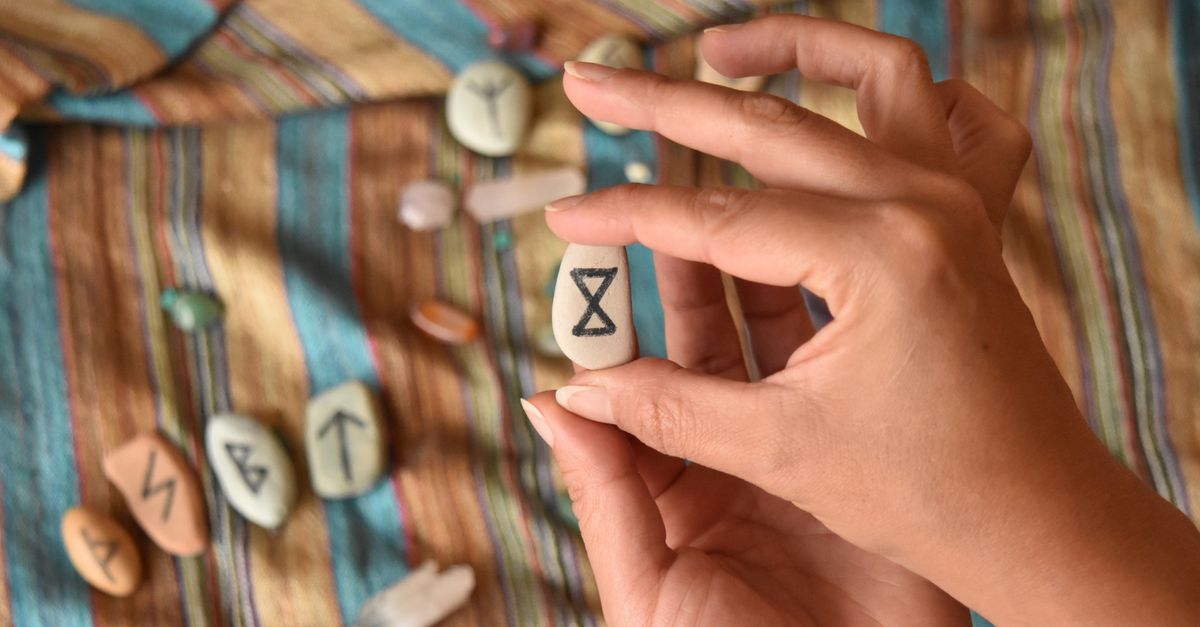
Separate the alphabet from the reading method
The Elder Futhark is a historical writing system, not a single documented universal fortune-telling manual. Modern rune-reading traditions can differ in their layouts, symbolic associations, blank-rune practices, reversal rules, and interpretive language. A search result may therefore combine an authentic historical character with a much later divinatory meaning attached by the author of that page.
Educational background is available from Penn State's overview of runic alphabets and the Viking Ship Museum's guide to runes. For the broader boundary between historical reference and modern practice, see Historical Runes vs Modern Divination: Where the Line Sits.
The practical rule for this workflow is simple: source-checked identity remains separate from Lizely-authored entertainment rules. In particular, the labels Notice, Question, and Small step belong to the modern product. They are not positions recovered from one ancient three-rune casting method, and a reconstructed literal gloss is not proof that every rune had one permanent spiritual meaning.
Identify a symbol by its full record
Visual resemblance alone is not the safest identifier because runic characters can look similar at small sizes. A complete record combines the rendered character with its Unicode code point, common reconstructed name, transliteration, group, and position. The shared catalogue also provides a reconstructed literal gloss and, where needed, an uncertainty note.
These representative anchor records show how a symbol, name, and code point work together:
| Character | Catalogued name | Unicode code point |
|---|---|---|
| ᚠ | Fehu | U+16A0 |
| ᚦ | Thurisaz | U+16A6 |
| ᚹ | Wunjo | U+16B9 |
| ᚺ | Hagalaz | U+16BA |
| ᛈ | Pertho | U+16C8 |
| ᛉ | Algiz | U+16C9 |
| ᛏ | Tiwaz | U+16CF |
| ᛟ | Othala or Othalan | U+16DF |
This is a sample of the catalogue rather than its complete list of 24 entries. To inspect every character, use the Rune Meanings reference catalogue,.
- Character and Unicode code point: These provide the most exact visual and machine-readable identifiers, helping distinguish characters that look nearly identical in a particular font.
- Common reconstructed name and transliteration: The name labels the catalogue entry, while the transliteration gives its conventional letter or sound representation. Both are reference data, not interpretive instructions.
- Group and position: Each entry has an aett, or group, plus a position from one through eight. This locates the character within the conventional three-group catalogue.
- Reconstructed literal gloss: This is a reconstructed word sense used only as an optional metaphorical word-image for reflection. It is not presented as a direct transcription from one ancient source.
- Uncertainty note: When a name, sound, or gloss is disputed, the note stays attached to that historical field. Do not detach the note or quietly turn an uncertain reconstruction into a certainty.
The reading tool imports the same maintained 24-entry catalogue used by the reference tool rather than keeping a second copied list. That boundary means a correction to a historical identity has one maintained location, while the modern draw and prompts can evolve without rewriting the underlying data.
Draw and read three symbols
- Open Rune Reading and choose Draw three runes. The browser's Web Crypto random-number generator supplies 23 unsigned 32-bit words for a complete local Fisher–Yates shuffle of the shared 24-entry catalogue. The first three shuffled entries are assigned to Notice, Question, and Small step. Because the selection is without replacement, one rune cannot appear twice in the same reading. If secure browser randomness is unavailable, the tool reports an error instead of silently falling back to Math.random or making a server request.
- Read the identity fields before considering any interpretation. Check the character, Unicode code point, common reconstructed name, transliteration, group, and position. If an uncertainty note is displayed, keep it with the relevant historical field.
- Read the reconstructed literal gloss as a reference to a word-image, not as a forecast. The tool uses that gloss metaphorically for self-reflection rather than assigning the rune a permanent spiritual meaning or declaring an event likely.
- Use the prompt attached to each position. Notice asks what detail the historical word-image brings to attention. Question asks what open question the word-image helps you phrase. Small step asks what small, reversible possibility comes to mind. Treat these as invitations to reflect rather than commands to decide.
- Choose Draw three runes again whenever you want another arrangement. A repeat draw creates a new independent shuffle, so the same three runes are not guaranteed to appear.
Use the literal gloss as a word-image
The three prompts move through three different tasks: noticing, formulating, and considering a bounded action. Notice is observational, Question turns the symbol into an open line of inquiry, and Small step asks for something modest and reversible. None of them turns the rune into proof of a hidden fact or an instruction about what must happen.
A useful note-taking pattern is:
- Record: Write the exact character, common name, and group before assigning personal meaning.
- Qualify: Keep any uncertainty note with the name, transliteration, or gloss to which it applies.
- Notice: Name a detail or association prompted by the reconstructed word-image without claiming that it is an ancient fixed meaning.
- Question: Phrase one open question that the word-image helps you articulate.
- Try: Consider one small, reversible possibility, while retaining responsibility for any actual choice.
This sequence also prevents a common mix-up: the reconstructed gloss explains the material used for reflection, while the modern prompt explains how the card is being used in the activity.
Keep the historical and modern layers distinct
Historical reference layer
The rune characters, Unicode code points, common reconstructed names, transliterations, group positions, reconstructed literal glosses, and uncertainty notes come from the shared source-checked 24-entry table. These fields identify the Elder Futhark material and make visible where the reconstruction is uncertain.
Modern reading layer
The random draw, the order of the three cards, the Notice/Question/Small step labels, and the reflection prompts are Lizely-authored product rules. The activity does not add a blank rune, rotate cards into reversed positions, or claim to reproduce one ancient casting practice.
Consequently, a completed reading is entertainment and self-reflection rather than a historical reconstruction. It does not predict facts, read another person's mind, establish supernatural causes, or provide medical, mental-health, legal, financial, safety, relationship, employment, or crisis guidance.
Privacy and repeat-draw behavior
The draw is completed locally in your browser. It is not stored, uploaded, tied to an account, or sent to an outside service, and the tool performs no server processing. Closing or refreshing the page discards the displayed cards. The reading remains useful offline after its page assets have loaded.
A new draw is a fresh local shuffle rather than a continuation of the previous arrangement. This makes the tool suitable for casual experimentation and reflection while keeping each result deliberately temporary.
Use a symbol-first checklist
- Match the visible character to its Unicode code point.
- Confirm the catalogue's exact common name and transliteration.
- Check the character's group and position within that group.
- Keep every uncertainty note attached to its historical field.
- Read the literal gloss as a reconstructed word-image, not a prediction.
- Answer the assigned modern prompt without treating it as ancient authority or professional advice.
That final separation is what keeps rune reading symbols useful without overstating them: the characters have identifiable historical records, while the three-card exercise provides a clearly modern structure for entertainment and personal reflection.
If you're weighing options, Is Tarot Card Reading Safe to Use Online? covers this in detail.