The Elder Futhark is a 24-character writing system documented through surviving inscriptions across Germanic Europe between roughly the 2nd and 8th centuries CE, and the runic record contains no evidence of a single universal fortune-telling manual. Modern rune divination is a layered, contemporary practice that applies later medieval and post-medieval interpretive material, new spread layouts, reversal rules, blank-rune additions, and prompt-driven reflection onto those same characters. The boundary matters because every claim a reader encounters about what a rune "really means" sits somewhere on the spectrum between source-checked historical fact and modern authorial rule, and most online tools blend the two without labeling them. A practical way to keep the two apart is to treat the rune identity table as historical reference data and treat the draw order, the position labels, the reflection prompts, and any interpretive language as modern product rules that the tool openly owns. The Rune Reading tool does exactly that: it imports its 24-entry identity table from a shared reference catalogue and labels every modern addition as Lizely-authored entertainment rules, so the reader always sees which layer they are looking at.
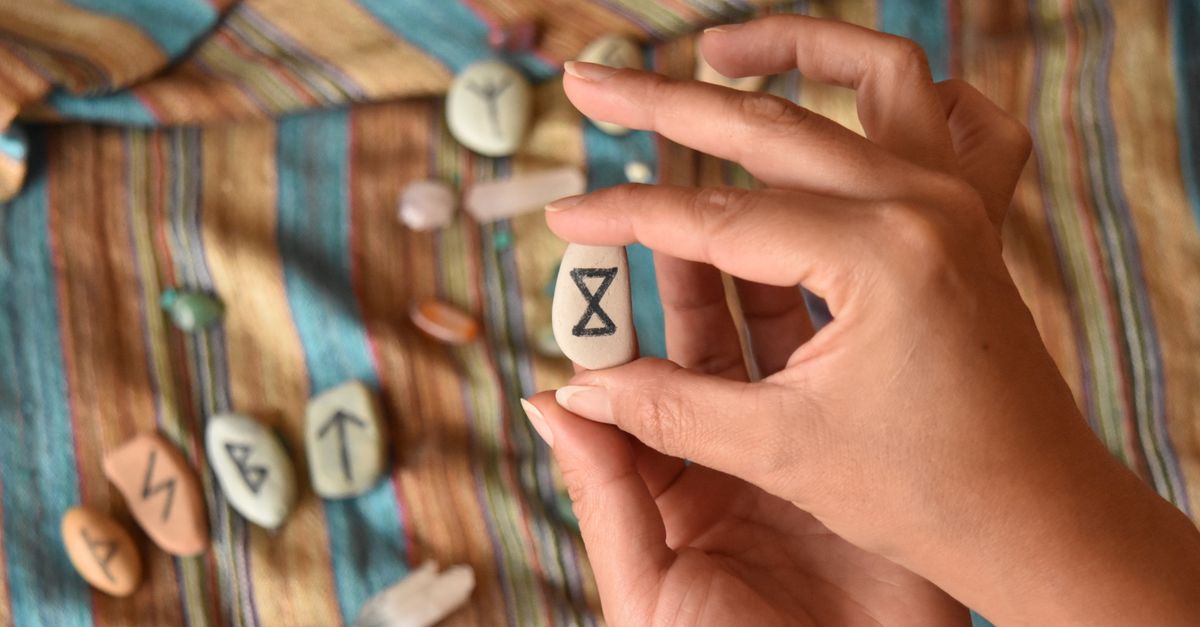
What "historical" actually means for runes
The historical layer of rune study is built on a few verifiable kinds of evidence. Surviving inscriptions on metal, bone, wood, and stone give the physical record of how the characters were written and combined. The Unicode runic block (see the Unicode Standard chart) is the modern encoding reference that fixes the character shape, the code point, and the commonly used transliteration for each rune, including the 24 Elder Futhark entries arranged in the conventional three groups of eight. Medieval rune poems — chiefly the Old Norwegian, Old Icelandic, and Old English rune poems — supply short verse glosses that are sometimes used as the source for a "literal" meaning. These glosses are reconstructed where the manuscript tradition is incomplete, and any tool that handles them honestly keeps the reconstruction label visible. Museum and university reference pages such as the Penn State runic alphabets page and the Viking Ship Museum's educational material describe the writing-system context without claiming a divination manual.
That is the floor of historical evidence: encoded characters, surviving inscriptions, dated poems with reconstructed glosses, and reference material. Everything else — the three-position spread, the reversed-card rule, the blank rune, the tarot-style prompt categories, the astrology-style correspondences — was added later and is best handled as modern product rules.
The additions modern rune divination makes on top
Modern rune divination is the layer that turns a writing system into a fortune-telling tool, and it is large, varied, and openly authored. Practitioners and toolmakers in the 20th and 21st centuries have introduced spread layouts (one rune, three runes, five runes, the "Norns" spread, the nine-rune Runic Wheel), reversal rules (some readers treat an inverted rune as a blocked or opposite meaning), and the blank rune (a 25th tile added to represent the unknowable, which has no basis in the 24-entry catalogue). They have also layered interpretive language: each rune gets a "meaning" that can read like a tarot card meaning, with general life themes, love, work, and money lines. The rune poems supply the literal anchor; everything beyond that anchor is a contemporary choice.
This is not a criticism. It is labeling. The historical layer has a fixed shape — 24 characters, three groups of eight, Unicode code points, reconstructed names, transliterations, and glosses. The modern layer is plastic: it can include or exclude a blank rune, rotate cards, number positions, phrase prompts as questions, adopt a Norse flavor or a Jungian flavor, and be designed for entertainment or for personal ritual. A tool that respects the boundary shows the historical layer once, in one maintained catalogue, and lets the modern layer evolve independently.
Where the two layers blur in everyday tools
The blur happens because most rune tools do not separate the two kinds of information visually or structurally. A typical rune-meanings page shows the character, a paragraph of symbolic meaning, an upright interpretation, a reversed interpretation, sometimes a love line, and sometimes a yes/no answer — all in one continuous block. The reader cannot tell which sentences come from a reconstructed Old English gloss and which come from the page author's imagination. Over time, this drift becomes a problem: if a tool keeps its own private copy of the 24-entry catalogue, a correction to a historical fact has to be made in every copy, and the copies will drift apart.
The Rune Reading tool avoids this by importing the 24-entry identity table directly from the shared reference catalogue, so the character, Unicode code point, common name, transliteration, aett, and position are pulled from one maintained location. Tests verify object identity rather than checking that two independently typed lists happen to match. A correction to a rune's historical identity is made once, in the shared catalogue, and every consumer of that catalogue picks up the change automatically. The entertainment interaction — the draw, the three labels, the reflection prompts — can evolve on its own schedule without rewriting the historical data.
How to draw three runes for self-reflection
The Rune Reading tool runs in the browser and processes everything locally. Use the steps below to produce a fresh, reproducible draw from the shared 24-entry catalogue.
- Open the Rune Reading page and locate the Draw three runes button on the entry screen. The page loads the shared 24-entry Elder Futhark catalogue from local assets; no network request is sent for the catalogue itself.
- Click Draw three runes. The browser's Web Crypto generator supplies 23 unsigned 32-bit words to a complete Fisher-Yates shuffle of the 24 entries. The first three shuffled entries are taken in order and assigned to the Notice, Question, and Small step positions. Because the selection is made without replacement, the same rune cannot appear twice in one draw.
- Read each card's historical identity block first: the rune character, its Unicode code point, its common reconstructed name, its transliteration, its aett, its position in the conventional catalogue, and its reconstructed literal gloss. If the catalogue marks a name, sound, or gloss as disputed, that uncertainty note stays attached to the historical field.
- Treat the three prompts as modern reflection cues rather than ancient instructions. Notice asks what detail the historical word-image brings to your attention; Question asks what open question the word-image helps you phrase; Small step asks what small, reversible possibility comes to mind.
- Click Draw three runes again whenever you want a different arrangement. Each click starts a new independent shuffle. The previous draw is not stored, uploaded, or tied to any account.
- Close or refresh the page when you are done. The displayed cards are discarded with the page; nothing is written to localStorage, sessionStorage, or any server.
If your browser cannot supply secure randomness, the tool reports an error instead of silently falling back to Math.random or to a server call. That choice keeps the draw from being predicted or reproduced outside the page.
Limits the tool keeps on purpose
The Rune Reading tool does not add a blank rune, does not rotate cards into reversed positions, and does not claim that the three card labels — Notice, Question, Small step — are ancient. It does not predict the future, discover hidden facts, read another person's mind, establish supernatural causes, or provide medical, mental-health, legal, financial, safety, relationship, employment, or crisis guidance. Where the catalogue says a name, sound, or gloss is disputed, that uncertainty remains visible on the card. The tool's job is to keep the historical layer honest and to let the modern layer be what it openly is: a Lizely-authored entertainment and self-reflection activity that uses a documented writing system as raw material.
Historical layer vs modern layer at a glance
The table below summarizes how the two layers divide in this tool. The same separation applies to any rune resource that wants to be honest about what is recoverable and what is invented.
| Layer | What it covers | How the tool handles it |
|---|---|---|
| Historical identity | Rune character, Unicode code point, common reconstructed name, transliteration, aett, position, reconstructed literal gloss, uncertainty notes. | Imported from the shared 24-entry catalogue. Tested with eight literal anchors (Fehu, Thurisaz, Wunjo, Hagalaz, Pertho, Algiz, Tiwaz, Othala or Othalan) and invariants (24 entries, three groups of eight, unique characters and code points, positions one through eight in every group). |
| Modern draw | Local no-replacement shuffle of three entries from the 24-entry catalogue. | Web Crypto supplies 23 unsigned 32-bit words to a full Fisher-Yates shuffle; the first three entries are used. |
| Modern position labels | Notice, Question, Small step. | Openly labeled as Lizely-authored product rules. Not described as ancient. |
| Modern reflection prompts | What detail, what question, what small reversible possibility. | Generic, neutral, and reversible. No permanent spiritual meaning is assigned to the rune. |
| Disputed fields | Name, sound, or gloss where the catalogue flags uncertainty. | The uncertainty note stays attached to the historical field on the card. |
| Reversed meanings, blank rune, predictions | Interpretive additions common in modern rune readers. | Deliberately not included. |
Treating historical runes and modern divination as two separate layers is the most useful thing a reader can do with any rune tool. It removes the implicit promise that a shuffled tile will answer a real-life question and replaces that promise with a clearer activity: study a documented writing system, reflect on a word-image, and decide your next small step yourself. For a deeper read on the same boundary — including which rune meanings can claim ancient pedigree and which cannot — see the guide on whether Elder Futhark rune meanings are ancient definitions. That is the contract the Rune Reading tool keeps to, and the same contract is what to look for in any rune resource that takes both history and modern practice seriously.
If you're weighing options, Saturn Return Exact Date vs Window Explained covers this in detail.