The opposite birthday Moon phase is 180° around the lunar cycle: New Moon opposes Full Moon, First Quarter opposes Last Quarter, Waxing Crescent opposes Waning Gibbous, and Waxing Gibbous opposes Waning Crescent.
This pairing is a geometric rule, not a personality or compatibility claim. For an exact comparison, use the geocentric phase angles: add 180° to the first angle and wrap it around a 360° cycle. The Birthday Moon Phase Calculator reports that angle for one documented birth instant, so run it separately for each birthday when comparing two people.
The result also includes illumination, the eight-stage display band, and nearby primary events. Those outputs describe the geocentric phase at the normalized instant; they do not describe what the Moon looked like from a particular horizon.
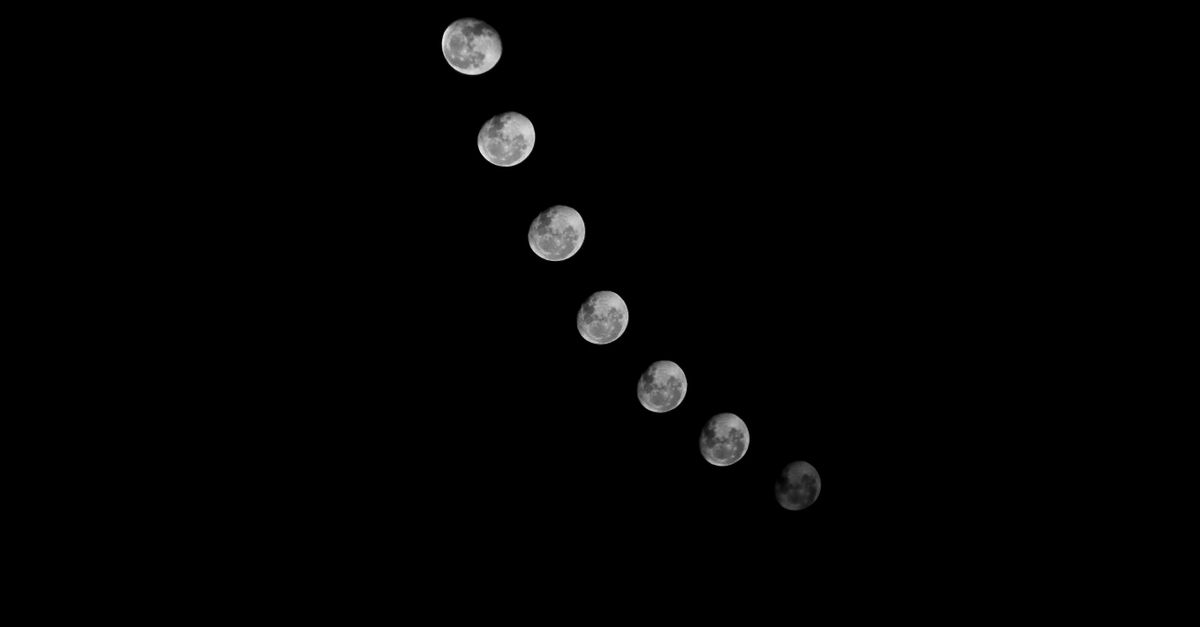
The 180° rule for opposite Moon phases
The four primary phase events are instantaneous angles defined at 0°, 90°, 180°, and 270°, as summarized by the USNO Dates of Primary Phases. Lizely’s eight display bands place their boundaries halfway between those primary angles.
| Lizely display band | Disclosed 45-degree band | Primary event anchor | Broad opposite |
|---|---|---|---|
| New Moon | 337.5°–22.5°, wrapping through 0° | 0° | Full Moon |
| Waxing Crescent | 22.5°–67.5° | — | Waning Gibbous |
| First Quarter | 67.5°–112.5° | 90° | Last Quarter |
| Waxing Gibbous | 112.5°–157.5° | — | Waning Crescent |
| Full Moon | 157.5°–202.5° | 180° | New Moon |
| Waning Gibbous | 202.5°–247.5° | — | Waxing Crescent |
| Last Quarter | 247.5°–292.5° | 270° | First Quarter |
| Waning Crescent | 292.5°–337.5° | — | Waxing Gibbous |
The equal-width eight-stage names are a Lizely display convention, not an official USNO classification. This distinction matters when researching opposite phases: two people can have complementary band names without their exact angles being 180° apart. Report exact 180° opposition separately from an opposite-label pairing.
Calculate the opposite birthday Moon phase
- Collect the birth record. Find the local birth date, clock time, and a documented UTC or UTC-equivalent offset that applied at that place and moment. Do not substitute the browser’s current time zone for a historical offset.
- Enter the documented fields. Open the Birthday Moon Phase Calculator, enter the local date, clock time, and offset, and calculate the instant estimate. Use a date from 1700 through 2100; invalid dates, clock times, offsets, and normalized calculation instants outside that range are rejected.
- Review the normalized result. Check the entered local time and normalized UTC-like calculation time together. Record the phase angle, illuminated fraction, eight-stage Lizely band, and nearby primary events rather than relying on the label alone.
- Derive the opposite target. If the first person’s phase angle is α, calculate the target as (α + 180°) mod 360°. In plain terms, add 180° and wrap the result around the 360° cycle.
- Compare a second birthday. Repeat the same workflow for the second person using that person’s own date, time, and documented offset. If the two angles are α and β, calculate the circular separation as min(|α − β|, 360° − |α − β|). A separation of exactly 180° is exact phase-angle opposition.
- State the result precisely. Say “exact 180° phase-angle opposition” only when the calculated separation is 180°. If the separation is different, the broad labels may still form an opposite pair, but it is not an exact 180° match.
Handle an unknown birth time without false precision
The exact-input workflow requires a date, clock time, and documented offset. When the clock time is unavailable, the calculator offers a deliberately less certain approximation rather than presenting a guessed birth time as fact.
| Workflow | Required information | Reported result | Qualification |
|---|---|---|---|
| Instant estimate | Local birth date, clock time, and documented UTC or UTC-equivalent offset | Normalized calculation instant, phase angle, illumination, Lizely band, and nearby primary events | Depends on the entered date, time, and offset |
| Unknown-time approximation | Birth date and the offset defining that local day; no clock time | Local-noon estimate, day-start and day-end comparisons, possible labels, and primary-event warning | Marked “Phase-boundary approximation” and less certain by design |
The approximation calculates local noon, then compares the start and end of the local day. If the broad display label differs across that interval, both possibilities are shown rather than treating noon as definitive. It also checks whether a New Moon, First Quarter, Full Moon, or Last Quarter occurred during the local day and warns that the unknown birth time may have fallen before or after that event.
When a birth may sit close to a phase boundary, the birthday near a lunar phase boundary guide explains why the warning and both possible labels matter more than forcing one confident result.
How the clock time becomes an instant
A local clock reading is not a unique instant without the offset that applied then. The calculator therefore requires an explicit UTC or UTC-equivalent offset because a browser’s current time zone cannot reliably reconstruct historical daylight-saving changes or political time-zone rules.
For early dates, the result may be a proleptic UTC-like estimate. Before standard time zones, local mean time may not map reliably to a modern offset. The entered offset is therefore a documented conversion convention, not a promise that modern UTC or the same civil time zone existed on the birth date.
Birthplace is unnecessary for this calculation because a geocentric phase is measured from Earth’s center. The result is not a local-horizon, moonrise, weather, or visibility calculation, so it cannot establish whether the Moon was above a particular horizon at the birth location.
Read the angle, illumination, and events together
The normalized instant answers when the phase was calculated; the angle identifies its position in the cycle; the illuminated fraction describes the Moon’s lit portion; the Lizely band supplies a convenient label; and the nearby primary events show how close the instant is to a formal phase boundary. Read all five together, especially when the result falls near a band edge.
The pinned Astronomy Engine 2.1.19 calculation is tested against 12 literal minute-resolution events from the USNO Astronomical Applications API. The fixtures cover all four primary phases, a leap year, year rollovers, and the 1700 and 2100 limits, and every tested event must be found within two minutes. This is a validation standard, not a promise of second-level or professional-observatory precision.
No birth input is uploaded, stored, or sent to USNO, NASA, a CDN, or a paid service. Once the page assets are loaded, the calculation works locally without a network connection. The output remains an astronomical estimate and is not suitable for navigation, safety, tides, religious observance, local visibility, or other time-critical decisions.
Opposite phases and compatibility trends
The 180° relationship is the astronomy behind the “Moon opposite Moon” language used in some compatibility trends. It can identify a genuine geometric pairing, but astronomy does not demonstrate personality, romantic compatibility, luck, fate, or life direction. The Birthday Moon Phase Calculator deliberately does not infer those conclusions from a birth phase.
For a more careful evaluation of the symbolic trend, see the Moon Phase Soulmate Test Accuracy: An Evidence Check. Keep the astronomical result—angle, illumination, phase event, and uncertainty—separate from any symbolic interpretation applied afterward.
State the answer precisely
A clear comparison should identify the normalized birth instant, phase angle, broad band, illumination, nearby event, and whether the result is exact or approximate.
- Name the documented offset used for each birth.
- Label an unknown-time result “Phase-boundary approximation.”
- Report complementary broad labels as a broad pairing.
- Reserve “exact opposite” for a calculated 180° separation.
- Keep symbolic compatibility claims separate from the astronomical record.
For a deeper look, see What Does Today's Moon Phase Mean? A Practical Reading.