Today's Moon phase means the Moon's current geocentric Sun–Moon phase angle: 0° is New Moon, 90° is First Quarter, 180° is Full Moon, and 270° is Last Quarter.
The illuminated percentage adds how much of the Moon is lit, while nearby primary-phase events provide the times surrounding those four exact angles. In a fortune-style reading, the broader stage can act as a symbolic prompt for reflection, but it does not predict events, mood, or luck.
Because the phase changes continuously, a date-independent article cannot safely assign one label to every moment. Open Moon Phase Today to check the result for the current browser instant instead.
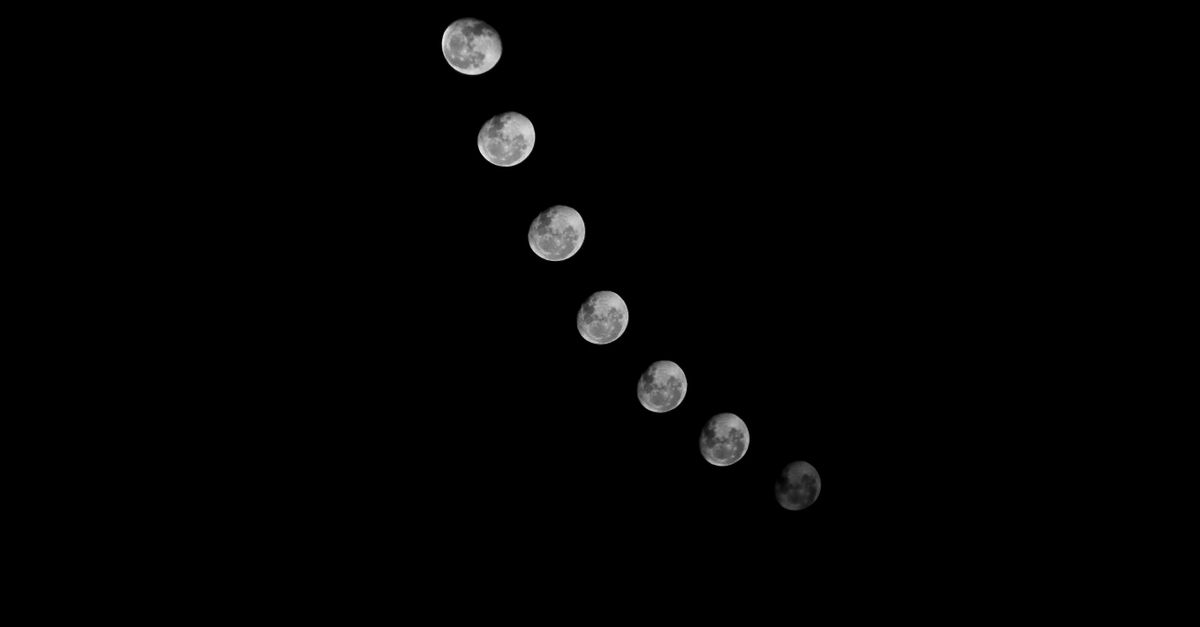
What the live result measures
Moon Phase Today calculates the difference between the Moon's and Sun's geocentric ecliptic longitudes. It then presents that angle through a convenient eight-stage display, the Moon's illuminated fraction, and surrounding primary-phase events. The calculation time and time zone resolved by your browser are shown with the result.
| Displayed field | What it reports | What not to confuse it with |
|---|---|---|
| Eight-stage label | The broad angle band containing the current phase angle | An official USNO classification or the exact instant of a primary event |
| Phase angle | The current geocentric Moon–Sun ecliptic longitude difference | Observational-apparent timing for a particular observing site |
| Illuminated percentage | The Moon's illuminated fraction at the calculation instant | The percentage visible above your local horizon |
| Nearby primary events | Times for the surrounding 0°, 90°, 180°, and 270° events | Multi-day labels for those events |
| Timestamp and time zone | The browser instant used and the time zone resolved by the browser | Your city, location permission, or a location-specific moonrise schedule |
Because a geocentric phase does not depend on the viewer's city, the calculation does not need GPS or a location name. This makes the result useful for identifying the worldwide cycle stage while leaving separate questions such as visibility, moonrise, and local horizon conditions unanswered.
Why an exact phase moment differs from a daily label
Primary phases are mathematical instants. New Moon occurs when the geocentric phase angle reaches 0°, First Quarter at 90°, Full Moon at 180°, and Last Quarter at 270°. The broad display label covers a wider range around those points, so seeing “First Quarter” in the eight-stage display does not necessarily mean that the exact 90° event is happening now.
The nearby primary-phase events are therefore important. They show when the surrounding exact-angle events fall, while the broad label tells you which everyday stage contains the current angle. If the two quarter names look similar, First Quarter vs Last Quarter Moon: How to Tell Them Apart Today provides a focused comparison.
An event is also a timestamp rather than a calendar-day category. For that reason, read the calculation time and resolved browser time zone before comparing today's event with a date published in another local time zone.
The eight stages and their reflective meanings
The eight-stage names follow a disclosed Lizely convention created by dividing the angle circle at the halfway points between the four primary angles. They are useful everyday labels, not official United States Naval Observatory classifications. Lower band limits are included, upper limits are excluded, and the New Moon band wraps cleanly across 360°.
| Display stage | Angle band | Direction | Fortune-style reflective theme |
|---|---|---|---|
| New Moon | 337.5°–360° and 0°–22.5° | Waning to 0°, then waxing | Reset, intention, and a fresh beginning |
| Waxing Crescent | 22.5°–67.5° | Waxing | Nurture an idea and build momentum |
| First Quarter | 67.5°–112.5° | Waxing | Choose, act, and address obstacles |
| Waxing Gibbous | 112.5°–157.5° | Waxing | Refine, prepare, and bring work toward completion |
| Full Moon | 157.5°–202.5° | Waxing to 180°, then waning | Culmination, clarity, and acknowledgment |
| Waning Gibbous | 202.5°–247.5° | Waning | Share, integrate, and review what was learned |
| Last Quarter | 247.5°–292.5° | Waning | Reassess, adjust, and release what no longer fits |
| Waning Crescent | 292.5°–337.5° | Waning | Rest, close a cycle, and prepare for renewal |
These themes are optional prompts rather than predictions. They can help organize journaling or reflection, but they do not establish that a particular phase causes a favorable outcome or a particular emotional state.
Check today's phase in three steps
- Open the calculator and wait for the local result. Moon Phase Today displays the current eight-stage label, phase angle, illuminated percentage, and nearby primary-phase events. It does not request your city, coordinates, or location permission.
- Confirm the instant being measured. Read the calculation timestamp and the browser-resolved time zone. Select Recalculate whenever you want a fresh browser instant. The widget also refreshes automatically once per minute while it remains mounted.
- Separate the daily label from the exact event. Use the angle-band table to understand the current display stage, then consult the nearby events when you need the timing of the exact 0°, 90°, 180°, or 270° primary phase.
The supported calculation range is 1700 through 2100, and the current-time interface normally remains well inside that boundary. The calculation runs locally with the shipped astronomy-engine package; it does not upload a date, require an account, or contact a remote astronomy service. Once the page assets have loaded, the current result remains available offline.
How the phase times are checked
The site ships with the precisely pinned Astronomy Engine 2.1.19 package and uses a narrow local adapter for the calculations required by this tool. USNO is used only for research and test fixtures, never when a visitor opens or recalculates the page.
Twelve literal, minute-resolution primary-phase timestamps were frozen from the USNO Astronomical Applications API. They cover all four event types, February 2020 in a leap year, a December-to-January event crossing, and the 1700–2100 limits. Every local phase search must differ from its corresponding USNO fixture by no more than two minutes.
That comparison provides a clear, testable accuracy boundary, but the output should still be treated as an educational astronomical estimate. It does not claim second-level precision, professional ephemeris status, or observational-apparent timing for a particular site.
Turn today's result into a grounded reflection
Once you have the live result, read it in a fixed order so the symbolic interpretation stays anchored to the astronomical data:
- Read the eight-stage label to identify the broad part of the cycle.
- Check whether the angle places the Moon in a waxing or waning section.
- Note the illuminated percentage as a description of the current illuminated fraction, not as a luck or intensity score.
- Look at the nearest primary event when you want to understand the transition surrounding the current stage.
- Choose one reflective theme from the stage table and turn it into a specific journaling or planning question.
For example, a waxing stage can frame a reflection around initiative, development, or refinement, while a waning stage can frame one around review, release, or preparation. A higher illuminated percentage does not mean better luck, a stronger personality, or more auspicious timing. It simply reports more of the Moon's apparent disk as illuminated at that instant.
What today's phase does not answer
A geocentric phase result cannot establish whether you can see the Moon from your location. Moonrise, moonset, weather, atmospheric visibility, local horizon, and obstructions are separate, location-specific questions. Use a location-specific almanac or observation service when those details matter.
The result should also not be used as the sole basis for navigation, tide decisions, photography safety, religious observance, or another time-critical activity. Its supported purpose is to identify the current educational phase angle, illuminated fraction, broad display stage, and surrounding primary-event times.
In short, today's Moon phase describes where the Moon sits in its cycle, which way the illumination is progressing, and when the nearby exact primary events occur. Use the numerical fields for the astronomical reading, the disclosed stage table for optional reflection, and location-specific sources for practical observation questions.
For a deeper look, see Moon Sign and Attachment Style: What Each Can Tell You.