For a planting-by-the-Moon check, today’s phase is read from the Moon’s current geocentric Sun–Moon angle: 0° is New Moon, 90° is First Quarter, 180° is Full Moon, and 270° is Last Quarter.
Use Moon Phase Today to read that current angle, illuminated fraction, broad eight-stage label, and nearby primary-phase events. It supplies the astronomical reading for a planting plan; it does not decide which crop to plant, determine whether a tradition considers a task favorable, or assess whether local growing conditions are suitable.
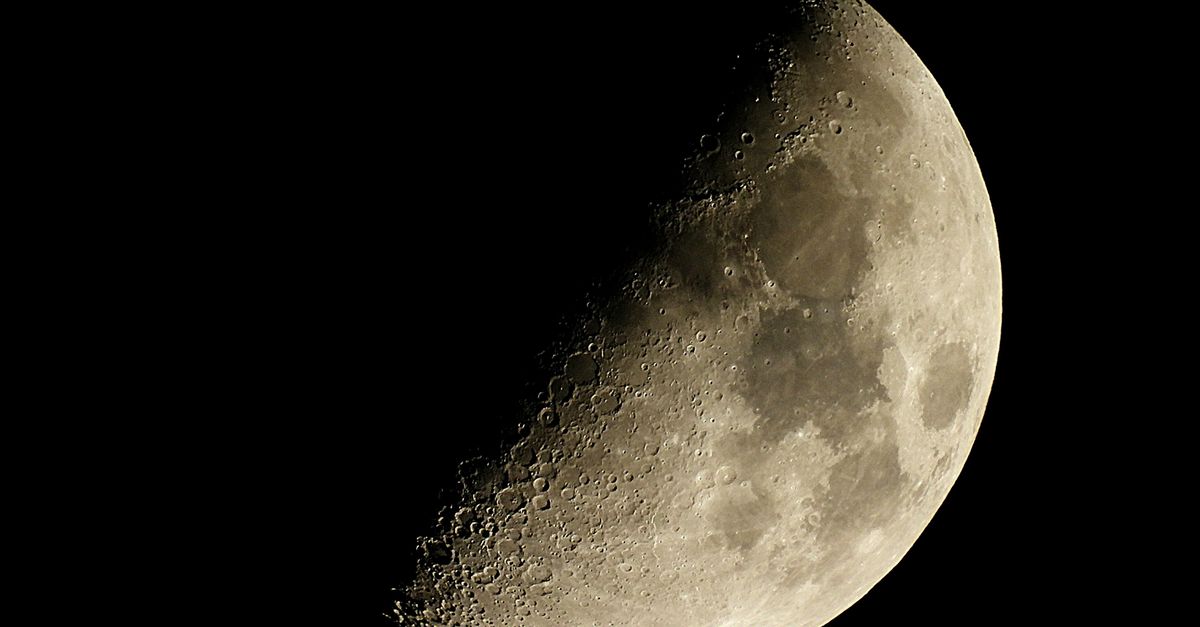
What “today” means for a planting check
A moon-phase calendar and a live phase lookup can differ because the tool samples the current instant reported by your browser, not a phase permanently assigned to the calendar date. The Moon’s geocentric angle changes continuously, so the displayed stage can change over time and even across midnight. When matching a result with a dated planting chart, check the calculation timestamp and resolved browser time zone; Why Moon Phase Dates Differ by Timezone explains the timing issue in more detail.
The displayed angle is the difference between the geocentric ecliptic longitudes of the Moon and Sun. Because that phase angle does not depend on the viewer’s city, the calculation requires no GPS or location permission. It also does not tell you what is visible over your particular horizon. Atmospheric visibility, local terrain, weather, moonrise, and moonset are separate questions that require location-specific information.
| Tool output | Direct answer | Planting relevance and limitation |
|---|---|---|
| Eight-stage label | Current broad phase band | Useful for a quick waxing-or-waning distinction, but it is a Lizely display convention rather than an exact primary event. |
| Phase angle | Current geocentric Moon–Sun longitude difference | Identifies the exact 0°, 90°, 180°, or 270° primary event when the current instant reaches one. |
| Illuminated percentage | Fraction of the Moon illuminated at that instant | Provides visual context but does not indicate whether a planting task will succeed. |
| Nearby primary-phase events | Surrounding primary-event times | Useful when a planting calendar refers to a particular quarter by date or time. |
| Calculation time and browser time zone | The sampled instant and its display context | Check both before comparing the result with another calendar. |
Check the phase before choosing a planting window
- Choose the decision. Note the crop or garden task and the specific planting-by-the-Moon rule you intend to follow. There is no universal set of planting instructions shared by every tradition.
- Open the tool and wait. Let the on-device calculation finish and show the eight-stage label, phase angle, illuminated percentage, and nearby primary-phase events.
- Capture the current reading. Record the label and angle together so you do not need to reconstruct the phase from the illumination percentage later.
- Confirm the instant. Read the calculation timestamp and resolved browser time zone. Choose Recalculate for a fresh browser instant; while the widget is mounted, it also refreshes automatically once per minute.
- Match the rule to the required precision. Use the exact angle when your rule only distinguishes waxing from waning. If it refers to New Moon, First Quarter, Full Moon, or Last Quarter as a particular instant, use the exact angle or nearby event time.
- Apply the tradition, then check the bed. Make the traditional phase association separately, and confirm frost timing, soil, moisture, and weather through local information before planting.
Read the exact angle behind the label
Four primary phases have exact mathematical meanings in this tool: New Moon is the instant the geocentric phase angle reaches 0°, First Quarter is 90°, Full Moon is 180°, and Last Quarter is 270°. These are instants, not multi-day labels. The USNO Phases of the Moon reference provides authoritative background on the four primary lunar events, while the tool’s eight-stage names are a Lizely display convention and are not official USNO classifications.
Each broad stage covers a 45-degree band. For example, the First Quarter band begins at 67.5° and ends before 112.5°, while the exact First Quarter event occurs at 90°. Use the exact angle or primary-event time when your chosen planting calendar names a precise instant. Use the broad band when you only need an everyday category.
| Eight-stage label | Included angle range | Exact primary angle within the band |
|---|---|---|
| New Moon | 337.5° through 360° and 0° through 22.5° | 0° |
| Waxing Crescent | 22.5° through 67.5° | None |
| First Quarter | 67.5° through 112.5° | 90° |
| Waxing Gibbous | 112.5° through 157.5° | None |
| Full Moon | 157.5° through 202.5° | 180° |
| Waning Gibbous | 202.5° through 247.5° | None |
| Last Quarter | 247.5° through 292.5° | 270° |
| Waning Crescent | 292.5° through 337.5° | None |
Lower bounds are included and upper bounds are excluded. The angle wraps cleanly at 360 degrees, which is why the New Moon band appears on both sides of zero. The illuminated percentage should not be used to redefine the exact quarter events because those events are defined by the phase angle.
Use the phase within a planting tradition
A common rule in planting-by-the-Moon calendars associates waxing phases with above-ground planting and waning phases with root-focused planting. That is a traditional gardening convention, not a recommendation generated by Moon Phase Today and not a guarantee of germination, yield, or plant health. The astronomical tool supplies the phase; you supply the rule you have chosen to follow.
On the eight-stage display, Waxing Crescent, First Quarter, and Waxing Gibbous fall on the waxing side, while Last Quarter, Waning Gibbous, and Waning Crescent fall on the waning side. New Moon and Full Moon mark exact transition angles. If a calendar assigns a special planting window to a quarter, use the nearby primary-phase event rather than treating the whole label band as that event. If you need only the direction of the cycle, Is the Moon Waxing or Waning Right Now provides a focused explanation of reading the angle bands.
Some versions of lunar gardening use different windows or add other variables, including astrological sign. Moon Phase Today does not calculate a sign and does not map any phase to a crop. Do not treat a label or sign displayed by another service as if this tool had approved the planting choice.
Keep astronomical timing separate from field conditions
A phase lookup can support a chosen lunar-gardening routine, but it cannot replace the practical checks that determine whether a plant can survive in a particular bed. Keep these inputs separate:
- Frost and season: check crop-specific frost timing and the local growing calendar separately.
- Soil and moisture: the tool does not assess soil temperature, drainage, water, or bed readiness.
- Weather and visibility: cloud cover, local horizon, moonrise, and moonset are outside the calculation and require location-specific information.
- Exact field timing: the result is an educational astronomical estimate, not an observational-apparent timing claim for your site or a professional ephemeris.
Even though the phase itself is global for a given instant, the practical planting task remains local. The absence of a location request is therefore a privacy feature, not a claim that all garden decisions are location-free.
How the calculation is performed and bounded
The widget runs locally with the precisely pinned astronomy-engine 2.1.19 package. A narrow adapter validates the supported date, calculates the geocentric phase angle and illuminated fraction, and searches for the surrounding 0°, 90°, 180°, and 270° primary events. It does not call the package’s broader vendor API, and a visitor’s calculation makes no remote astronomy request. No account, GPS, cookie, or browser storage is needed, and the current result remains available offline after the page assets have loaded.
Accuracy is tested against 12 literal, minute-resolution primary-phase timestamps frozen from the official USNO Astronomical Applications API. The fixtures cover all four event types, a leap year, a December-to-January crossing, and the 1700 and 2100 limits; every searched event must differ from its USNO fixture by no more than two minutes. The USNO Astronomical Applications API documentation describes the research service used for those fixtures, but USNO is never called when a visitor opens or recalculates the tool. This test bounds the tested event searches; it is not a claim of second-level precision for every current-phase reading.
The public input and output boundary is 1700 through 2100 because that is the independent comparison range, and the current-time interface normally remains inside it. Results should be treated as educational astronomical estimates, not as authority for tides, navigation, religious observance, photography safety, or other time-critical decisions.
Save a planting check you can repeat
For a reproducible record, note these details:
- The date, calculation time, and browser time zone
- The eight-stage label and exact phase angle
- The illuminated percentage
- The nearby primary event used by your chosen rule
- The crop, task, and named tradition you followed
- Separate frost, soil, moisture, and weather checks
Recheck immediately before planting if the planned time is close to a phase boundary or midnight. That makes the answer to “moon phase today for planting” transparent: an exact sampled astronomical reading plus the gardening tradition and local evidence you chose to apply.