The Moon is waxing when the geocentric angle between the Moon and the Sun, measured eastward along the ecliptic, is climbing from 0° toward 180°, and it is waning when that same angle is falling back from 180° toward 360°. In plain language, the Moon is waxing on any night when the bright portion you can see is getting visibly larger from one evening to the next, and it is waning on any night when that bright portion is getting visibly smaller. The two halves of the cycle are separated by two exact instants: First Quarter at 90°, where the growing phase hits its midpoint, and Last Quarter at 270°, where the shrinking phase hits its midpoint. New Moon at 0° and Full Moon at 180° are the book's ends of the cycle — at 0° the illuminated fraction drops to zero and the cycle restarts, at 180° it peaks at 100% before falling again. Those four angle values are the only true phase events in the cycle. Every other label — waxing crescent, waxing gibbous, waning gibbous, waning crescent — is a convenience band built on top of them, and Moon Phase Today displays both the precise angle and the eight-stage label so you can read the direction directly without ambiguity.
What "Waxing" and "Waning" Mean in Angle Terms
The terminology is older than the math behind it, but the two words name a single geometric direction. "Waxing" comes from an old English word for growing; "waning" comes from a related word for shrinking. In astronomy, they describe whether the illuminated fraction of the Moon's disk — the bright slice you can see from Earth — is moving toward its maximum or away from it.
The Moon is geocentrically waxing when the angular distance between the Moon and the Sun, measured eastward along the ecliptic, is between 0° and 180°. That span covers the entire trip from invisible New Moon up through First Quarter and on to peak Full Moon. The Moon is waning when that same angle is between 180° and 360°, which covers the trip from Full Moon back through Last Quarter and on around to the next New Moon. The two halves meet at exact instants: 90° (First Quarter) where the growth phase hits its halfway mark, and 270° (Last Quarter) where the shrinking phase hits its halfway mark.
At 0° and 180° the Moon is technically neither waxing nor waning — it is instantaneously at the bottom or top of the cycle, with the illuminated fraction at 0% or 100%. In practice, the four primary phase labels and the eight-stage display label only resolve to those exact angles for an instant, then slide off into one of the adjacent bands on the same side of the cycle.
Visual Cues in the Northern and Southern Hemispheres
You can read the direction from the shape and orientation of the lit portion, even without a tool. The illuminated side of the Moon always faces the Sun. Where the Sun is in the sky tells you which side of the Moon is bright, and that tells you which direction the cycle is going.
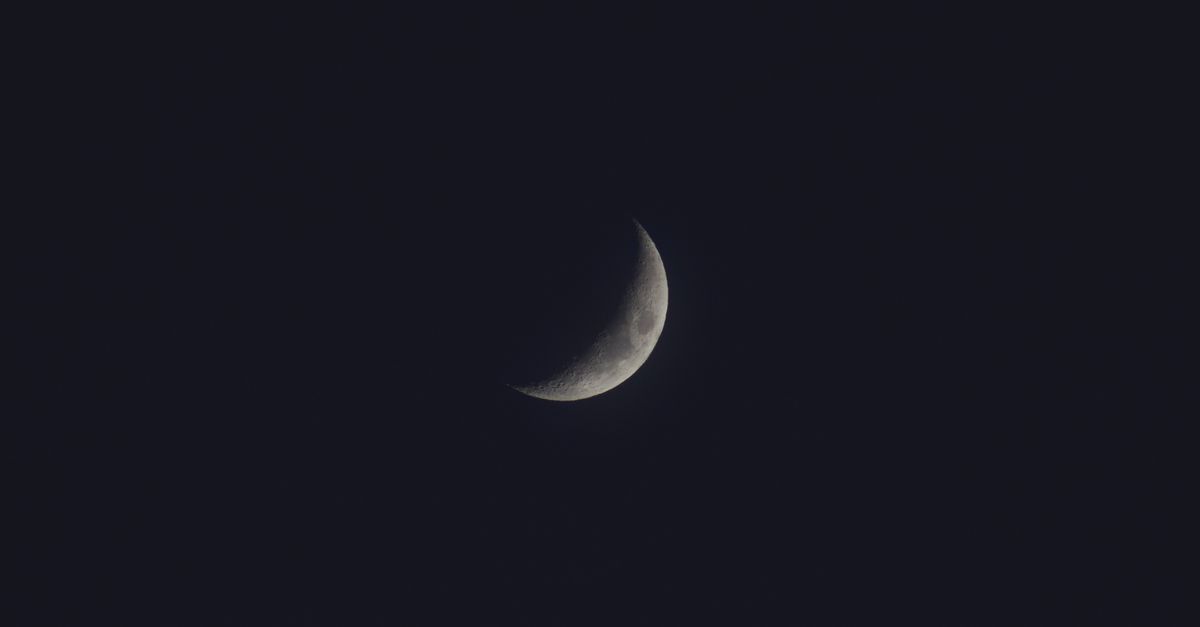
In the Northern Hemisphere, a waxing crescent or waxing gibbous moon is lit on its right side. The bright edge points toward the western horizon, because the Sun has just set or is about to set on that side. A waning moon in the Northern Hemisphere is lit on its left side, with the bright edge pointing toward the eastern horizon where the Sun will rise. A common Northern Hemisphere mnemonic is "DOC" — Dim On the right is a Crescent that is waxing; Bright On the right is also waxing (gibbous). The same rule reads backwards for the left side during the waning half.
In the Southern Hemisphere, the same Moon appears flipped. A waxing moon is lit on the left, and a waning moon is lit on the right. The direction — waxing vs waning — is the same; only the visual orientation relative to your horizon differs. Near the equator, the orientation depends on how high the Moon is and where the Sun is, but the angle Moon Phase Today reports is independent of your location, so the tool's answer works anywhere.
If you are unsure whether a half-moon is First Quarter (waxing) or Last Quarter (waning), the First Quarter vs Last Quarter guide walks through the timing-of-rising test that settles it without a tool.
How to Check the Direction Right Now
- Open Moon Phase Today and wait for the local calculation to render. The widget runs the phase calculation entirely inside your browser using the pinned astronomy-engine 2.1.19 package — no GPS, no account, and no runtime call to a remote astronomy service.
- Read the result row. The geocentric phase angle is the single most important number: anything between 0° and 180° means the Moon is waxing, and anything between 180° and 360° means it is waning — at the exact 0° and 180° instants the Moon sits at a cycle boundary, neither waxing nor waning. The illuminated fraction tells you how far through that half of the cycle the Moon currently sits.
- Read the calculation timestamp and the resolved browser time zone shown next to the result. They confirm which instant you are looking at and let you know how stale the displayed value would be if you leave the tab open.
- Choose Recalculate if you want a fresh reading. The widget samples a new browser instant on demand and also refreshes itself automatically once per minute while it is mounted, so the direction reading stays current without you doing anything.
- Cross-check the eight-stage label against the angle. The label is a convenience band built from half-way points between the four primary angles, so it will always agree with the direction implied by the angle, but the angle is the precise value to trust when the two seem to disagree.
Reading the Eight-Stage Phase Bands
The Moon Phase Today widget displays a broad label alongside the exact angle. That label is a Lizely convention built by dividing the angle circle at the half-way points between the four primary phase events. It must not be confused with an official United States Naval Observatory classification — USNO only defines the four primary phases as exact instants. The eight-band convention is disclosed in full so the mapping is transparent.
| Display Label | Geocentric Angle Range (degrees) |
|---|---|
| New Moon | 337.5° – 22.5° (wraps at 360°) |
| Waxing Crescent | 22.5° – 67.5° |
| First Quarter | 67.5° – 112.5° |
| Waxing Gibbous | 112.5° – 157.5° |
| Full Moon | 157.5° – 202.5° |
| Waning Gibbous | 202.5° – 247.5° |
| Last Quarter | 247.5° – 292.5° |
| Waning Crescent | 292.5° – 337.5° |
Every band whose name contains "Waxing" sits on the growing half of the cycle, so any label from Waxing Crescent through Waxing Gibbous is a waxing reading. Every band whose name contains "Waning" sits on the shrinking half. New Moon and Full Moon are the cycle's endpoints — the angle is technically stationary for an instant at each, then resumes its motion in the appropriate direction.
When the Direction Reverses and Why the Angle Matters
The Moon does not wax or wane at a perfectly steady pace — the angular speed varies slightly across the month because of the Moon's elliptical orbit — but the cycle always passes through the same four landmarks in the same order. New Moon at 0° is the cycle boundary at the start of the waxing half. First Quarter at 90° is the midpoint of the waxing half. Full Moon at 180° is the cycle boundary at the start of the waning half. Last Quarter at 270° is the midpoint of the waning half. The next New Moon at 360° (which is the same angle as 0°) restarts the cycle.
This is why the illuminated fraction alone is not enough to answer the question. A Moon that is 25% illuminated could be waxing (late Waxing Crescent, on the way up to Full) or waning (early Waning Crescent, on the way down to the next New Moon). The fraction tells you where you are in the cycle; only the angle tells you which direction the cycle is moving. Moon Phase Today reports both, so you can confirm the direction even when the visible shape is ambiguous — for example during daylight, near the horizon, or under a thin cloud layer where the bright edge is hard to identify.
For the current reading, Moon Phase Today is the direct path: open it, read the angle, and you have the direction without any other step. The geocentric angle that decides waxing or waning is the same number for every observer on Earth at the same instant, so the answer does not change based on where you happen to be standing.
Related reading: How to Calculate Your Moon Sign Without a Birth Time.