Retrograde Jupiter is a positional event, not a fortune verdict. Astronomically, every planet appears to drift backward through the zodiac for a portion of every year when Earth overtakes it in its orbit; Jupiter's retrograde stations happen roughly once a year and last about four months, and during that window Jupiter's apparent geocentric longitude simply decreases instead of increases. No peer-reviewed source treats this motion as evidence of bad luck, financial loss, or reduced opportunity, because no mechanism connects a planet's apparent direction to a person's wealth or fate. Cultural astrological traditions, by contrast, have long framed Jupiter as the planet of expansion, wisdom, and good fortune, and they sometimes interpret Jupiter's apparent reversal as a warning, a test, or a period of slowed growth. Those readings are cultural interpretations layered on top of an observable geometric fact, not measurements of probability or risk. A reproducible astronomical tool that returns Jupiter's apparent geocentric longitude and Western tropical sector for documented instants between 1700 and 2100 — without promising luck, money, or personality insights — gives readers a way to separate the geometry from the storytelling.
The Astronomical Geometry of a "Retrograde" Planet
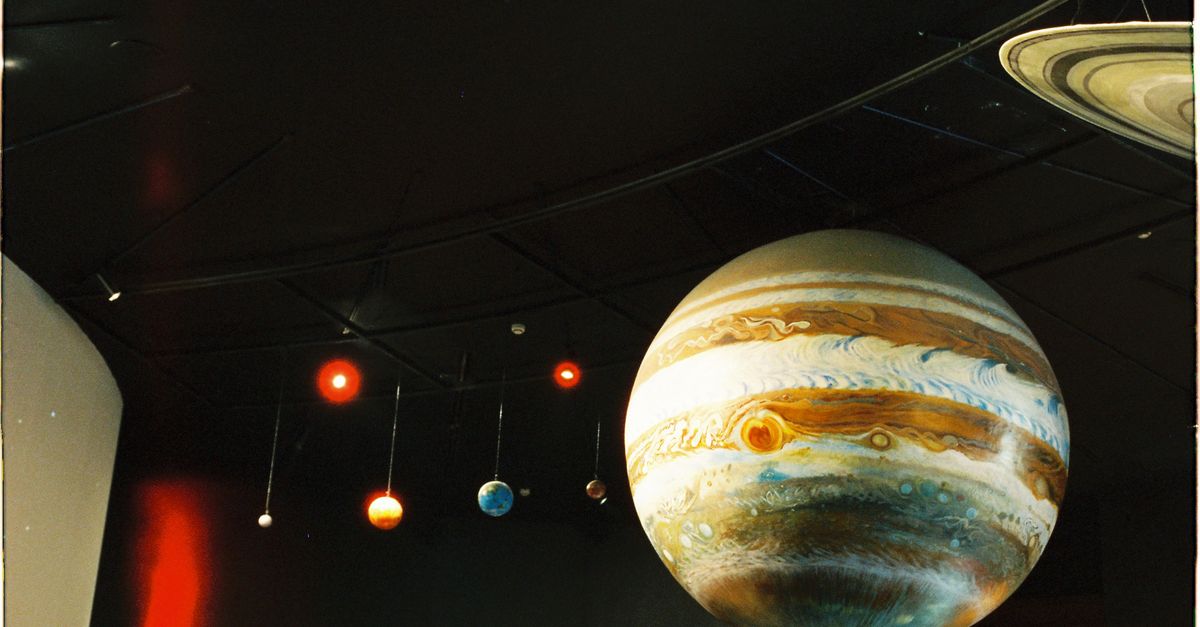
"Retrograde" describes apparent motion, not a change in the planet itself. As Earth and Jupiter orbit the Sun at different speeds, Jupiter's projection against the background stars occasionally slows, halts, and reverses direction for an Earth-based observer before resuming its forward course. Every classical planet beyond Earth can appear retrograde at some point, and the cause is the same: a perspective effect tied to orbital mechanics, not a change in physical influence. Jupiter's retrograde window is roughly four months long each year because Jupiter's orbit is much larger and slower than Earth's, so Earth takes about a year to lap Jupiter once per synodic cycle.
For an Earth-centered measurement, the relevant quantity is Jupiter's apparent geocentric longitude on the true ecliptic of date. That value is normalized into a zero-to-360-degree range, mapped to one of twelve equal 30-degree Western tropical sectors, and reported alongside the normalized calculation instant. None of those steps convert the geometry into a fortune verdict; they are reproducible, verifiable astronomical arithmetic that any offline ephemeris library can repeat.
Where the "Unlucky" Label Comes From
Astrological traditions treat Jupiter as a benefic, a planet associated with growth, opportunity, faith, teaching, and abundance. When that benefic appears to move backward, several schools of thought read it as a sign of compressed or redirected growth rather than outright loss. Vedic astrology, for instance, discusses Vakri Guru (retrograde Jupiter) as a placement that turns attention inward and that emphasizes wisdom, dharma, and children in specific house configurations. Western horoscope columns often warn readers that Jupiter retrograde can mean delayed plans, second thoughts about long-distance moves, or a year of reviewing finances. None of these framings come from peer-reviewed science; they are interpretive overlays that a reader can take or leave without contradicting any physical measurement.
Because the label travels faster than the geometry, a common question on search engines is whether retrograde Jupiter means bad luck in general. The honest answer is that no controlled study has shown that the apparent direction of Jupiter changes any measurable outcome in money, health, relationships, or career. Readers who find the cultural framing useful can keep it as a storytelling lens; readers who prefer to check the geometry first can use a tool that simply returns Jupiter's longitude and sign without attaching meaning to it.
How to Confirm Jupiter's Position at a Documented Moment
The Jupiter Sign Calculator answers the position question directly. It accepts a local date, a clock time, and a documented UTC or UTC-equivalent offset, converts those fields into a single proleptic instant, then maps Jupiter's apparent geocentric longitude to a Western tropical sector. To use it:
- Enter the local Gregorian date and the clock time of the moment you want to inspect.
- Enter the documented UTC offset (for example, +05:30, -04:00, or +09:00); offsets are accepted only from -12:00 through +14:00. Non-whole-hour offsets like +05:30 or +09:45 are accepted.
- Click Calculate to view Jupiter's apparent geocentric longitude, the resolved Western tropical sector, the normalized calculation instant, and the original entered fields.
- If the result sits within 0.05 degrees of a sector boundary, the page shows a warning. Recheck the recorded time and offset against the source document before treating the label as final.
- Copy the normalized instant if you intend to save the result, so the same input convention can be reproduced later by another visitor.
The calculator runs entirely in the browser through the offline Astronomy Engine 2.1.19 implementation, cross-checked against NASA JPL Horizons and IMCCE/INPOP. No location permission, no coordinates, and no runtime astronomy service are involved, which is why the same input always produces the same longitude.
The Twelve Western Tropical Sectors
Jupiter's longitude is reported on a 0–360 degree circle that the display layer divides into twelve equal half-open 30-degree sectors. Each sector starts at a multiple of 30 and runs up to (but not including) the next multiple, beginning with Aries at 0°. The table below lists every sector and its degree boundary exactly as the calculator uses them.
| Sector | Degree range (inclusive start, exclusive end) |
|---|---|
| Aries | 0° to 30° |
| Taurus | 30° to 60° |
| Gemini | 60° to 90° |
| Cancer | 90° to 120° |
| Leo | 120° to 150° |
| Virgo | 150° to 180° |
| Libra | 180° to 210° |
| Scorpio | 210° to 240° |
| Sagittarius | 240° to 270° |
| Capricorn | 270° to 300° |
| Aquarius | 300° to 330° |
| Pisces | 330° to 360° |
The mapping is uniform and astrological rather than astronomical; the actual constellations of the zodiac are unequal in width, and Western tropical astrology uses equal 30-degree divisions anchored to the March equinox. Knowing the exact boundaries matters when Jupiter is close to an edge, because a half-degree error in the recorded offset can shift the label from one sector to the next.
What a Boundary Warning Is Telling You
Jupiter moves more slowly than the Moon or Mercury, but at an exact sector edge, an uncertain historical instant can still flip the label. The calculator flags any result that lands within 0.05 degrees of a sector boundary. That warning is not an error; it is an invitation to verify the source record. A one-hour error in the recorded offset, or a clock that was set to local mean time before standard time zones existed, can move Jupiter from one sector to the next.
The page labels early outcomes as proleptic UTC-like estimates governed by the entered convention for this exact reason. Before standard time zones were adopted, local mean time did not always map cleanly to a modern numeric offset. The calculator never guesses daylight-saving history or political zone changes; it accepts the offset you supply, rejects impossible combinations, and labels the boundary case so you know to double-check.
What This Calculator Will Not Promise You
The Jupiter Sign Calculator returns an astronomical longitude, a sector label, a normalized instant, and (when relevant) a boundary warning. It does not return a luck score, a wealth rating, a personality profile, or an opportunity index. It does not endorse the cultural meanings that some readers attach to Jupiter, expansion, or retrograde motion. The output is reproducible entertainment-oriented geometry: a clearly documented cultural label layered on top of a verifiable astronomical number.
For readers who want a fuller picture of how Jupiter is moving in a chart, the same project publishes a retrograde planets tracker that lists which classical planets are direct, retrograde, or near-stationary at a documented instant. Readers who want to place Jupiter in context can also see how to find retrograde planets in a birth chart; the guide focuses on motion, not luck, and keeps the cultural labels separate from the astronomy.
Saving and Reproducing a Result
Because the longitude is computed from a normalized instant, that instant is the most useful artifact to keep alongside any saved result. Two visitors who enter the same local date, clock time, and offset will produce the same normalized calculation time and the same Jupiter sector. If you copy the normalized instant and the entered fields together, anyone with the offline ephemeris library — including the open-source Astronomy Engine version 2.1.19 referenced on the page — can verify the figure without sending a request to a runtime service.
For a quick sanity check, NASA's JPL Horizons documentation describes how apparent observer-centered ecliptic-of-date longitudes are computed, and the Astronomy Engine 2.1.19 release page lists the open-source implementation that powers the calculator. The pinned offline library is required to stay within 0.005 degrees of both JPL Horizons and IMCCE/INPOP for the eight pinned fixture cases; if your saved number disagrees with those fixtures, the most likely culprit is a typo in the offset, not an ephemeris bug.
Separating Geometry From Story
Whether retrograde Jupiter reads as unlucky, instructive, or simply ordinary depends entirely on the storytelling frame the reader brings to it. The geometry itself is neutral: a planet whose projected longitude is decreasing for a few months each year. Readers who want the cultural label can keep it as a cultural label; readers who want the number can take the number on its own. The Jupiter Sign Calculator's job is to give the number, name the cultural sector plainly, flag the boundary case, and stop. It does not turn a retrograde Jupiter into a verdict about money, love, or fate, and it makes no claim of professional ephemeris status.
Astrology is not a scientific personality assessment, and this page is built for entertainment and cultural interest. If a planetary reading is being used to guide a medical, legal, financial, safety, employment, or relationship decision, that is the wrong tool for the job. For everything else — curiosity, journaling, cultural research, comparing notes with friends — a reproducible longitude is the cleanest starting point. Use the Jupiter Sign Calculator to get that starting point, treat the sector label as one layer of meaning rather than the final word, and keep the normalized instant if you want to come back to the same number later.
For a deeper look, see Is Mercury Sign Intelligence? A Position, Not a Score.