The blank rune is a modern commercial invention that does not appear in any historical Elder Futhark manuscript, runic inscription, or medieval source, and scholars of runology do not recognize it as part of the original 24-character alphabet. The blank tile was added to rune sets during the late 20th century by publishers and divination authors who wanted a piece that could represent Wyrd, fate, the unconscious mind, or an unknown outcome when drawn during a reading. Because no ancient source describes a 25th rune, an empty wooden tile, or a symbol-less placeholder in any documented casting practice, every meaning attached to the blank rune comes from the modern author or vendor who introduced it rather than from reconstructed Old Norse or Proto-Germanic evidence. Vendors handle the blank in different ways: some label it "Wyrd," others call it "Odin's Rune," and a few use it as a wild card that overrides whichever rune was drawn alongside it. Treating the blank tile as if it carried the same historical weight as Fehu, Thurisaz, or any other reconstructed Elder Futhark character mixes entertainment symbolism with source-checked identity data, and the two should be kept visibly separate.
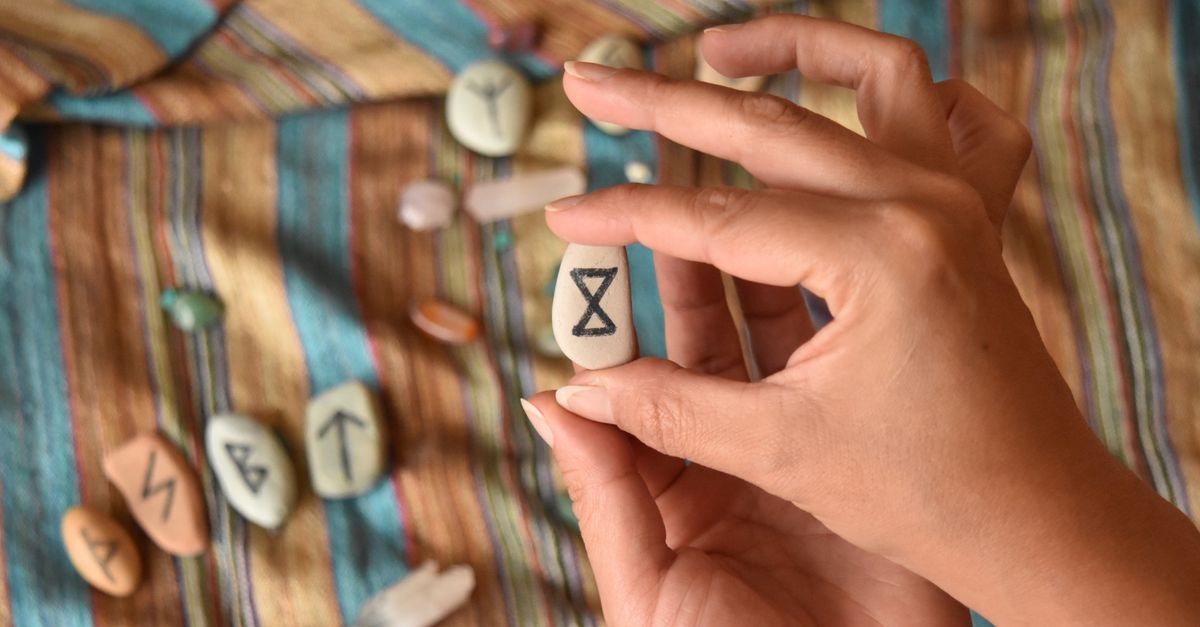
Where the Blank Rune Came From
The Elder Futhark is a writing system used across Germanic-speaking regions from roughly the 2nd to the 8th century CE. Its 24 characters are attested on hundreds of inscribed objects, including jewelry, amulets, weapons, and standing stones catalogued by runologists. According to Penn State's reference on runic alphabets, the surviving corpus contains no record of a 25th character, an empty tile, or a blank placeholder used for divination.
The blank rune first appeared in commercially produced rune sets and divination books in the late 20th century, often as a smooth, uncarved piece of wood or stone bundled alongside the 24 carved tiles. Publishers marketed it as a way to handle uncertainty during a reading: if the caster drew the blank, the moment was treated as undefined, fated, or outside the scope of the question being asked.
The Viking Ship Museum in Roskilde notes that the historical runic alphabet was a functional writing system rather than a single documented casting manual, which makes it impossible to point to any one ancient spread that uses a blank tile. Modern blank-rune practice is therefore an editorial choice layered on top of a reconstructed historical record, not a continuation of a documented medieval tradition.
What the Blank Rune Is Supposed to Mean
Because the blank tile has no historical anchor, each author who includes it assigns its symbolism. The most common associations fall into three loose categories, and the labels are not interchangeable.
| Category | Typical Label | Common Symbolism |
|---|---|---|
| Fate and Wyrd | Wyrd | Unknown destiny, things beyond personal control, the long arc of a situation |
| Wild card | Odin, the All-Father | A message from a higher power, a pivot point, or an override that supersedes the drawn rune |
| Psychological anchor | The Void, the Uncarved | The unconscious, a paused moment, the part of a question the caster has not yet named |
A rune set sold with the blank labeled "Wyrd" treats it as a signpost for fate, while a set that calls it "Odin" treats it as an active message. Readers who mix sources often find that the same blank tile carries very different meanings depending on which book they consulted last, which is one reason the symbol is hard to pin down to a single definition.
How Different Rune Sets Treat the Blank Tile
There is no single industry standard. Some publishers ship 25 tiles (24 carved plus one blank), others ship 24 with one tile left uncarved so the caster can choose its meaning, and a few modern authors skip the blank entirely. Casting instructions also differ: a few systems tell the reader to draw again if the blank comes up, others tell the reader to assign the blank's meaning to the situation regardless of the other tiles drawn, and still others use the blank as a "skip" tile that simply does not count toward the spread.
For readers who want a consistent experience, this variability is one practical reason to favor a tool with a single, clearly labeled set of rules. The Rune Reading tool uses a fixed three-position layout with no blank tile, no reversed meanings, and no override behavior, and it tells you which rules are which.
Why Rune Reading Omits the Blank Rune
Rune Reading draws three unique entries from the same 24-entry Elder Futhark catalogue used elsewhere on the site. The catalogue contains source-checked identity fields: rune character, Unicode code point, common reconstructed name, transliteration, aett, position in the conventional three-group ordering, and a reconstructed literal gloss. Where a name, sound, or gloss is disputed in the scholarly record, an uncertainty note remains visible on screen.
Adding a blank tile would require inserting a 25th entry that has no historical identity field, no Unicode code point, and no reconstructed gloss. That addition would either duplicate the catalogue logic or invent a second identity table just for entertainment, which is exactly the kind of drift the tool is designed to prevent. By keeping the blank out, the tool preserves the boundary between historical reference data and modern interpretive rules. The three card positions (Notice, Question, Small step) are explicitly Lizely-authored entertainment labels, and they are presented as such, separate from the historical identities underneath.
For readers who want to understand why that boundary matters in similar systems, the guide on historical runes versus modern divination walks through where the line sits between the two.
How to Draw Three Source-Checked Runes
- Open the Rune Reading tool in any current desktop or mobile browser. No account, file upload, or location permission is required, and nothing is sent to an outside service.
- Choose Draw three runes. The page generates a complete Fisher-Yates shuffle of the shared 24-entry catalogue using the browser's Web Crypto random number generator and takes the first three shuffled entries.
- Read each rune's identity block. You will see the character, Unicode code point, common reconstructed name, transliteration, aett, position, and the reconstructed literal gloss. Where the catalogue marks a name or gloss as uncertain, that note stays attached to the field.
- Move through the three prompt blocks in order. Notice asks what detail the word-image brings to attention, Question asks what open question the word-image helps you phrase, and Small step asks what small, reversible possibility comes to mind.
- Choose Draw again whenever you want a fresh arrangement. Each shuffle is independent, the result is not saved or uploaded, and closing or refreshing the page discards the displayed cards.
The tool shows an error instead of silently switching to a weaker random source if Web Crypto is unavailable. If that error appears, refresh the page in a current browser before drawing again so the secure randomness path is restored.
Looking Up a Rune Without Drawing
Some readers who search for "blank rune meaning" actually want a quick way to look up a single rune's identity before deciding how to handle a reading. The shared Rune Meanings reference page indexes all 24 Elder Futhark characters by Unicode name, code point, transliteration, or reconstructed literal gloss, and it does not draw, predict, or assign meaning on its own. Reading the catalogue entry first gives you the historical anchor, and the Rune Reading tool gives you the reflection prompts afterward, with no blank tile mixed in.
If you're weighing options, How to Make Sure You Use Tarot Card Meanings Correctly covers this in detail.