To convert bra size to an approximate bust circumference, use this formula: underbust band measurement + cup allowance (about 1 inch or 2.5 cm per cup step) = estimated bust circumference.
This is a reverse estimate based on a two-part bra label, not a guarantee. For the calculation, the band must correspond to a snug ribcage measurement, and the cup letter reflects the approximate difference between that band and the fullest part of the bust. A tape measure gives a more reliable personal measurement than a label-derived result.
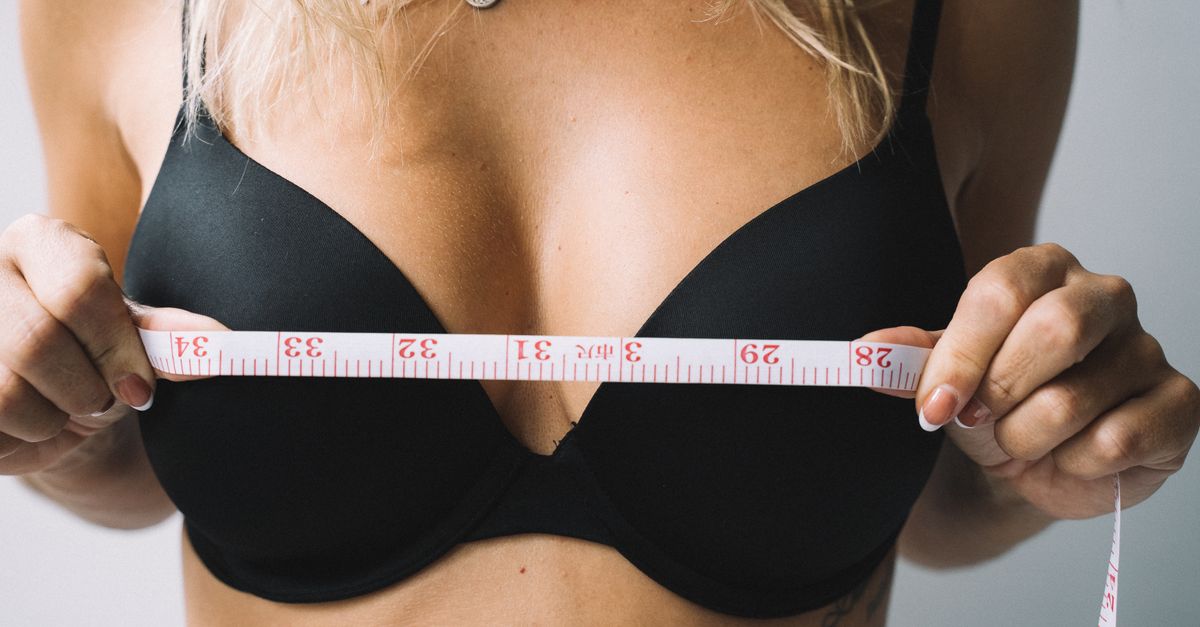
Choose the number that matches your goal
“Convert bra size to bust” can refer to three related tasks. A shopping label, a body measurement and an international bra size are not interchangeable, so decide which output you need before doing the arithmetic.
- Full bust circumference: measure loosely around the fullest part of the bust. This is a body dimension.
- Estimated bust circumference from a known bra label: convert the band to a real underbust measurement, count the cup steps and add the corresponding allowance.
- Equivalent bra size in another country: enter one complete band-and-cup size in the Bra Size Converter. This produces another label rather than a body measurement.
For example, a label translated from EU to US is useful when comparing products, but it does not reveal how tightly that bra will fit. Conversely, a bust circumference is not a bra size because it omits the separate band and cup components.
How the band-plus-cup estimate works
Start with the band as a physical underbust measurement. US and UK band numbers are inches, while EU band numbers are centimetres. A French band number is 15 higher than its EU equivalent, so subtract 15 to recover the centimetre band before adding the cup allowance. AU/NZ uses short band numbers, so translate that label to a system with an inch or centimetre band first.
The cup allowance comes from the difference between the full-bust and band measurements: roughly one inch per cup step. The familiar starting points are:
| Approximate bust minus band | US cup | UK cup | EU/FR cup |
|---|---|---|---|
| 1 in (2.5 cm) | A | A | A |
| 2 in (5 cm) | B | B | B |
| 3 in (7.5 cm) | C | C | C |
| 4 in (10 cm) | D | D | D |
| 5 in (12.5 cm) | DD | DD | E |
Here, “one cup step” means the next position in the relevant cup sequence. Above DD, cup names no longer line up one-for-one: the US label DDD corresponds to E in the UK and F in the European sequence. Count the cup’s ordinal position for the estimate, then use a proper label conversion when you need the exact letter.
Because band measurements and cup differences are rounded, the result should be reported as an estimate. It can help compare rough sizing information, but it cannot capture how a particular brand scales its label.
Worked example: turning a 34C label into a bust estimate
For a US 34C label, begin with the 34-inch band. C is the third cup step, so the approximate cup allowance is 3 inches. Substitute those values into the formula:
Estimated bust circumference = 34 + 3 = 37 inches.
For a metric approximation, 37 × 2.54 = 93.98 centimetres, which rounds to about 94 cm. The result estimates the circumference around the fullest part of the bust; it is not the underbust measurement and does not guarantee that a bra labelled 34C will fit.
Measure your bust accurately at home
When the goal is an actual measurement rather than a label-based estimate, use a soft tape measure. If you are starting from scratch, calculate your bra size at home in three steps for the same tape-measure routine.
- Find the band: wrap the tape snugly around your ribcage directly under the bust. Keep it level and parallel to the floor, then round the measurement to the nearest inch or centimetre.
- Find the full bust: take a loose measurement around the fullest part of the bust without pulling the tape tight. Record it in the same unit as the band.
- Calculate the cup difference: subtract the band measurement from the full-bust measurement. A one-inch difference corresponds roughly to A, two inches to B, three to C, four to D and five to DD; continue by counting cup steps.
- Record or translate the size: combine the band and resulting cup size, then translate the complete label if you need the equivalent in another national system.
Record the underbust measurement, full-bust measurement and final bra size separately. If a shop asks for a bust circumference, give the full-bust measurement; if it asks for a band or bra size, do not substitute one for the other.
Read international band and cup labels correctly
International conversion is not just a change of measurement unit. Both the band number and cup letter can change, and the cup conventions diverge in the larger sizes. The main patterns supported by the converter are:
| System | Band convention | Cup-label detail |
|---|---|---|
| US/Canada | 28–44 inches | Uses DD, DDD, G, H and I; there is no standalone F |
| UK | 28–44 inches | Continues with DD, E, F, FF, G and GG |
| EU | Centimetres | Counts through A, B, C, D, E, F and G without double letters |
| FR | Centimetres, with the band number 15 above the EU number | Uses the European-style single-letter progression |
| AU/NZ | Uses its own short band numbers | Shows the matching cup with the converted AU/NZ band |
Two useful checks show why a cup-only conversion is unsafe: US DDD maps to UK E, and US G maps to UK F. In the European sequence, US DD maps to EU E and US DDD maps to EU F. The converter uses a single cross-checked reference ladder for these split points instead of applying one universal letter shift.
AU/NZ also uses its own short numbers, so a US 34 band appears as AU/NZ 12. These relationships explain why an imported label cannot be translated by changing the final cup letter alone; the band and cup must be considered together.
Translate a label with the Bra Size Converter
The supported workflow for the Bra Size Converter is label-to-label translation. Choose US/Canada, UK, EU, FR or AU/NZ as the input system, select the band and cup you already know, and read the equivalent size in the results table. The US and UK band controls use the 28–44 inch range, while the converter carries the same complete input size across every available output system.
- Select the sizing system in which you already know the band and cup.
- Select the corresponding band and cup from that system.
- Read the matching US/Canada, UK, EU, FR and AU/NZ sizes in the results table.
All conversion runs in the browser, so nothing you type is uploaded or stored. More importantly for this task, the product accepts one band-and-cup label and returns equivalent labels. It does not take underbust or full-bust measurements, and it does not calculate a bust circumference.
Let fit decide after conversion
No bra label guarantees fit. Bra sizing is not perfectly standardised, and real fit varies noticeably between brands, styles, fabrics, and wired versus wireless construction. Vanity sizing is also common. A converted size is therefore a well-researched starting point rather than a final answer.
This matters especially for extended cup sizes because naming conventions differ most in that range. Try the bra on where possible or check the specific brand’s own size chart before buying. For more about measurement accuracy and why estimates differ, see how accurate a bra size calculator is.
If you need to know your body’s bust circumference, take the tape measurement rather than reverse-engineering a label. If you need to understand an imported bra’s label, convert the complete band-and-cup size, then use the brand’s fit guidance and a try-on to make the final decision.