The Short Answer: No Gap Is Ever Allowed
A thermometer in Thermometers Puzzle can never have a gap in its fluid, because every filled cell is required to form a single continuous prefix that starts at the rounded bulb and flows forward toward the tip without skipping any cell on that thermometer's path.
That rule is enforced by the puzzle's design rather than by an honor system. The eight two-cell paths on the fixed 4×4 board are stored as ordered arrays, and the level you assign to each thermometer tells the engine exactly how many cells to fill starting from index zero, which is the bulb. A level of one fills only the bulb. A level of two fills the bulb and the next cell along the same path. There is no level value the solver accepts that would place fluid in the tip while leaving the bulb empty, and no level value that would leave an unfilled cell sandwiched between two filled cells on the same thermometer.
If you ever think you see a gap mid-path, the move that produced it was rejected before the board updated, or what you are actually looking at is the empty tail of a partially filled thermometer. An empty tail beyond the last filled cell is allowed — only gaps between two filled cells on the same path are forbidden. To remove doubt, open the bulb and tip of any thermometer and trace its cells in order. The fluid should occupy the first one or two cells and leave the rest empty, never anything in between. The maintained rules reference at Puzzle Thermometers describes the same continuous-fill behavior, and Puzzle Genius independently cross-checks that bulb-first prefix property for the same puzzle family.
This is why the puzzle feels different from a generic "fill in the cells" logic grid. Each thermometer behaves more like a single slider than a bag of independent cells, which means you cannot treat a thermometer as four or five separate decisions but as one ordered decision whose length is bounded by the path itself.
Why the No-Gap Rule Exists in Thermometers Puzzle
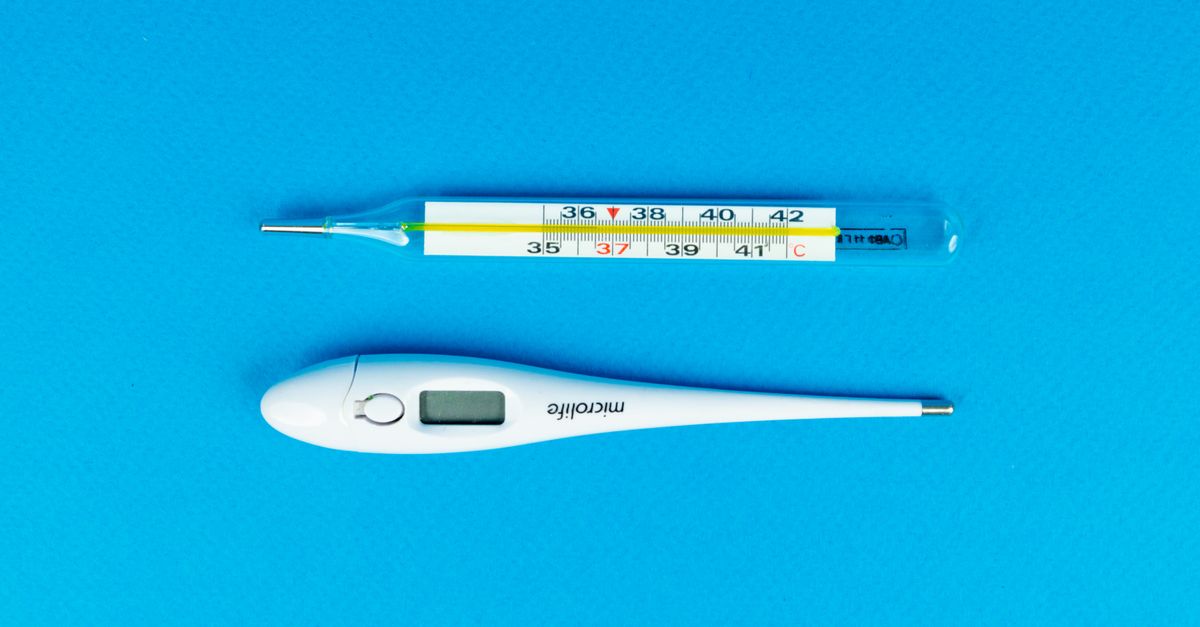
The continuous-fill rule is not an arbitrary decoration. It comes from how real mercury thermometers behave: fluid expands outward from the bulb as temperature rises, so by definition there cannot be a bubble of empty space trapped behind a forward-moving column of mercury. The puzzle borrows that physical metaphor and turns it into a logical constraint, which is why the validator can reject illegal configurations instantly.
In practice, this constraint is what makes the puzzle solvable without guessing. Every thermometer is a one-dimensional variable with a small domain of legal levels. On the fixed 4×4 board the eight thermometers are each exactly two cells long, which means each path has only three legal levels: zero, one, or two. Combined with the eight row and column clues, the search space collapses to a handful of possibilities, and the rule that fluid can never have a gap is what prunes the rest.
For example, suppose a thermometer points horizontally with its bulb on the left. If its row clue says the row needs three filled cells and the column clue says the column needs two filled cells, the thermometer can still legally be empty, half-filled, or full — but it can never be "full in the right cell only" or "full in the right cell with the left cell empty." That last configuration is the gap the rule prohibits, and the level array structure of the puzzle simply does not allow you to enter it.
The same logic applies in reverse: a thermometer whose bulb sits in a row that needs many filled cells cannot be left empty, and a thermometer whose tip sits in a column that is already at its clue cap would, if raised further, push that column past its clue and trigger a reported contradiction. The gap rule and the clue rule work together, and the engine exposes both as the single validation check that decides whether a move is accepted.
Set Continuous Fluid Levels on the 4×4 Board
The fixed Thermometers board is four cells wide and four cells tall, partitioned into eight two-cell thermometers. Each path has a rounded bulb at one end and a square tip at the other, and the row and column clues are printed along the outside of the grid. To set fluid levels without creating a gap, follow these steps on the Thermometers Puzzle playable board.
- Move the selection with the arrow keys until the cursor sits on either the bulb or the tip of the thermometer you want to adjust.
- Press Space to raise that thermometer's fluid level by one cell, starting from the bulb. The first Space fills only the bulb; a second Space fills the bulb and the next cell along the path.
- If the selected segment is already filled, press Space again to lower the level back to the segment immediately before it. Each Space press moves the level by exactly one cell, so there is no risk of jumping past a cell and accidentally creating a gap.
- After every Space press, mentally check that the row and column clues get closer to being satisfied. The clues from top to bottom are 3, 2, 3, and 1, and from left to right are 2, 2, 2, and 3 — together they require exactly nine filled cells on the board.
- If a row or column is at its clue cap, do not add any more fluid in that line. The validator reports any move whose resulting row or column would exceed its clue as a contradiction, which flags an overfill that needs attention.
- Press Enter on an unfilled cell to place or remove an optional empty mark. Empty marks are private notes only and never affect whether a thermometer can have a gap, because the validator reads the fluid levels, not the marks.
- When the ninth filled cell appears, every row and column total becomes exact and the puzzle is complete. Your score is updated from the starting 1,000 based on the number of Space actions you used.
If at any point the board rejects your move or highlights a warning, the underlying reason is almost always that you tried to raise a level past its tip or that the move would push a row or column over its clue. Either situation is reported as a contradiction, and the no-gap property of the board is preserved.
The Disclosed Six-Action Solution and Score
Because every grid cell belongs to exactly one thermometer and every thermometer is exactly two cells long, the entire board state can be written as a single array of eight integers in the range zero through two. The disclosed solution for the fixed 4×4 board is the level vector 2, 1, 0, 2, 1, 2, 1, 0, which sums to nine filled cells — exactly the count demanded by the row and column clues.
| Thermometer | Path length | Disclosed level | Filled cells |
|---|---|---|---|
| 1 | 2 | 2 | Bulb and tip |
| 2 | 2 | 1 | Bulb only |
| 3 | 2 | 0 | None |
| 4 | 2 | 2 | Bulb and tip |
| 5 | 2 | 1 | Bulb only |
| 6 | 2 | 2 | Bulb and tip |
| 7 | 2 | 1 | Bulb only |
| 8 | 2 | 0 | None |
Setting those levels with the keyboard means selecting bulb or tip cells 1, 3, 6, 9, 11, and 12 in that order and pressing Space on each. Six Space actions are required because only the six nonzero levels need a press — the two empty thermometers at level zero stay at zero. The score formula is straightforward: you start at 1,000 and lose 10 points per Space press, so the disclosed six-action route finishes at 940.
It is worth pointing out that this score depends on the number of level actions, not on how you organized your thinking. A correct solve in seven actions would score 930, and a correct solve in nine actions would score 910. A move that is rejected as invalid does not count against your score, because the level array is never modified when validation fails.
Validation, Score Formula, and Restart Behavior
Every Space press triggers a full validation pass. The engine rebuilds the filled-cell set from the eight paths and their levels after every action, so the no-gap property is checked continuously rather than only at the end. A level must be an integer from zero through the path length, and any move that would push a level past the tip is rejected outright. Any move that would push a row or column over its clue is reported as a contradiction, but the move is still undone, which means the score penalty only applies to moves that were actually accepted.
| Move outcome | Effect on score | Effect on board |
|---|---|---|
| Accepted Space press | −10 points | Level raised or lowered by one cell |
| Rejected level past tip | No change | No change, move not applied |
| Reported row or column overfill | No change | Contradiction warning shown |
| Accepted Enter on unfilled cell | No change | Optional empty mark toggled |
| Restart | Restored to 1,000 | All eight levels reset, marks cleared |
Restart clears every thermometer back to level zero, removes all empty marks, resets the cursor, restores the starting score of 1,000, and removes any active contradiction warning. Your best completed score is saved only in this browser's localStorage, so it will be there the next time you load the same browser, but it will not sync across devices or accounts. There is no timer, no audio, no downloaded asset, and no account requirement, so a restart is genuinely lossless.
Controls Beyond the Keyboard
Mouse and touch users have an equivalent path. A click on a bulb or tip sets the level through the selected segment exactly the way Space does, while a context-menu gesture on an unfilled cell places or removes the optional empty mark that Enter handles on the keyboard. Each input method reaches the same level array, so the no-gap rule is enforced identically regardless of how you choose to play.
If you need to step away from the screen, double-press Escape to display a shared simulated spreadsheet that hides the puzzle, and double-press Escape again to return to the exact board state you left. Restart is not triggered by the boss key, so your current levels and marks are preserved while the cover is visible.
The interface itself is a responsive semantic CSS grid rather than a canvas, and every cell announces its position, bulb or tip role, fill state, and mark state to assistive technology. Bulbs, tips, fluid, empty marks, clues, selection, warnings, and surfaces all draw from the site's CSS variables, which is why the no-gap behavior is visible as well as logical — a partial fill always shows the same continuous blob of fluid starting from the rounded bulb and never a stranded dot near the tip.
Related reading: Liquid Physics Puzzle: How a 7×7 Routing Game Works.