The Moon phase you were born under is the geocentric Moon-Sun ecliptic-longitude difference at your exact birth instant, expressed on a 0 to 360 degree cycle where 0 degrees marks New Moon, 90 degrees marks First Quarter, 180 degrees marks Full Moon, and 270 degrees marks Last Quarter. That angle does not depend on the city, hospital, or country where you were born, because it is an Earth-centered quantity rather than a local horizon measurement, so two babies born at the same documented UTC instant on opposite sides of the planet share the same Moon-Sun angle and therefore the same Moon phase. To turn your birth date into a specific angle, the Birthday Moon Phase Calculator converts your local civil date and clock time into a single proleptic UTC-like instant using the documented UTC or UTC-equivalent offset you supply, then asks a pinned offline astronomy engine for the Moon-Sun angle, the illuminated fraction, and the four primary phase events nearest that instant. The answer is reproducible, auditable, and works without a network call once the page is loaded.
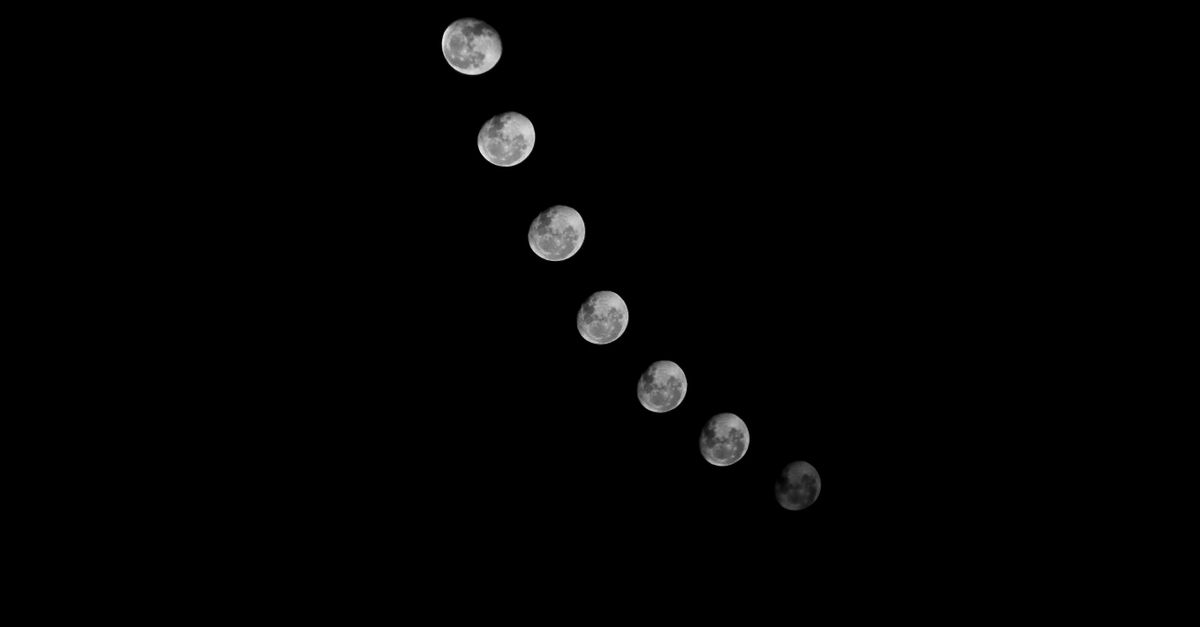
What "born under a moon phase" actually means
The phrase "born under a moon phase" can mean two quite different things, and the calculator is built around the astronomical one rather than an astrological personality reading. Astronomically, the Moon's phase is purely a function of the angular distance between the Sun and the Moon as seen from the center of Earth. That angle changes continuously, so each documented instant has its own precise phase value. Astrologically, the phase is sometimes used as a coarse personality label, but no scientific link between lunar phase at birth and life outcomes has been established, and the tool deliberately does not infer personality, compatibility, luck, fate, or life advice from a phase value.
Within the astronomical meaning, two layers of classification sit on top of the continuous angle. The first layer is the four primary phase events defined by the United States Naval Observatory: New Moon at 0 degrees, First Quarter at 90 degrees, Full Moon at 180 degrees, and Last Quarter at 270 degrees. These are instantaneous angular crossings, not ranges. The second layer is a set of broader display bands that group the cycle into eight named stretches of 45 degrees each. Both layers appear in the calculator output, and the eight-stage labels are a Lizely display convention rather than an official USNO or NASA classification.
Why an exact instant matters more than the date
Most people who search for "what moon phase was I born under" know their birth date but not always their exact birth time, and sometimes not even the offset that applied at the place. The Moon moves through its cycle roughly every 29.53 days. A birth within a few hours of a New Moon, a Full Moon, or a quarter crossing can land on either side of the boundary, which flips the broad display label even though the calendar date stays the same. A single date is not enough to pick a side, so the calculator needs the time and the documented offset that applied at that place and moment to place the birth unambiguously inside one 45 degree band.
The browser's current time-zone setting cannot reconstruct that information on its own. Historical daylight-saving rules, war-time shifts, and political boundary changes mean the offset that applied at 3:14 a.m. on the day you were born may not match today's offset for the same region. The tool therefore treats the UTC offset as a separate, user-supplied input rather than reading it from the device. If you cannot supply it, the tool offers an explicit approximation mode rather than guessing silently and silently giving you a wrong label.
Find your birth moon phase
- Open the Birthday Moon Phase Calculator page so the local assets, including the pinned Astronomy Engine 2.1.19 build, load once into your browser and are ready for offline use.
- Enter the local civil date of birth in the date field, including year, month, and day in the order your birth record uses.
- Enter the local clock time of birth in the time field as recorded on your birth record. If your record only states "morning," "afternoon," or "evening," see the section below for the unknown-time approximation mode.
- Enter the documented UTC offset, or UTC-equivalent offset, that applied in that place at that moment. For most modern births this is a whole-hour value such as -05:00, +00:00, or +09:00; historical births may need a half-hour or quarter-hour value, which the field accepts as a signed offset in hours and minutes.
- Calculate the instant estimate. The tool resolves your three local fields plus the offset to one proleptic UTC-like instant, and rejects invalid dates, clocks, offsets, or normalized calculation instants outside the 1700 through 2100 window before the astronomy calculation runs.
- Review the output together: the normalized UTC instant shown beside your entered local time, the Moon-Sun angle in degrees, the illuminated fraction, the eight-stage Lizely display band, and the nearest New Moon, First Quarter, Full Moon, or Last Quarter events around that instant.
When you do not know your birth time
If your birth certificate only records the date, choose the unknown-time mode deliberately rather than leaving the time blank. The calculator then computes the phase for local noon on that date using your entered offset, compares the start and end of the offset-defined local day, and decides which broad label to show. If the eight-stage label differs between noon and either day endpoint, both possibilities are displayed side by side instead of one being treated as definitive. The result is visibly marked "Phase-boundary approximation" so it cannot be confused with an exact-mode answer.
The tool also checks whether a New Moon, First Quarter, Full Moon, or Last Quarter instant occurred during your offset-defined local day. If one did, the result explains that an unknown birth time may place you before or after that event, which can change the broad label even when the calendar date does not. Early-date results carry an additional caveat: before standard time zones, local mean time may not map to a reliable modern offset, so the calculator treats the answer as a proleptic UTC-like estimate and keeps your entered convention visible in the output rather than hiding it behind a default.
Reading the result: primary events and display bands
| Primary event | Moon-Sun angle | What it means |
|---|---|---|
| New Moon | 0 degrees | Sun and Moon share the same geocentric ecliptic longitude; the near side is unlit. |
| First Quarter | 90 degrees | The Moon has completed a quarter of its orbit from New Moon; half the disk is lit. |
| Full Moon | 180 degrees | Sun and Moon sit on opposite sides of Earth; the near side is fully lit. |
| Last Quarter | 270 degrees | The Moon is three-quarters of the way through its orbit; half the disk is lit again. |
The eight-stage display bands sit between those primary events. Lizely places the boundaries halfway between primary angles, so each band covers 45 degrees. Starting at 337.5 degrees and wrapping through 0 degrees, the cycle reads New Moon, Waxing Crescent, First Quarter, Waxing Gibbous, Full Moon, Waning Gibbous, Last Quarter, and Waning Crescent. These equal-width bands are a disclosed product convention; USNO supplies the four primary meanings and the fixture times used for accuracy testing, but does not classify the in-between ranges.
If you want a closer look at the direction of the cycle, the waxing versus waning reading guide explains how to tell which side of the Full Moon your result sits on. If you also want to compare the Moon's ecliptic-longitude sector to the broader "Moon sign" idea used in astrology, the phase versus Moon sign guide lays out what each calculation actually measures and which inputs each one needs.
What the tool does and does not claim
The result is an astronomical estimate, not a precision-grade ephemeris. Accuracy is tested rather than implied: twelve literal minute-resolution events from the official USNO service cover all four primary phases, a leap year, year rollovers, and the 1700 and 2100 limits, and the pinned astronomy-engine build must find every event within two minutes of the USNO fixture. NASA terminology is used to cross-check familiar phase names and physical explanations, but neither official service is contacted when a visitor uses the page.
The calculator does not request a birthplace or location permission, because geocentric phase is an Earth-center quantity rather than a local horizon, moonrise, weather, or visibility calculation. No birth input is uploaded, stored, or sent to USNO, NASA, a CDN, or any paid service, and once the page assets are loaded, the result works without a network connection. The page is not suitable for navigation, safety, tides, religious observance, local visibility, or other time-critical decisions, and it does not infer personality, luck, or compatibility from a phase value. For a terminology cross-check, the official USNO primary phase dates and the underlying USNO Astronomical Applications API remain the authoritative public references.