Today’s Moon phase is the eight-stage band containing the Moon’s current geocentric Sun–Moon angle; the exact New Moon, First Quarter, Full Moon, and Last Quarter instants occur at 0°, 90°, 180°, and 270°.
The Moon’s phase changes continuously, so “today” does not have one fixed label from midnight to midnight. For the current label and the information behind it, open Moon Phase Today. It samples the current instant reported by your browser and displays the eight-stage label, geocentric phase angle, illuminated percentage, surrounding primary-phase events, calculation timestamp, and resolved browser time zone.
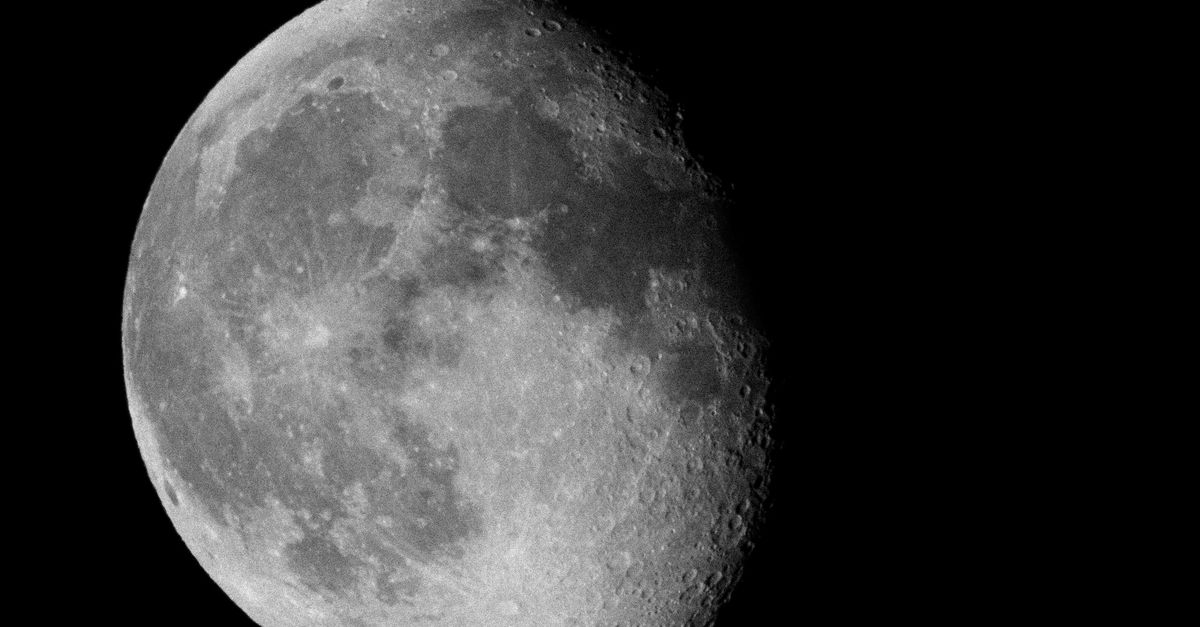
The current answer in two layers
There are two useful ways to describe the Moon at a particular moment. The eight-stage label gives a quick, everyday classification, while the phase angle gives the underlying astronomical position. A phase such as Waxing Gibbous is therefore a broad range of angles rather than a single instant. By contrast, the primary phases defined by the tool are mathematically precise event points: New Moon at 0°, First Quarter at 90°, Full Moon at 180°, and Last Quarter at 270°.
That distinction matters when a calendar or guide lists “Full Moon” for a date. It identifies the part of the lunar cycle in which the Moon appears, but it does not mean the exact Full Moon event lasts for the whole date. The calculation timestamp and nearby event time provide the more precise answer.
At a given instant, the geocentric phase does not change simply because you move to another city. The calculation uses the difference between the Moon’s and Sun’s apparent geocentric ecliptic longitudes, so the tool does not request GPS, a city, or location permission. Atmospheric visibility and the appearance above a particular horizon are separate questions.
Check the current phase in five steps
- Open the tool and wait for the local calculation. The result displays the current eight-stage label, phase angle, illuminated percentage, and nearby primary-phase events.
- Read the calculation timestamp and browser time zone. These show the instant that produced the displayed result and the time zone used to present its timing. Choose Recalculate when you want to sample a fresh browser instant. While the widget remains mounted, it also refreshes automatically once per minute.
- Read the phase angle and illuminated percentage together. The angle determines which eight-stage band applies. The percentage gives the continuously changing illuminated fraction, but it does not report whether the Moon is visible from your location.
- Match the angle to the disclosed band table below. Use the eight-stage name for a concise daily answer, not as a substitute for the exact primary-event angle.
- Inspect the surrounding primary-phase events. Compare their displayed times with the calculation timestamp to see which exact event was most recent and which was approaching. The exact event is identified by its mathematically defined angle, not merely by the broad display label.
How the eight phase bands are defined
The phase angle is represented around a 0°–360° circle. Lizely’s disclosed display convention places boundaries halfway between successive primary angles, creating eight broad bands. The following ranges describe which label the tool displays for a given angle.
| Display label | Geocentric phase angle | Position relative to the exact events |
|---|---|---|
| New Moon | 337.5°–360° and 0°–22.5° | Broad band spanning the 0° New Moon event |
| Waxing Crescent | 22.5°–67.5° | Between the 0° and 90° primary events |
| First Quarter | 67.5°–112.5° | Broad band spanning the 90° First Quarter event |
| Waxing Gibbous | 112.5°–157.5° | Between the 90° and 180° primary events |
| Full Moon | 157.5°–202.5° | Broad band spanning the 180° Full Moon event |
| Waning Gibbous | 202.5°–247.5° | Between the 180° and 270° primary events |
| Last Quarter | 247.5°–292.5° | Broad band spanning the 270° Last Quarter event |
| Waning Crescent | 292.5°–337.5° | Between the 270° and 360° primary events |
Each lower boundary is included and each upper boundary is excluded. The angle wraps cleanly at 360°, where it returns to the 0° direction. These eight labels are a Lizely display convention created for convenient everyday use. They should not be presented as official United States Naval Observatory classifications.
Why the daily label can differ from the exact event
A broad label describes the Moon’s position within a range. An exact primary phase exists only at the specified angle. For example, the First Quarter display band begins before the 90° point and continues after it, but the First Quarter event itself is the instant at 90°. The nearby primary-phase events keep that distinction visible by showing when the surrounding mathematical events occur.
Time zone presentation can also affect which calendar date appears beside an event. The underlying geocentric angle for an absolute instant remains the same, but converting that instant into local dates can move an event across midnight. If another source places the same event on the adjacent date, why Moon Phase dates can differ by time zone explains the issue in more detail.
If the result seems different from an earlier reading, compare the calculation timestamps before treating the change as an inconsistency. Recalculating takes a new browser instant, while the automatic once-per-minute refresh also advances the sample. The Moon’s phase does not jump backward; the displayed time and angle are what identify the result being compared.
What each output field represents
The tool separates the measurement, display label, event times, and reference time so each can be interpreted correctly.
| Result field | Direct meaning | Important distinction |
|---|---|---|
| Eight-stage label | The broad display band containing the current phase angle | A convenient Lizely convention, not an official USNO category or an exact event |
| Phase angle | The current geocentric difference between the Moon’s and Sun’s ecliptic longitudes | The underlying value used to select the broad band |
| Illuminated percentage | The illuminated fraction of the Moon viewed from Earth | It does not indicate cloud cover, atmospheric visibility, or whether the Moon is above your horizon |
| Nearby primary-phase events | Surrounding events found for the exact 0°, 90°, 180°, and 270° angles | They are event instants, not multi-day phase labels |
| Calculation timestamp and browser time zone | The sampled browser instant and the time zone resolved for its presentation | They establish which result and calendar date you are viewing |
In practical terms, use the broad band when the question is simply “What phase is it today?” Use the phase angle and nearby event time when you need the more exact astronomical position or the precise instant of New, First Quarter, Full, or Last Moon.
What this phase result cannot answer
The output describes lunar geometry as seen geocentrically from Earth. It does not provide a complete observing forecast for your location. In particular, it does not establish:
- Moonrise or moonset times
- Whether the Moon is currently visible from your position
- Weather, cloud cover, or atmospheric visibility
- Your local horizon, obstructions, or the Moon’s apparent position above it
- Observational-apparent event timing for a particular observing site
Those questions require separate location-specific information. A clear lunar phase does not guarantee that the Moon will be visible, just as a poor local horizon does not change the geocentric phase angle. The results are educational astronomical estimates and do not claim professional ephemeris status, second-level precision, or suitability for navigation, tides, religious observance, photography safety, or other time-critical decisions.
Accuracy, privacy, and supported date limits
The calculation uses the pinned astronomy-engine 2.1.19 package, which is shipped with the application rather than copied from a CDN. A narrow local adapter handles the supported-date validation, geocentric phase-angle and illumination calculation, and searches for the four primary angles. The visitor’s calculation runs in the tool widget and does not call the broader vendor API or make a runtime request to a remote astronomy service.
The test suite contains 12 literal primary-phase timestamps frozen from the official USNO Astronomical Applications API. They cover all four primary event types, dates near the supported limits, February 2020 in a leap year, and events crossing from December into January. Every test result must differ from its minute-resolution USNO reference by no more than two minutes. The USNO Astronomical Applications API documentation identifies the independent reference service used to build those fixtures. USNO is not contacted when a visitor opens or recalculates the tool.
The public supported date boundary is 1700 through 2100 because that is the range covered by the USNO service used for independent comparison; the current-instant interface normally remains well inside it. The calculation needs no account or location permission, and the current result remains available offline after the page assets have loaded. Treat the output as an educational astronomical estimate rather than a precision ephemeris.
Related reading: Moon Sign and Stress Reactions: A Cultural Guide.