The First Quarter and Last Quarter moons are the two half-illuminated phases of the lunar cycle, occurring when the Moon is at 90° and 270° geocentric phase angles, respectively. These phases mark the Moon’s one-quarter and three-quarter positions in its orbit around Earth, with the First Quarter showing the right half illuminated and the Last Quarter showing the left half. While both phases appear as half circles in the sky, their positions in the lunar cycle, illumination direction, and symbolic meanings differ. The First Quarter Moon rises around noon and sets near midnight, making it visible in the afternoon and early evening, while the Last Quarter Moon rises around midnight and sets near noon, appearing in the early morning and pre-dawn sky. These phases are exact mathematical instants—New Moon at 0°, First Quarter at 90°, Full Moon at 180°, and Last Quarter at 270°—but the Moon Phase Today tool uses a broader eight-stage label system to describe the current phase for everyday use. This system divides the 360° cycle into 22.5° bands, ensuring you can quickly identify whether the Moon is waxing (growing) or waning (shrinking) without memorizing precise angles.
Understanding the difference between these phases is useful for stargazing, photography, gardening, or simply appreciating the night sky. The First Quarter Moon is often called a "waxing half-moon," signaling the Moon’s transition toward fullness, while the Last Quarter Moon is a "waning half-moon," indicating the approach of the New Moon. These phases also influence tidal patterns, with the combined gravitational pull of the Sun and Moon creating stronger tides during New and Full Moons (spring tides) and weaker tides during the quarter phases (neap tides). If you’ve ever wondered whether the Moon is in its First or Last Quarter, the Moon Phase Today tool provides an instant, location-free way to check the current phase angle, illuminated fraction, and nearby primary events. The tool calculates the geocentric phase locally in your browser, so you don’t need to share your location or wait for a network request. It also displays the calculation time and your browser’s time zone, making it easy to track the Moon’s progress through its cycle.
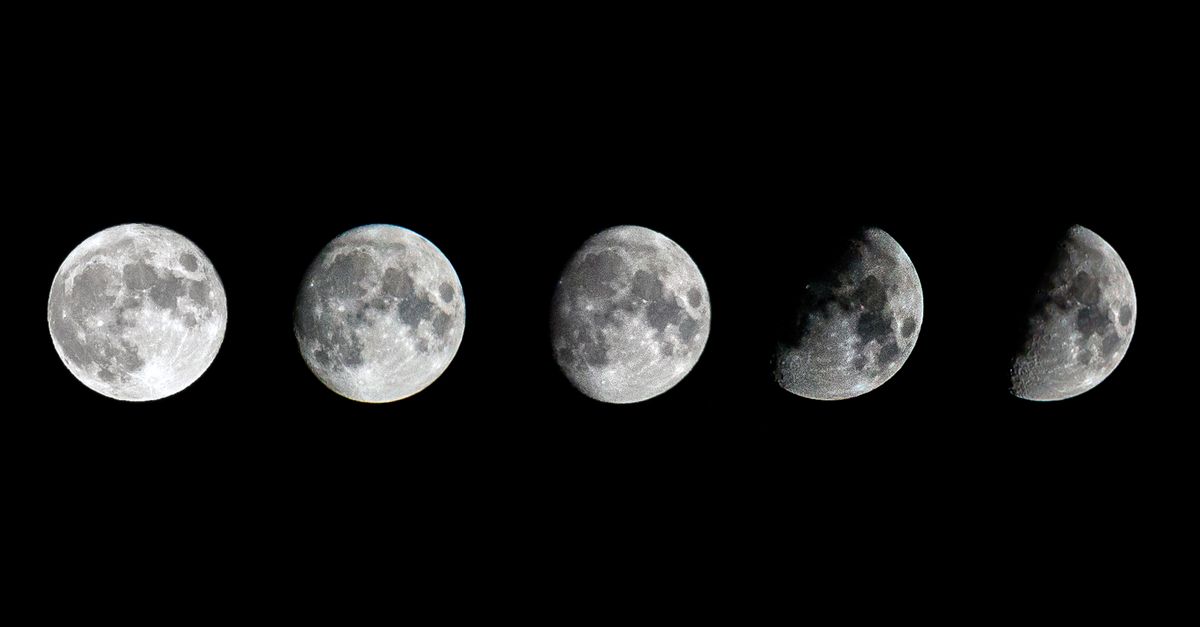
How the First and Last Quarter Moons Differ
The First Quarter and Last Quarter moons are mirror images of each other in the lunar cycle, separated by about 14.77 days. The table below highlights their key differences:
| Feature | First Quarter Moon | Last Quarter Moon |
|---|---|---|
| Geocentric Phase Angle | 90° | 270° |
| Illuminated Side | Right half | Left half |
| Position in Lunar Cycle | One-quarter through the cycle (waxing) | Three-quarters through the cycle (waning) |
| Rise Time | Around noon | Around midnight |
| Set Time | Around midnight | Around noon |
| Visibility Window | Afternoon and early evening | Early morning and pre-dawn |
| Symbolic Meaning | Action, decision-making, growth | Reflection, release, completion |
| Tidal Influence | Neap tides (weaker) | Neap tides (weaker) |
The First Quarter Moon is often associated with taking action or making decisions, as it represents a midpoint between the New Moon’s potential and the Full Moon’s culmination. In contrast, the Last Quarter Moon is a time for reflection, letting go, and preparing for the cycle’s end. While both phases share the same 50% illumination, their positions in the sky and the direction of their illuminated sides make them easy to distinguish with practice. The Moon Phase Today tool simplifies this process by showing the current phase angle and a clear eight-stage label, so you can quickly determine whether the Moon is waxing or waning.
How to Check the Current Moon Phase with Moon Phase Today
If you want to know whether the Moon is in its First Quarter, Last Quarter, or another phase right now, follow these steps to use the Moon Phase Today tool:
- Open the Moon Phase Today tool in your browser. The page will automatically calculate the current geocentric phase without requiring location permission or a network request.
- Wait a moment for the local calculation to complete. The tool will display the current eight-stage phase label (e.g., "First Quarter" or "Last Quarter"), the exact phase angle, and the illuminated fraction of the Moon’s surface.
- Review the nearby primary-phase events listed below the main result. These show the exact timestamps for the next or previous New Moon, First Quarter, Full Moon, and Last Quarter, so you can track the Moon’s progress through its cycle.
- Note the calculation timestamp and your browser’s resolved time zone. If you want to check the phase at a different moment, click the "Recalculate" button to sample a fresh browser instant.
- Use the disclosed angle-band table to confirm how the eight-stage label maps to the exact phase angle. For example, the First Quarter label covers angles from 67.5° to 112.5°, while the Last Quarter label covers 247.5° to 292.5°.
The tool updates automatically once per minute while the page is open, so you can leave it running to monitor the Moon’s phase in real time. Because the calculation is performed locally, the result remains available offline after the page loads, making it a reliable resource even without an internet connection.
Why the Eight-Stage Labels Matter
The Moon Phase Today tool uses an eight-stage labeling system to describe the current phase, dividing the 360° lunar cycle into 22.5° bands. This convention, while not an official USNO classification, provides a practical way to identify the Moon’s phase without memorizing exact angles. The eight stages are:
- New Moon: 337.5°–360° and 0°–22.5° (Moon is dark, beginning of the cycle)
- Waxing Crescent: 22.5°–67.5° (growing sliver, right side illuminated)
- First Quarter: 67.5°–112.5° (right half illuminated, 90° instant)
- Waxing Gibbous: 112.5°–157.5° (growing toward full, more than half illuminated)
- Full Moon: 157.5°–202.5° (fully illuminated, 180° instant)
- Waning Gibbous: 202.5°–247.5° (shrinking from full, more than half illuminated)
- Last Quarter: 247.5°–292.5° (left half illuminated, 270° instant)
- Waning Crescent: 292.5°–337.5° (shrinking sliver, left side illuminated)
These bands are fully disclosed in the tool, so you can see exactly how the current phase angle maps to the label. For example, if the tool shows a phase angle of 100°, it falls within the First Quarter band (67.5°–112.5°), even though the exact 90° First Quarter instant may have already passed. This system is particularly useful for casual observers who want to know whether the Moon is waxing or waning without tracking precise angles. The primary phases—New Moon, First Quarter, Full Moon, and Last Quarter—are exact mathematical events, but the eight-stage labels provide a convenient way to describe the Moon’s appearance on any given day.
How the Tool Calculates the Moon’s Phase
The Moon Phase Today tool calculates the geocentric phase angle and illuminated fraction using Astronomy Engine 2.1.19, a pinned, MIT-licensed package that runs entirely in your browser. The tool does not contact external servers or request location data, ensuring your privacy and allowing offline use. Here’s how it works:
At the current browser instant, the tool calls a narrow local adapter around Astronomy Engine to compute the difference in ecliptic longitude between the Moon and the Sun. This difference, known as the phase angle, determines the Moon’s position in its cycle. The tool then calculates the illuminated fraction of the Moon’s visible surface based on this angle. For example, a 90° phase angle corresponds to a 50% illuminated First Quarter Moon, while a 270° angle corresponds to a 50% illuminated Last Quarter Moon. The tool also searches locally for the surrounding primary-phase events (New Moon, First Quarter, Full Moon, and Last Quarter) to provide context for the current phase.
Accuracy is ensured through a set of twelve test fixtures frozen from the official USNO Astronomical Applications API. These fixtures include primary-phase timestamps spanning the years 1700 to 2100, covering leap years, year boundaries, and events that cross from December into January. The tool’s calculations are required to match the USNO timestamps within a two-minute margin, providing a reliable educational estimate. While the tool does not claim second-level precision or suitability for professional astronomical use, it offers a practical way to check the Moon’s phase for everyday purposes like stargazing, gardening, or photography.
Because the calculation is geocentric, it does not account for the viewer’s location on Earth. This means the tool cannot predict moonrise, moonset, or the Moon’s appearance over your local horizon—those details depend on your city and atmospheric conditions. However, for determining the Moon’s phase angle and illuminated fraction, the geocentric approach is both accurate and efficient, making the tool a quick and reliable resource for anyone curious about the current lunar phase.
Common Misconceptions About Quarter Moons
Despite their names, the First and Last Quarter moons are often misunderstood. Here are a few common misconceptions and the facts behind them:
- Misconception: The First Quarter Moon is the first half of the lunar cycle, and the Last Quarter Moon is the last half. Fact: The "quarter" in First Quarter and Last Quarter refers to the Moon’s position in its orbit, not the cycle’s timeline. The First Quarter Moon occurs when the Moon is one-quarter of the way through its orbit (90°), while the Last Quarter Moon occurs when it is three-quarters of the way through (270°).
- Misconception: The First and Last Quarter moons are full days, not exact instants. Fact: The primary phases—New Moon, First Quarter, Full Moon, and Last Quarter—are exact mathematical events that occur at specific moments. The Moon Phase Today tool shows the exact timestamps for these events, so you can see when they occur in your time zone. The eight-stage labels, however, describe broader periods around these instants for everyday use.
- Misconception: The First Quarter Moon is always visible at night, and the Last Quarter Moon is always visible during the day. Fact: The First Quarter Moon rises around noon and is visible in the afternoon and early evening, while the Last Quarter Moon rises around midnight and is visible in the early morning and pre-dawn sky. Both phases can be seen during daylight hours, depending on the time of year and your location.
- Misconception: The First and Last Quarter moons have the same tidal effects as the New and Full Moons. Fact: The gravitational pull of the Sun and Moon aligns during the New and Full Moons, creating stronger spring tides. During the quarter phases, the Sun and Moon form a 90° angle, resulting in weaker neap tides. This is why tidal ranges are smaller during the First and Last Quarter moons.
Understanding these distinctions can help you better appreciate the Moon’s role in the sky and its influence on Earth. The Moon Phase Today tool provides a straightforward way to check the current phase and debunk common myths by showing the exact phase angle and illuminated fraction.
If you're weighing options, Waxing vs Waning Birth Moon: How to Read the Phase covers this in detail.
If you're weighing options, Mercury Sign vs Mercury House: What Each One Measures covers this in detail.