The details that matter are the card’s orientation, deck tradition, position in a spread, neighboring cards, and the context of the question.
A lookup and a reading answer different tasks. A lookup helps you identify a card’s conventional theme, while a reading considers how that theme functions in a particular arrangement. A short phrase can orient your thinking, but it does not explain every symbol, tradition, and possible context behind the card.
In a Rider-Waite-Smith reference, begin by confirming the exact card and its upright orientation. Add position and neighboring-card context only when the card came from a spread. The Rider-Waite-Smith catalogue described here does not draw a card, accept a personal question, score an outcome, or produce a prediction, so its results should be treated as reference material rather than a finished reading.
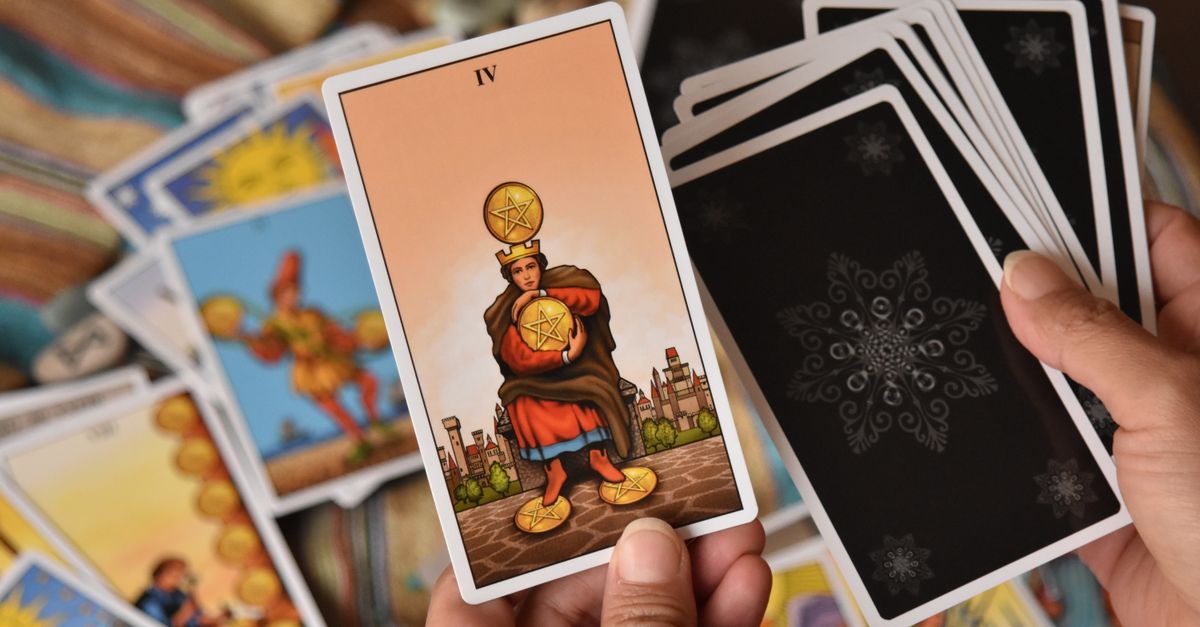
The details that change a tarot meaning
Before assigning an interpretation, separate the information that identifies the card from the information that gives it context. These are the main details to check:
- Deck tradition: Card imagery, numbering, and themes belong to a particular system. A Rider-Waite-Smith reference should not be presented as an interpretation for every historic tarot tradition.
- Orientation: Upright and reversed meanings are different scopes. A reversed card should not silently be treated as an upright card.
- Exact identity: The title, number, rank, suit, and arcana group help prevent confusion between cards with related imagery or themes.
- Position in a spread: When a card belongs to an arrangement, its assigned role can change which part of its meaning deserves attention.
- Neighboring cards and context: Surrounding cards, the reader’s focus, history, and the subject being explored can alter the emphasis of a theme.
For a standalone reference lookup, deck, orientation, and exact identity are the essential controls. Position, adjacent cards, and your focus become relevant when you move from identifying a theme to interpreting an arrangement. This separation prevents a concise catalogue entry from being mistaken for a complete reading.
Set the deck and orientation first
The reference framework comes before the individual card. Tarot Card Meanings covers the Rider-Waite-Smith tradition, including 22 Major Arcana cards and 56 Minor Arcana cards. Its theme phrases are original, concise paraphrases informed by A. E. Waite’s public-domain text; they are not copied from a modern commercial guidebook. The catalogue also makes clear that one short phrase cannot exhaust a symbol or an entire reading tradition.
Orientation is equally important. The catalogue is explicitly upright-only, so it does not provide reversed meanings or a method for deriving them from the upright entry. For broader cultural background on tarot’s changing deck history, the Victoria and Albert Museum’s guide to tarot cards provides a useful reference outside the catalogue itself.
Check these boundaries before comparing cards. A phrase drawn from an upright Rider-Waite-Smith catalogue should be presented as one tradition’s compact description—not as a universal definition, a prediction, or a substitute for examining the imagery and your own circumstances.
Confirm the card’s identity and catalogue position
Before interpreting a result, verify where the card sits in the declared deck structure. The catalogue separates the cards into two clearly defined groups:
| Card group | Catalogue size | Defined order | Useful identity check |
|---|---|---|---|
| Major Arcana | 22 cards | The Fool at 0 through The World at 21 | Check the number and title together. |
| Minor Arcana | 56 cards | Four suits, each with Ace, Two through Ten, Page, Knight, Queen, and King | Check the suit and rank before reading the theme. |
The four Minor suits are Wands, Cups, Swords, and Pentacles, each containing fourteen cards. Two numbering details can provide a useful alignment check: Strength is VIII and Justice is XI in this Rider-Waite-Smith sequence. Other historic deck traditions may number those cards differently, so an unexpected number can indicate that the deck framework needs another look rather than a different interpretation of the same entry.
Search can match a card title, theme, rank, suit, or arcana label. Because a broad theme may match several cards, use the identity fields to decide which result you actually meant. For example, a match found through a theme should still be checked against its number, rank, suit, and arcana classification before you quote or apply it.
Read a theme phrase in context
A catalogue theme is best treated as a starting point. It can identify a recurring idea associated with a card, but it cannot by itself account for the full image, a card’s position, adjacent cards, historical context, or the concerns of the person considering it. Meanings can vary by deck, surrounding cards, reader, history, and context, even when the card identity is correct.
That limitation also changes how a result should be worded. Instead of saying that a card “will cause” a particular event, describe its listed theme and consider the question being explored: What part of this theme fits the present context? What neighboring theme supports or complicates it? What remains outside the catalogue’s scope?
The search feature is useful for finding and comparing reference entries, but it does not perform that synthesis for you. Use a verified card entry to ground the discussion, then distinguish clearly between the catalogue’s upright themes, your contextual reasoning, and any conclusion the reference itself did not make.
Search and inspect meanings step by step
- Open the catalogue and enter a query. Search by an exact card name, part of a title, or a concise theme such as a single concept. The search checks normalized title, theme, rank, suit, and arcana text.
- Narrow the group when needed. Use the Arcana filter to choose Major or Minor Arcana. If you are browsing Minor Arcana, use the Suit filter for Wands, Cups, Swords, or Pentacles. Combine filters with the search term rather than assuming every visible title matches the word you entered.
- Select a visible card. Opening a result displays its title, arcana classification, rank, suit, and concise upright themes. Major Arcana entries also show their number, allowing you to verify The Fool at 0, Strength at VIII, Justice at XI, and The World at 21.
- Confirm the identity before using the theme. Compare the displayed title and classification with the card you intended to find. If several results appear plausible, inspect each matching entry rather than assuming the first result is the intended card.
- Refine the visible set. If a new search or filter excludes the selected card, the detail panel follows the first visible result instead of showing stale information. If nothing matches, the list reports that no cards are visible and the panel asks you to select a card after changing the filters.
- Use the two reset controls correctly. Clear search removes the text query while preserving the other filters. Reset catalogue restores all 78 cards and returns the selection to The Fool. Neither control draws a card, generates a reading, or submits a question.
This workflow keeps the lookup reproducible: the same query and filters determine which entries are visible, and each selected detail panel is resolved from the current result set. It also avoids a common source of confusion—assuming that a previous card’s meaning is still active after the visible list has changed.
Match your task to the tool’s scope
Different tarot tasks need different levels of detail. The catalogue is strongest when your task is identification or reference exploration; it does not turn a theme into a complete interpretation.
| Your task | Details to check | What the catalogue supports |
|---|---|---|
| Identify one card | Exact title, number, rank, suit, and arcana group | Search and select the matching entry, then inspect its upright themes. |
| Browse a group of cards | Major or Minor classification and, for Minor cards, suit | Combine Arcana and Suit filters with keyword search. |
| Explore a concept | The search theme and the identity of every matching card | Return concise theme matches without ranking or predicting their importance. |
| Interpret a card in a spread | Position, neighboring cards, deck, orientation, and reader context | Supply an upright reference theme only; it does not generate the spread interpretation. |
| Find a reversed meaning | Card orientation | Reversed meanings are outside the product’s scope. |
No account or personal information is required, and the catalogue makes no network request. Nothing entered into it is uploaded. That makes it suitable for browsing a deck without submitting a personal question, although anyone who can view the device may still see information shown on screen.
Use a final verification checklist
- Confirm the card’s exact title and identifiers.
- Confirm that the entry belongs to the Rider-Waite-Smith sequence.
- Confirm that you are looking at an upright entry.
- Separate the listed theme from your own contextual interpretation.
- Add position, adjacent cards, and your focus only for a reading context.
- Do not present the catalogue as a prediction or claim of certainty.
Used this way, a tarot card meaning becomes a disciplined reference point: it tells you what the catalogue associates with a verified card, while leaving interpretation, context, and uncertainty visible rather than presenting them as facts the tool never established.
Related reading: Tarot Reading Online Free: How to Judge Accuracy.
Related reading: What Details Matter When Using a Zodiac Modality Chart?.