Today’s Moon illumination percentage is the Moon’s current geocentric illuminated fraction multiplied by 100 at the displayed calculation instant. Moon Phase Today calculates that live value locally, and the percentage changes continuously as the Moon’s phase angle advances.
The tool answers the “today” part with the browser’s current instant, not an assumed morning, midnight, or daily average. Its result combines the illuminated percentage and phase angle with an eight-stage display label, nearby primary-phase events, the calculation timestamp, and the browser-resolved time zone. All of those fields matter when you want a precise reference rather than a generic phase name.
Because the calculation is geocentric, your city, GPS permission, and local horizon are not needed to obtain the number. Weather, visibility, moonrise, and moonset remain separate location-specific questions.
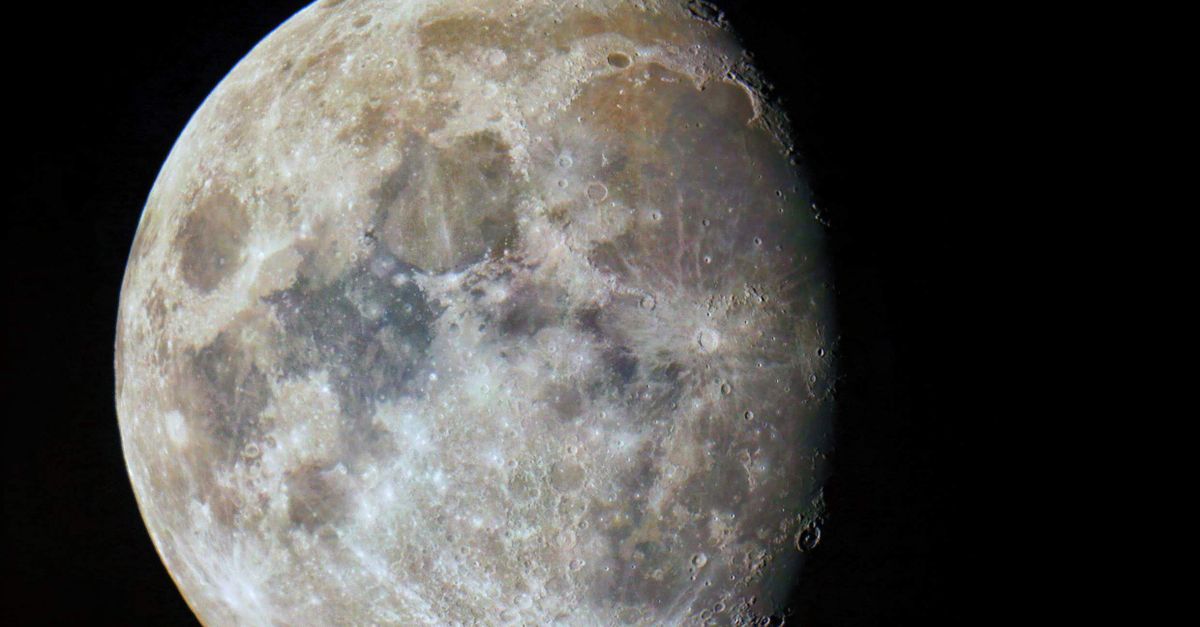
What the illumination percentage represents
The illumination percentage is a snapshot of how much of the Moon is illuminated as measured from an Earth-centered viewpoint at one instant. The calculation starts with the geocentric ecliptic longitude difference between the Moon and the Sun, expressed as a phase angle running around a 0°–360° circle. It then reports the corresponding illuminated fraction as a percentage.
“Geocentric” means the calculation is centered on Earth rather than on one observer. Your city is not an input. The result describes the Earth-centered phase for its stated instant; what you can actually see locally still depends on separate conditions such as the horizon, atmosphere, and weather.
That distinction keeps two commonly confused outputs separate. The illuminated percentage answers “how much is lit at this instant?” The phase label answers “which broad stage is this angle in?” For the exact moments that define New Moon, First Quarter, Full Moon, and Last Quarter, use the mathematical angle and the nearby primary-event times.
| Primary phase | Exact geocentric phase angle | Exact event meaning |
|---|---|---|
| New Moon | 0° | The Moon-Sun longitude difference reaches 0°. |
| First Quarter | 90° | The Moon-Sun longitude difference reaches 90°. |
| Full Moon | 180° | The Moon-Sun longitude difference reaches 180°. |
| Last Quarter | 270° | The Moon-Sun longitude difference reaches 270°. |
These four are exact event definitions, not multi-day categories. For example, the exact First Quarter instant is 90°, even though the broader First Quarter display band covers 67.5°–112.5°. The nearby event listing is therefore the relevant reference when you need an event time rather than a label for the current result.
Read today’s percentage from the live result
- Open the tool and wait for the local calculation to appear. The completed result shows the current eight-stage label, phase angle, illuminated percentage, and nearby primary-phase events. The calculation does not require a location prompt.
- Read the illuminated percentage together with the phase angle, then check the calculation timestamp and resolved browser time zone. Those fields identify the instant behind the number and prevent a result from one moment being mistaken for a fixed value for the whole day.
- Choose Recalculate whenever you want to sample a fresh browser instant. While the widget is mounted, it also refreshes automatically once per minute.
- Compare the phase angle with the disclosed bands below. Use the eight-stage name for an everyday description, and use an exact 0°, 90°, 180°, or 270° angle only to identify the corresponding mathematical primary-phase instant.
Why the display uses eight broad labels
The result’s eight-stage name is a Lizely display convention, created by dividing the angle circle at points halfway between the four primary angles. It makes the current result easy to scan, but it is not an official United States Naval Observatory phase classification. Only the four primary events have the exact angle meanings listed in the preceding table.
| Eight-stage display label | Disclosed phase-angle band |
|---|---|
| New Moon | 337.5°–360° and 0°–22.5° |
| Waxing Crescent | 22.5°–67.5° |
| First Quarter | 67.5°–112.5° |
| Waxing Gibbous | 112.5°–157.5° |
| Full Moon | 157.5°–202.5° |
| Waning Gibbous | 202.5°–247.5° |
| Last Quarter | 247.5°–292.5° |
| Waning Crescent | 292.5°–337.5° |
For every band, the lower endpoint is included and the upper endpoint is excluded. New Moon is the wraparound case: its range runs from 337.5° through 360° and then from 0° through 22.5°. This means a broad label can include angles on both sides of the exact 0° New Moon instant, while the exact event itself remains 0°.
That boundary rule also prevents adjacent labels from claiming the same angle. A display name such as Waxing Gibbous is a convenient summary of the Moon’s position in its cycle, not a statement that an exact primary phase is occurring. If you need the exact event, rely on the angle and nearby primary-phase event rather than inferring an event date from the broad name.
Keep the calculation instant in view
The percentage and the eight-stage label are both time-sensitive. Between one calculation and the next, the Moon-Sun longitude difference advances and the illuminated fraction can change. An open page therefore represents the displayed calculation time, not a promise that the same percentage will remain on screen indefinitely.
The browser-resolved time zone gives the timestamp useful local context, but it is not used to request a place of observation. A change in that time zone can alter how a timestamp is presented and which calendar date surrounds it; it does not turn the underlying phase into a city-specific observation. For a deeper look at that distinction, see why Moon phase dates differ by time zone.
Midnight does not reset the Moon’s illuminated fraction. If a recalculation crosses midnight, the calculation time advances and the resulting angle or percentage may differ. Treat the timestamp, phase angle, and percentage as one internally consistent snapshot rather than combining values taken from different moments.
What the local calculation can—and cannot—establish
The calculation runs locally in the tool widget with a precisely pinned copy of astronomy-engine 2.1.19. A narrow adapter exposes only the supported date validation, geocentric phase and illumination calculation, and primary-angle search needed here. The package ships with the application rather than coming from a CDN. The visitor’s date is not uploaded, USNO is not contacted at runtime, and no account or location permission is required. Once the page assets have loaded, the current result remains fully available offline.
Accuracy is bounded and testable. Twelve literal primary-phase timestamps were frozen from the official USNO Astronomical Applications API, covering all four event types, a leap-year case, a December-to-January crossing, and the 1700 and 2100 limits. The tests compare the pinned Astronomy Engine 2.1.19 release with those minute-resolution records and require every result to be within two minutes. USNO serves only as the research and test-fixture source; it is never called when you open or recalculate the tool.
The supported public input and output boundary is 1700 through 2100 because that is the range covered by the USNO service used for independent comparison. The current-time interface normally remains well inside those limits. Results should still be treated as educational astronomical estimates: the tool does not claim second-level precision, observational-apparent timing for a particular site, professional ephemeris status, or fitness for navigation, photography safety, tides, religious observance, or other time-critical decisions.
Atmospheric visibility, the local horizon, weather, moonrise, and moonset require information the tool intentionally does not collect. The illumination percentage can describe the geocentric lit fraction, but it cannot tell you whether the Moon will clear a roofline, shine through cloud, or appear in the sky at a particular local time.
Match the output to the question
- For today’s illumination percentage: use the displayed illuminated percentage and keep the calculation timestamp with it if you plan to save or quote the result.
- For an everyday phase description: use the eight-stage label, remembering that it represents a broad angle band rather than an exact event.
- For the exact New, First Quarter, Full, or Last Moon instant: check for 0°, 90°, 180°, or 270° respectively and use the nearby primary-phase event time.
- For local visibility or timing: do not use the illumination percentage as a substitute for location-specific rise, set, weather, horizon, or observational data.
In short, the most direct answer to “today moon illumination percentage” is the live percentage in the tool at the stated calculation instant. The angle and timestamp provide the context needed to reproduce that answer later, while the disclosed bands explain the label without overstating its precision.
For a deeper look, see How Often Does the Moon Change Zodiac Signs?.