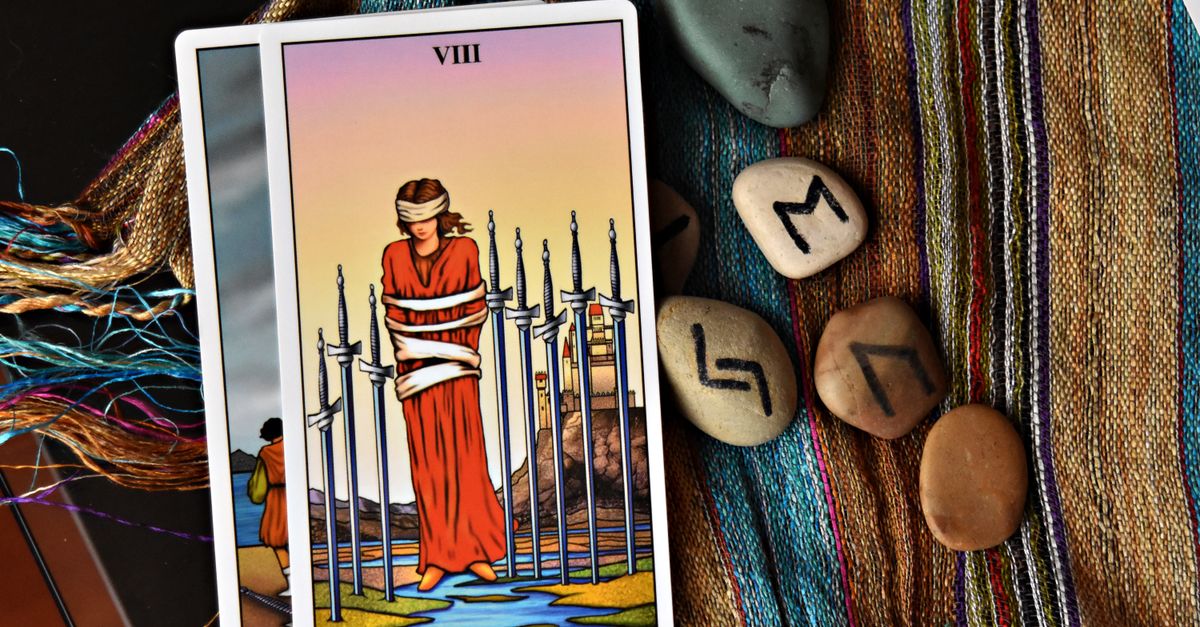
A rune reading pulls a small handful of symbols — usually one to six — from the 24-character Elder Futhark, the oldest attested runic alphabet of northern Europe, and treats each symbol's reconstructed literal word-image as a prompt for self-reflection. A tarot reading pulls cards from a separate 78-card deck split into a 22-card Major Arcana and a 56-card Minor Arcana, and uses illustrated scenes paired with positional spreads such as a three-card Past/Present/Future layout or a ten-card Celtic Cross. The two systems share the role of symbolic self-reflection tools, but they diverge on symbol size, draw convention, spread structure, and prompt tone. Rune draws typically work with a tight catalogue and short readings; tarot draws typically lay down larger spreads with assigned positional meanings and richer imagery. Lizely's Rune Reading tool draws three unique entries without replacement from the shared 24-entry Elder Futhark catalogue, runs a local Fisher-Yates shuffle with Web Crypto entropy, and assigns the chosen entries to Notice, Question, and Small step — three Lizely-authored reflection prompts kept clearly separate from the historical identity fields.
Where Rune and Tarot Readings Diverge
The single most useful point of comparison is the catalogue itself. Rune draws pull from a 24-entry catalogue organized into three groups of eight, known as three aettir; tarot draws pull from 78 illustrated cards organized into two arcana with four suits. The size difference matters because it sets the typical reading scale: with 24 symbols, a rune draw can plausibly work with one to six entries without repetition, while with 78 cards a tarot spread can sit comfortably at three, five, or ten cards because no suit or number duplicates within a single spread. The visual contrast matters too: rune identities on screen appear as a single character, a Unicode name, a transliteration, and a reconstructed literal gloss. Tarot identities appear as a card name, a suit or arcana label, and — in many decks — a numbered position within its suit. Both feeds can be replayed locally in a browser, but the rune reference object that backs the reading is the same source-checked 24-entry table already used by Lizely's Rune Meanings reference catalogue, so any correction to a historical identity has one maintained home rather than two drifting copies.
Comparing the Symbol Sets Side by Side
The two systems start from different cultural sources, different sizes, and different ways of labeling entries.
| Dimension | Rune Reading (Elder Futhark) | Tarot Reading (Rider–Waite–Smith) |
|---|---|---|
| Catalogue size | 24 entries in three groups of eight | 78 cards in two arcana (22 Major, 56 Minor) |
| Earliest full attestation | Northern European inscriptions, roughly 2nd to 8th century CE | 15th-century Italian card games, with esoteric layers added in the 19th and 20th centuries |
| Visual identifier | A single Unicode character and its reconstructed literal word-image | A full illustrated scene, named card, and suit or arcana |
| Typical draw size in reflection practice | One to six symbols, often without replacement | Three, five, or ten cards with assigned positional meanings |
| Documented randomness source | Web Crypto 32-bit words feeding a Fisher-Yates shuffle | Reproducible seed for an upright three-card draw |
| Reconstructed or sourced fields | Names, sounds, and glosses explicitly labeled as reconstructions | Major Arcana names and Minor Arcana correspondences from a named deck tradition |
| What it explicitly does not add | No reversed positions, no blank rune, no predictive claims | No reversal layers in the upright draw, no question submission, no prediction |
The asymmetry is informative: the Elder Futhark is older as a writing system, but the standard rune-reading spreads people use today are mostly modern constructions; the tarot's visual iconography is mostly 19th- and 20th-century, even though the cards themselves are older. Both tools treat their catalogue as a historical reference object and their draw rules as a modern, entertainment-only layer — a separation that matters for accuracy because it lets the catalogue be corrected in one place without rewriting the interaction.
Spread Style and Prompt Tone
A rune cast traditionally answers a single question with a single rune, while modern rune sets often pull three runes for past/present/future or a similar short sequence. A tarot reading, by contrast, is rarely reduced to one card: even the simplest three-card spread assigns positional meaning to each card, and a Celtic Cross pulls ten. The prompt that each system presents to the reader also differs in tone. A rune prompt is usually short and word-image-based — for example, asking the visitor what detail of the literal meaning draws their attention, what open question it helps them phrase, or what small step it suggests. A tarot prompt is usually longer and scene-based, asking the visitor to read an illustrated tableau through the lens of a position such as "what is passing" or "what is approaching." The Rune Reading tool formalizes this shorter tone by assigning the three drawn entries to Notice, Question, and Small step — three reflection labels that deliberately avoid predictions, decisions, or diagnoses and do not pretend to recreate one ancient casting practice. If you want the longer scene-based prompt tone, Lizely's Tarot Card Reading tool lays down a reproducible upright three-card draw with Past, Present, and Future labels that you can reveal one at a time.
How to Run a Three-Rune Reflection in Your Browser
The Rune Reading tool runs entirely on the page, draws three unique runes, and produces three reflection prompts in order. To use it for self-reflection:
- Open the Rune Reading page and confirm the page has fully loaded before drawing — the tool remains useful offline after its assets load.
- Choose "Draw three runes" to start a local, no-replacement shuffle of the shared 24-entry Elder Futhark catalogue.
- Read the three cards in order: the first card is the Notice prompt, the second is the Question prompt, and the third is the Small step prompt. Each card shows its historical identity fields first and then the reflection prompt.
- Read each rune's source-checked identity alongside its reconstructed literal gloss, keeping any uncertainty note attached to that historical field visible — for example, where the catalogue records that a name or sound is disputed, that dispute remains visible on the card.
- Use the Notice, Question, and Small step labels only as Lizely-authored reflection prompts. Notice asks what detail the historical word-image brings to attention; Question asks what open question the word-image helps you phrase; Small step asks what small, reversible possibility comes to mind.
- Draw again whenever you want a new independent arrangement. Each draw runs a fresh Fisher-Yates shuffle of the 24 shared entries using 23 unsigned 32-bit values from Web Crypto; the browser reports an error rather than fall back to a weaker randomness source.
- Close or refresh the page when you are done — the result is not stored locally, uploaded, or tied to an account, and no part of the draw is sent to an outside service.
The three labels are not positional meanings in the tarot sense: they do not describe time, parties, or outcome categories. They are three different ways of asking a single rune's reconstructed literal gloss to function as a metaphorical word-image for self-reflection.
How the Tool Keeps Reflection Separate from Prediction
The Rune Reading tool draws a clear boundary between two kinds of information. The first kind is the historical identity table: each rune's character, Unicode code point, common reconstructed name, transliteration, position in the conventional three-group catalogue, and reconstructed literal gloss. Those fields come from the same source-checked 24-entry table already used by Lizely's Rune Meanings reference tool. The second kind is the entertainment interaction: the order of the draw, the three card positions, and every reflection question, which are explicitly modern Lizely-authored product rules. That separation matters because it lets a correction to a historical identity happen in one place without rewriting the entertainment layer, and it lets the entertainment layer evolve without rewriting the historical data.
The tool uses the existing catalogue object directly, and the implementation requires object identity rather than merely checking that two independently typed lists happen to match — a safeguard against duplicate reference tables drifting apart. Eight literal anchors independently lock representative points across the shared catalogue: Fehu, Thurisaz, Wunjo, Hagalaz, Pertho, Algiz, Tiwaz, and Othala or Othalan. Tests verify the character, Unicode code point, common name, transliteration, aett, and position for each anchor, and further invariants require exactly 24 entries, three groups of eight, unique characters and code points, and positions one through eight in every group.
Where the catalogue says a name, sound, or gloss is disputed, that uncertainty remains visible on the card. The Elder Futhark is a historical writing system, not a single documented universal fortune-telling manual, so the tool does not add a blank rune, does not rotate cards into reversed positions, and does not claim that its three labels are ancient. It does not predict the future, discover hidden facts, read another person's mind, establish supernatural causes, or provide medical, mental-health, legal, financial, safety, relationship, employment, or crisis guidance — a boundary the page keeps visible so the reflection prompts remain prompts and not advice.
Choosing the Right System for Your Practice
The practical question behind the search "rune reading vs tarot reading" usually comes down to a few concrete tradeoffs:
- Catalogue familiarity. If you already know the names and word-images of the Elder Futhark symbols, a rune draw gives you a tightly bounded set you can read without constant reference. If you work better with illustrated scenes and named archetypes, tarot gives you a denser vocabulary per card.
- Draw length. If you want a single quick prompt, one rune is enough; if you want a multi-position layout, tarot's named spreads map cleanly to that need.
- Prompt tone. Rune prompts are usually shorter and word-image-based. Tarot prompts are usually scene-based and benefit from more space on the page.
- Tools available. The Rune Reading tool is the simplest entry point if you want to compare the two systems without installing anything — it pulls three unique entries from the shared catalogue and presents the resulting reflection prompts in your browser. The Tarot Card Reading tool is the equivalent on the tarot side, with a reproducible upright three-card draw and Past, Present, Future labels.
A reasonable starting routine is to run one rune draw at the start of a reflection session for a short word-image prompt, and to use tarot when you want a longer, positionally structured layout. Both systems sit inside the same entertainment-and-self-reflection category, and neither one will tell you what to do — a boundary that is the most useful shared trait between them.
If you're weighing options, How to Compare Tarot Birth Card Calculator Approaches covers this in detail.
If you're weighing options, Choosing the Right Approach to Use Tarot Card Meanings covers this in detail.