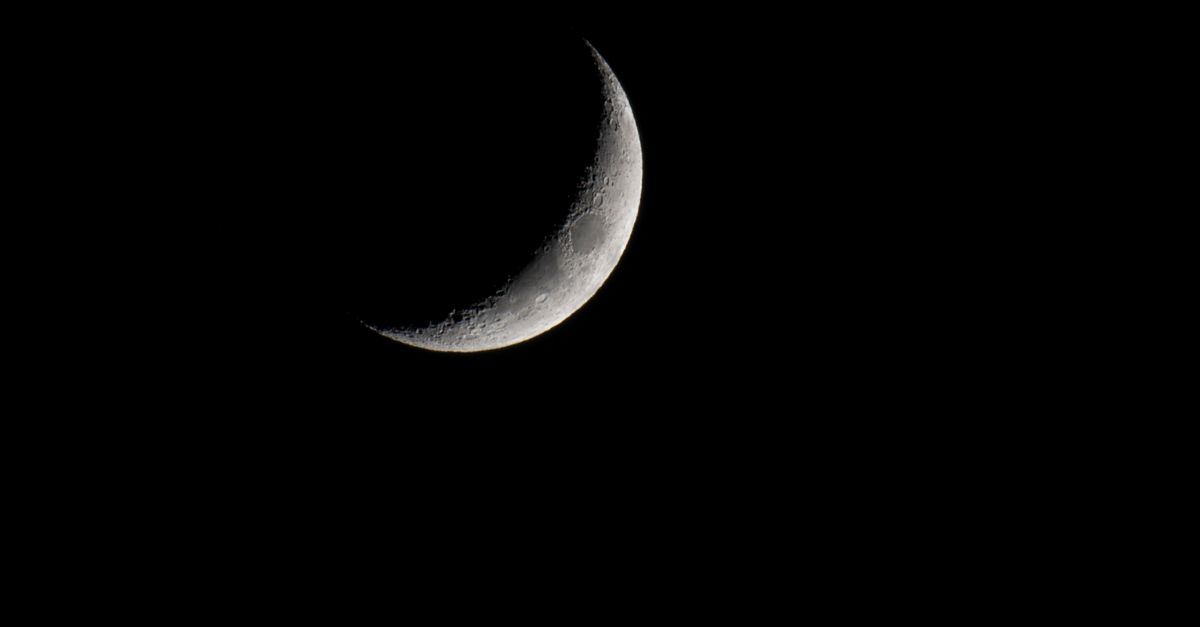
Moon age is the count of elapsed days and fractions of a day since the most recent New Moon, measured from the exact instant the geocentric phase angle reaches 0°. At that precise moment the age resets to 0.0 and begins climbing by roughly 1.0 each day along the ~29.53-day synodic cycle, passing about 7.38 days at First Quarter, ~14.77 days at Full Moon, and ~22.15 days at Last Quarter before returning to 0.0 at the next New Moon. In practical terms, the moon age is a quick shorthand for where the Moon sits in its visible cycle: a small age means a thin or absent crescent in the western evening sky, an age near seven days puts the half-lit First Quarter high in the sky at sunset, and an age near fifteen days brings the fully lit disk overhead at midnight. Because the synodic month does not divide evenly into calendar months, the moon age for a given calendar date shifts by roughly two days from one month to the next and resets every ~29.53 days.
What "Moon Age" Actually Measures
Astronomical moon age is the elapsed time, expressed in days and fractions of a day, since the most recent New Moon. The National Astronomical Observatory of Japan defines 月齢 (moon age) as the count starting at 0.0 at the instant of new moon and growing by 1.0 per day until the next new moon, where it returns to 0.0. The English-language astronomical convention uses the same definition, so a moon age of 12.4 means the Moon is 12.4 days past the previous New Moon and roughly 17.1 days from the next one.
Moon age is a single number that compresses the geometry of the Sun-Moon-Earth system into a position-in-cycle reading. It does not, by itself, describe how the Moon looks from a given location: a moon age of 14.7 corresponds to a Full Moon, which every observer on Earth sees as a fully lit disk, while a moon age of 0.3 is a near-invisible New Moon that can only be detected by its gravitational or geometric effect. So when a search asks for "moon age today meaning," the meaning is: how many days into the current lunar cycle the Moon sits right now.
How Moon Age Relates to Phase Angle and Illumination
Two other quantities travel with moon age and together fully describe what the Moon is doing geometrically. The phase angle is the geocentric ecliptic longitude difference between the Moon and the Sun, measured from 0° to 360°. The illuminated fraction is the share of the Moon's Earth-facing disk reflecting sunlight toward Earth, ranging from 0% at New Moon to 100% at Full Moon and back.
The two move together because the synodic month is the time for the Moon-Sun angle to grow by 360°. With a synodic month of about 29.53 days, the average angular speed is 360° ÷ 29.53 ≈ 12.19° per day of age. So an age of one day corresponds to roughly 12.19° of phase angle, an age of seven days to ~85.3°, and an age of 14.77 days to ~180° (Full Moon). The phase angle can be measured more precisely than moon age at any given instant, which is why astronomy engines report the angle first and let you derive age from it.
The Moon Phase Today widget reports the geocentric phase angle as the primary number, the illuminated fraction as a percentage, and the convenient eight-stage label as a quick reading. The widget does not directly print moon age in days, but the angle and illumination are sufficient to position the Moon in its current cycle.
Reading Today's Moon Age with Moon Phase Today
- Open Moon Phase Today in your browser. The page is self-contained and does not need to ask for permission to run.
- Wait for the local calculation to render. You will see an eight-stage label, a phase angle in degrees, an illuminated fraction as a percentage, and the surrounding primary-phase events.
- Read the calculation timestamp and the browser-resolved time zone printed next to the result. The timestamp confirms the exact browser instant used.
- Look up the displayed phase angle in the disclosed angle-band table further down the page to confirm which band the label came from. This is also how to translate the angle into an approximate moon age.
- Note the surrounding primary-phase events. These are the calculated instants of the nearest New Moon, First Quarter, Full Moon, and Last Quarter, and they bracket where today's instant sits inside the current lunation.
- Click Recalculate any time you want a fresh browser instant. The widget also auto-refreshes once per minute while it remains mounted, so the displayed age tracks the current minute.
- For an exact age conversion in days, divide the displayed angle by 12.19. The result is an approximate moon age in days, accurate to a fraction of a day for any instant inside the 1700–2100 public boundary.
The Eight-Stage Label Versus the Exact Primary Phases
The eight-stage label is a Lizely convention created by dividing the angle circle at half-way points between the four primary angles. The bands are fully disclosed rather than hidden, and they cover the entire 0°–360° circle with a small wrap at 360°. The following table lists each band and its angle range.
| Display Label | Angle Range |
|---|---|
| New Moon | 337.5°–360° and 0°–22.5° |
| Waxing Crescent | 22.5°–67.5° |
| First Quarter | 67.5°–112.5° |
| Waxing Gibbous | 112.5°–157.5° |
| Full Moon | 157.5°–202.5° |
| Waning Gibbous | 202.5°–247.5° |
| Last Quarter | 247.5°–292.5° |
| Waning Crescent | 292.5°–337.5° |
Lower bounds are included and upper bounds are excluded, except that the angle wraps cleanly at 360°. The four primary events are single instants at 0°, 90°, 180°, and 270° and are not multi-day labels. The eight-stage label is convenient for everyday reading; the angle is the precise number. The relationship to age is qualitative, with the New Moon band straddling day 0, the First Quarter band near day 7, the Full Moon band near day 15, and the Last Quarter band near day 22.
For more on how the label can change at midnight, see Why the Moon Phase Label Can Change After Midnight.
From Angle to Approximate Age: One Worked Step
The widget publishes the angle, and you can convert that to a moon age estimate using the average synodic rate.
age_in_days ≈ phase_angle_degrees ÷ 12.19
If the displayed phase angle is 122.3°, the calculation is 122.3 ÷ 12.19 ≈ 10.03 days, which sits in the Waxing Gibbous band (112.5°–157.5°) and represents roughly 10 days into the current lunar cycle. The small fractional uncertainty is consistent with the synodic month not being exactly 29.53 days in every lunation, and with the widget's stated educational precision.
Accuracy, Limits, and What This Calculator Does Not Cover
The widget pins astronomy-engine 2.1.19 and runs the calculation locally inside the tool island. The package is MIT licensed, has no runtime dependencies, is shipped with the application rather than loaded from a CDN, and is loaded only when this widget is requested. Twelve minute-resolution primary-phase timestamps were frozen from the official USNO Astronomical Applications API, and the engine is required to match each one. The page intentionally does not call USNO at runtime and never requests location.
The accepted accuracy bound is two minutes against the frozen USNO timestamps, with the input and output boundary set at years 1700 through 2100 because that is the range covered by the USNO service used for the independent comparison. The current-time interface normally sits well inside that boundary. Results are treated as educational astronomical estimates. The page does not claim second-level precision, observational-apparent timing for a particular site, professional ephemeris status, or suitability for navigation, photography safety, tides, religious observance, or other time-critical decisions.
Moonrise, moonset, atmospheric visibility, local horizon, and weather are different questions and require location-specific data the widget intentionally does not collect. Geocentric phase does not depend on the viewer's city, which is why the widget does not need GPS, a city, or an account. For more on what the result is useful for, see What Is the Current Moon Phase Useful For: A Direct Answer. The independent reference used during engineering is the public USNO Phases of the Moon service, which is never called when the widget is opened.