The Elder Futhark is a 24-character Germanic runic alphabet in use across northern Europe from roughly 150 to 800 CE, making it the oldest documented runic system and the parent of every later futhark and stave script. Its earliest surviving inscriptions appear on metal and bone artefacts from the second century, and by the seventh century its letters had spread from the Black Sea to Scandinavia. The script is divided into three groups of eight characters called aettir, each named in later tradition after a deity. Because no single surviving manual lays out fixed meanings for the runes, modern listings of rune names, sounds, and literal glosses are scholarly reconstructions drawn from comparative philology, from later runic traditions, and from a handful of medieval manuscripts that mention the names. That distinction between historically attested letterforms and reconstructed literal meanings sits at the core of any careful treatment of Elder Futhark rune history, and it shapes what a modern self-reflection tool built on this alphabet can honestly show.
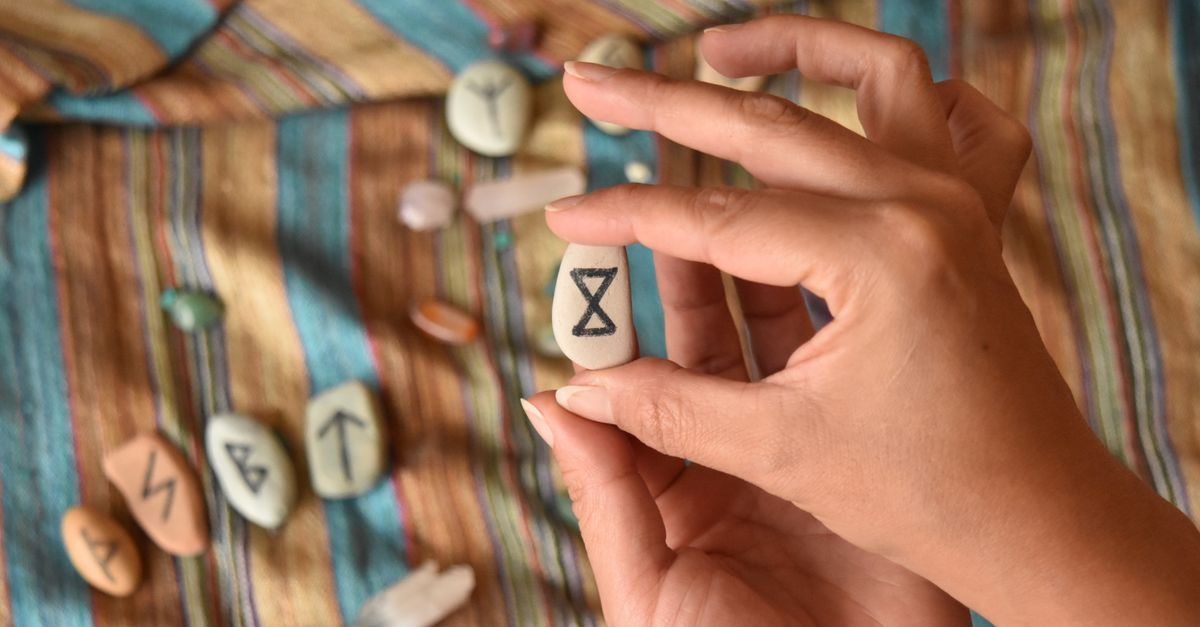
From the Second Century to the Eighth
The oldest secure Elder Futhark inscriptions cluster around the second century CE, including the Vimose finds from Denmark and early Migration Period specimens from what is now northern Germany and Poland. Material finds from the first century remain debated, but the body of accepted second-century specimens is large enough to anchor the conventional date range cited by every modern reference. By the fifth century, the 24-character alphabet was used across a wide arc, from the Carpathian basin to the North Sea coast, and a parallel tradition carried related forms into Anglo-Saxon England.
From the seventh century onward the script began fragmenting: Scandinavian inscriptions gradually shifted to the 16-character Younger Futhark, while Continental and Anglo-Saxon users adopted extended or reformed sets. The 24-character form therefore covers roughly six centuries as a working writing system, longer if its proto-runic precursors are counted. Educational museum material such as the Penn State reference on runic alphabets and the Viking Ship Museum's introduction to Viking Age runes both treat this six-century window as the canonical lifespan of the Elder Futhark proper.
The Three Aettir and Their Place in the Alphabet
Every standard reference treats the Elder Futhark as three groups of eight characters, and the divisions mattered historically: the proto-Norse word fuþark itself names the first six characters in order (ᚠ ᚢ ᚦ ᚨ ᚱ ᚲ), which is why the alphabet's three groups share so little internal logic by modern reading. The convention of three aettir continues to organize teaching charts and modern reference tables, including the source-checked 24-entry catalogue used by Lizely's rune tools. Each tool entry carries the rune character, its Unicode code point, its reconstructed name, its transliteration, the aett it belongs to, and any uncertainty note attached to that historical field.
The following eight rows show anchor points inside that catalogue, drawn from the literal anchors the tools verify for stability. Each anchor opens, anchors, or closes one of the three aettir, and the same fields are present for the remaining sixteen entries in the shared table:
| Rune | Code point | Common name | Transliteration | Aett |
|---|---|---|---|---|
| ᚠ | U+16A0 | Fehu | f | First |
| ᚦ | U+16A6 | Thurisaz | þ | First |
| ᚹ | U+16B9 | Wunjo | w | First |
| ᚺ | U+16BA | Hagalaz | h | Second |
| ᛈ | U+16C8 | Perthro | p | Second |
| ᛉ | U+16C9 | Algiz | z | Second |
| ᛏ | U+16CF | Tiwaz | t | Third |
| ᛟ | U+16DF | Othala (also Othalan) | o | Third |
Where a name, sound, or gloss is disputed across published sources, the catalogue keeps that uncertainty visible rather than silently smoothing it over. Variants such as Othala and Othalan attached to the same character are one example: they record two attested name forms rather than two separate entries.
Why Names and Glosses Are Reconstructions
A common assumption is that each Elder Futhark rune arrived already paired with a fixed symbolic meaning, but the surviving record does not support that. The rune names that modern charts display are academic reconstructions, pieced together from later runic alphabets, from Old English and Old High German glossaries, from the Norwegian and Icelandic rune poems, and from comparative work on early Germanic languages. The literal glosses attached to those names (Fehu associated with cattle or movable wealth, Othala with inherited land) are derived from the names rather than read directly from contemporary inscriptions. A typical rune inscription from the fourth or fifth century records a word, a personal name, a maker's mark, or a memorial formula; it does not record the meaning of the rune itself.
That is why authoritative sources flag reconstructed forms as reconstructions rather than transcriptions. The shared reference catalogue preserves any disagreement, so a visitor who sees Othala or Othalan on a card is not seeing two competing entries but two attested name forms attached to the same Elder Futhark entry. Looking up a rune by its Unicode name, code point, transliteration, or reconstructed gloss keeps all of these layers visible on a single page rather than collapsing them into a single confident caption.
One Historical Table, Two Modern Uses
Modern Elder Futhark resources fall into two broad families. Reference tools let a visitor look up each character by Unicode name, code point, transliteration, or reconstructed gloss. Entertainment tools randomly draw a small number of runes for personal reflection. Lizely maintains only one source-checked 24-entry reference table, not two duplicate copies, and both the lookup and the draw import the same catalogue object directly. The reference page lists every entry with its historical identity fields and any uncertainty note; the draw page samples three entries from that table without replacement and attaches three modern reflection prompts to them.
Because the historical data lives in a single maintained location, a correction to a reconstructed gloss only needs to be made once for both tools to use the corrected version. For visitors who want to look up every character before drawing, the complete Elder Futhark reference catalogue is the place to start, since it exposes the same catalogue object the draw tool samples from.
Running a Three-Rune Draw
The Rune Reading tool creates a local, ephemeral three-rune arrangement from that same 24-entry table. Working through a session looks like this:
- Open the Rune Reading page in any modern desktop or mobile browser.
- Click the Draw three runes control to trigger a local no-replacement shuffle of the shared 24-entry catalogue.
- Read each card's source-checked identity, its reconstructed literal gloss, and any uncertainty note attached to that historical field.
- Use the Notice, Question, and Small step prompts only as Lizely-authored reflection starting points, not as instructions.
- Click Draw three runes again whenever a fresh arrangement is wanted; closing or refreshing the page discards the cards.
The shuffle runs entirely in the browser: 23 unsigned 32-bit words from the Web Crypto API feed a full Fisher-Yates shuffle of the 24 entries, and the first three shuffled entries are assigned to Notice, Question, and Small step. Because the selection is made without replacement, one rune cannot appear twice in the same reading. If secure browser randomness is unavailable, the tool reports an error rather than falling back to a weaker source.
What the Reading Does Not Provide
The draw is built as an entertainment and self-reflection activity, not as a divination engine. It does not predict an event, tell a visitor what decision to make, diagnose anything, read another person's mind, or stand in for medical, mental-health, legal, financial, safety, relationship, employment, or crisis guidance. It does not add a blank rune, does not rotate cards into reversed positions, and does not claim that its three labels (Notice, Question, Small step) are ancient.
Modern rune-reading systems vary widely in layout, symbolic associations, blank-rune use, reversal rules, and interpretive language, and this tool deliberately narrows its claims so that the historical data (the character, its code point, its reconstructed name and gloss) is clearly separated from the entertainment rules (the random draw and the three prompts). For visitors studying Elder Futhark rune history, the result is a way to sit with three historical word-images for a few minutes without the experience drifting into predictive framing, and a fresh arrangement is always one click away.