The eight birth Moon phases are eight equal 45-degree display bands derived from the Moon’s geocentric ecliptic-longitude difference from the Sun.
In order, they are New Moon, Waxing Crescent, First Quarter, Waxing Gibbous, Full Moon, Waning Gibbous, Last Quarter, and Waning Crescent. A birth-phase label therefore describes the Moon’s position in its cycle at a particular instant, rather than a calendar date by itself.
A crucial distinction runs through the explanation: astronomy recognizes four primary phase events, while the eight familiar labels divide the space between them into more readable stages. A reliable result can show both systems, together with the illumination and nearby events needed to interpret the birth instant.
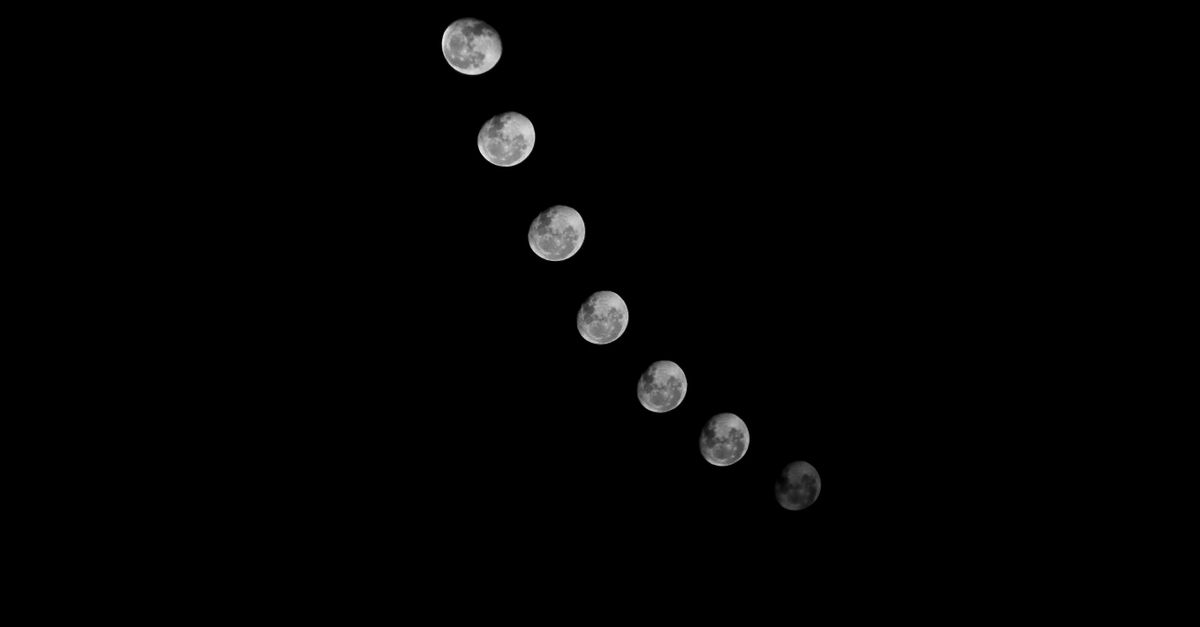
The eight stages from new Moon to new Moon
“Waxing” describes the part of the cycle when the illuminated portion seen from Earth is increasing; “waning” describes the part when it is decreasing. The phase angle and illumination change continuously, so a broad stage label should not be treated as one fixed percentage of light.
| Display stage | Moon-minus-Sun angle band | Astronomical position | Common symbolic theme |
|---|---|---|---|
| New Moon | 337.5°–22.5°, wrapping through 0° | The illuminated fraction is near its minimum and begins growing again. | Beginnings, reset, and intention |
| Waxing Crescent | 22.5°–67.5° | The angle moves toward the First Quarter event as illumination grows. | Curiosity, first steps, and initiative |
| First Quarter | 67.5°–112.5° | The band is centered on the 90° primary event, with illumination increasing. | Decisions, action, and working through tension |
| Waxing Gibbous | 112.5°–157.5° | The angle moves toward opposition while the illuminated portion continues to grow. | Refinement, preparation, and near completion |
| Full Moon | 157.5°–202.5° | The band is centered on the 180° opposition event and maximum illumination. | Culmination, visibility, and heightened awareness |
| Waning Gibbous | 202.5°–247.5° | The angle moves beyond opposition while the illuminated portion declines. | Sharing, review, and integration |
| Last Quarter | 247.5°–292.5° | The band is centered on the 270° primary event, with illumination decreasing. | Reassessment, release, and reorientation |
| Waning Crescent | 292.5°–337.5° | The angle approaches the next New Moon and illumination falls toward its minimum. | Rest, closure, and renewal |
The symbolic themes in the final column are interpretive language commonly used in astrology and self-reflection. They are not conclusions established by astronomy, and they should not be presented as proven personality, compatibility, luck, or destiny traits. The Birthday Moon Phase Calculator reports astronomical facts; it deliberately does not turn a phase into life advice.
Why four primary events anchor the eight labels
The USNO Dates of Primary Phases reference identifies four instantaneous lunar events. The geocentric angle here is the difference between the Moon’s and Sun’s ecliptic longitudes, reduced to a position from 0° through 360°.
| Primary event | Exact phase angle | Geocentric relationship |
|---|---|---|
| New Moon | 0° | The Moon and Sun have the same ecliptic longitude. |
| First Quarter | 90° | Their ecliptic longitudes are separated by one quarter of the cycle. |
| Full Moon | 180° | Their ecliptic longitudes are opposite. |
| Last Quarter | 270° | The cycle has moved through three quarters to the other quarter separation. |
Lizely places the eight display boundaries halfway between those primary angles. That creates the disclosed 45-degree bands, including the New Moon band that wraps across 0°. These eight equal-width names are a Lizely display convention, not official USNO or NASA classifications.
This distinction prevents a common category error: a birth labeled “First Quarter” may be anywhere inside the 67.5°–112.5° display band, not necessarily at the exact 90° event. The nearby primary events help distinguish the broad label from the precise angular position.
Calculate your birth Moon phase
The following workflow preserves the birth date, local clock time, and offset so that the resulting instant can be checked rather than guessed.
- Collect the civil birth details. Find the local birth date, the recorded clock time, and the documented UTC or UTC-equivalent offset that applied at that place and moment. Use a reliable historical source for the offset; a browser’s current time zone may not reflect historical daylight-saving or political changes.
- Open the Birthday Moon Phase Calculator and enter the date, clock time, and signed offset. These are the required inputs for an exact-mode instant estimate.
- Run the calculation and check the time conversion. The entered local time is normalized to one auditable proleptic UTC-like instant. The result keeps both the entered local time and the normalized calculation time visible. Invalid dates, clocks, or offsets, and normalized instants outside 1700 through 2100, are rejected before the astronomy calculation runs.
- Use approximation mode only when the birth time is genuinely unknown. The tool deliberately calculates local noon, compares the start and end of the local day, and labels the result “Phase-boundary approximation.” If the broad labels at those endpoints differ, it shows both possibilities instead of presenting noon as definitive.
- Read the complete result together. Review the normalized instant, phase angle, illuminated fraction, eight-stage display band, and nearby primary events. The illumination is the fraction of the Moon’s apparent disk that is lit as viewed from Earth, while the nearby events show whether the birth moment sits close to a primary phase.
Reading exact and unknown-time results
Exact mode
Exact mode is appropriate when the date, clock time, and offset all describe the same documented birth moment. The calculator uses deterministic civil-time arithmetic to resolve those fields into one normalized instant instead of interpreting an ambiguous free-form date string. That makes the conversion auditable: a reader can compare the original local fields with the normalized calculation time.
Even in exact mode, the phase angle is an astronomical estimate rather than second-level or professional-observatory precision. The illuminated fraction and phase angle should therefore be read together with the stage and nearby events, not as independent proof that the birth occurred at a perfectly clean stage center.
Unknown-time mode
An unknown birth time can occasionally cross a display boundary during the same local day. For that reason, the approximation is more than a simple noon substitution. It checks the local day’s endpoints and searches for a New Moon, First Quarter, Full Moon, or Last Quarter event occurring within that day. If one does, the result explains that the unknown birth time may have fallen before or after the event.
When the broad endpoint labels differ, both possibilities remain visible. This prevents a noon result from being mistaken for a recorded fact. Even when the day appears to stay within one broad stage, the result remains explicitly an approximation because the actual clock time could still sit near an edge.
Time-zone and historical-date cautions
A local clock reading is not a unique instant until its offset is known. Entering the offset explicitly prevents the calculator from assuming that today’s time-zone rules also applied at the birth. Historical daylight-saving changes, political adjustments, and other local conventions can all make that distinction important.
Early dates require an additional qualification. Before standard time zones, local mean time may not correspond reliably to a modern documented offset. In that case, the result is described as a proleptic UTC-like estimate, and the convention entered by the user remains visible. The offset is a conversion instruction, not proof that modern UTC or a standard civil time zone existed on that date.
No birthplace is required because this is a geocentric calculation: it describes the Moon’s phase as viewed from Earth’s center, not above one particular horizon. It does not calculate moonrise, local visibility, weather, or the appearance of the Moon from a specific place.
What the result can and cannot establish
The product’s accuracy is tested rather than simply asserted. Its pinned Astronomy Engine 2.1.19 implementation is checked against twelve literal, minute-resolution USNO events covering all four primary phases, a leap year, year rollovers, and the 1700 and 2100 limits. The implementation must find every test event within two minutes of its USNO fixture. USNO and NASA are not called when a visitor uses the calculator.
The calculation runs locally through the pinned astronomy package behind a narrow Lizely adapter. Birth input is not uploaded, stored, or sent to USNO, NASA, a content delivery network, or a paid service. Once the page assets have loaded, the calculation can work without a network connection.
The output is still an astronomical estimate. It is not suitable for navigation, safety, tides, religious observance, local visibility, or other time-critical decisions, and it does not claim second-level precision. Its appropriate uses are educational exploration of the birth instant, understanding the eight-stage display, and reviewing the result’s boundaries and uncertainties—not deriving personality, compatibility, fate, or guaranteed life outcomes.
If you're weighing options, Today Moon Illumination Percentage: A Live Guide covers this in detail.
If you're weighing options, How Do I Use a Personal Month Number: A Clear Routine covers this in detail.