The Chinese Lucky Numbers tool counts how often the digits 8, 9, and 4 appear in any wedding date, registration number, address, or other digit string, and shows the 1-based position of each occurrence, without producing a luck score or a prediction about the marriage. Couples planning a wedding in the Chinese custom often talk about which dates carry the right sound associations, which phone numbers feel right to share, and which price digits to request from a venue. This page focuses on one narrow, verifiable step in that process: literally counting the three culturally discussed digits in a number string a couple might be weighing, while making clear that the count is only a count. The tool does not rank candidates, advise a payment, or imply that one date will produce a better marriage than another. It records how many 8s, 9s, and 4s are present and where each one sits in the retained digit sequence, then leaves the decision to the people involved.
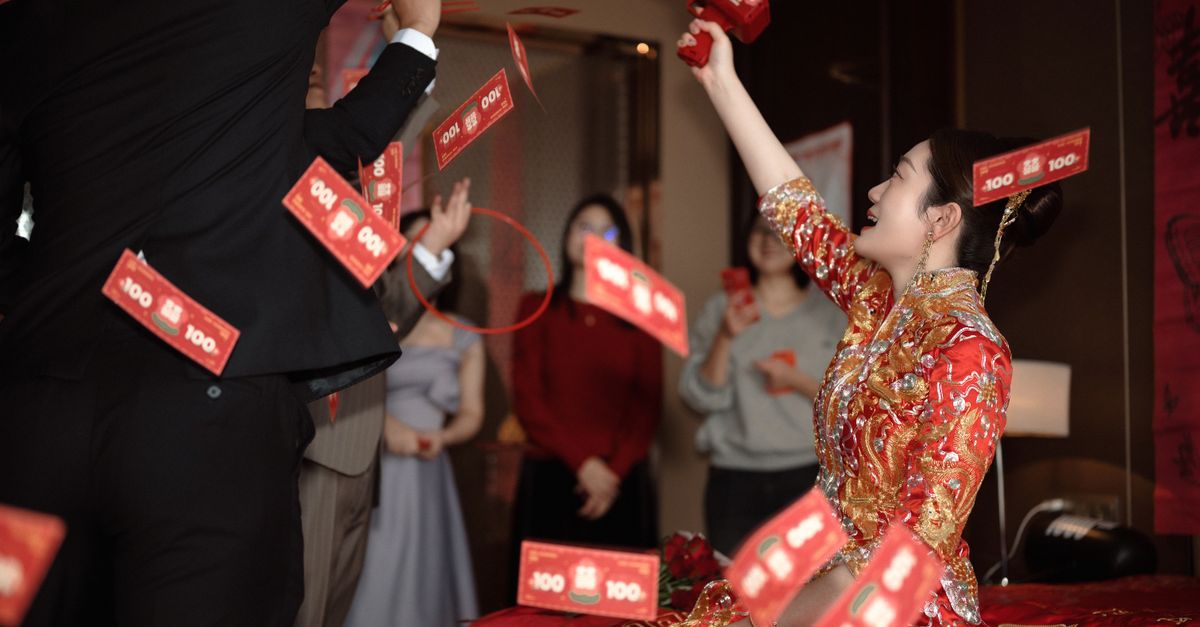
Why 8, 9, and 4 come up in Chinese marriage customs
Chinese number customs are language-based. They grow out of sound resemblances between Mandarin syllables and other words that carry emotional weight. Three of those resemblances are reported often enough to count as common reference points for weddings, anniversaries, and family milestones.
Digit 8 is associated with prosperity or becoming wealthy because the Mandarin pronunciation bā is reported as resembling syllables used in words linked to getting rich. Brides and grooms who follow the custom sometimes prefer dates, addresses, or registration numbers that include 8, on the understanding that the sound resemblance carries a positive tone. The strength of the association varies by region and dialect, which is why the reference card for 8 uses cautious wording rather than a universal claim of good luck.
Digit 9 is associated with longevity or something long-lasting through the jiǔ sound relationship, where jiǔ also means "long" in words such as jiǔyuǎn (far-reaching or forever). Because marriage is understood as a long partnership, the 9 association is often mentioned alongside 8 in wedding-related discussions, where a long union is the emotional reference point rather than a literal lifespan claim. Cultural sources such as the Shaanxi government overview of the Double Ninth Festival and longevity describe the same jiǔ sound connection in everyday cultural writing.
Digit 4 is often avoided because sì can sound similar to sǐ, the word for death. Couples who observe the custom sometimes screen candidate dates, addresses, or shared numbers for the presence of 4 before committing. The strength of these customs varies by language, dialect, region, community, generation, and personal practice, and many people treat them as light reference rather than firm rules.
These three associations are documented in everyday cultural references such as the Carnegie Mellon overview of Chinese number culture and in research writing such as the Malaysian Management Journal article on number beliefs and pronunciation, which describe the same sound-based patterns without claiming that any digit is universally lucky or unlucky.
What the Chinese Lucky Numbers tool actually counts
The Chinese Lucky Numbers tool is a narrow cultural reference and string analyzer. It explains three widely reported associations — 8 with prosperity, 9 with longevity, and 4 with death — and then counts how often those three digits appear in a string the user enters. Every other digit is grouped as neutral or unclassified within the tool, because the page deliberately limits its scope to the three source-backed claims instead of presenting a partial reference as if it were complete cultural authority.
| Digit | Reported Mandarin sound association | How the tool frames it |
|---|---|---|
| 8 | bā resembles syllables tied to becoming prosperous | Associated with wealth or prosperity |
| 9 | jiǔ resembles words for long-lasting | Associated with longevity |
| 4 | sì resembles sǐ (death) | Commonly avoided |
| 0, 1, 2, 3, 5, 6, 7 | Not within the three-source-backed scope | Neutral or unclassified by this tool |
The tool records literal occurrences of 8, 9, and 4 only. It does not rank phone numbers, addresses, prices, plates, dates, or business names. It does not produce a luck score, recommend a decision, predict an outcome, or state that any count of digits will influence a marriage, a relationship, a health outcome, or a lifespan. Each count it returns is a count, not an endorsement. The framing matters because the same three-digit count in a wedding date and the same count in a price quote carry different emotional weight for different people, and the tool deliberately stays out of that interpretation.
How to inspect 8, 9, and 4 in a marriage-related number
- Review the three source-bounded reference cards that the page displays before the analyzer. They use cautious wording such as associated and commonly avoided rather than declaring that any digit is universally lucky or unlucky, and they remind you that practice varies by language, region, and personal habit.
- Enter up to 64 Unicode characters into the field, including the candidate string you want to inspect — for example a wedding date in YYYYMMDD form, a registration number, a price, an apartment number, or a shared phone number. Surrounding text and separators are allowed.
- Choose Analyze digits. Fullwidth digits 0 through 9 are normalized to ordinary ASCII digits, every non-digit character is dropped, and the tool then counts 8, 9, and 4 in the retained digit sequence and shows their 1-based positions.
- Read the result cards for counts and positions only. Treat any count as a count, not as a score. Two 8s simply means two 8s were present in the retained sequence at the positions listed.
- Select Clear to remove the local input and result before entering the next candidate string. Nothing is stored between sessions, and the next run starts from an empty field.
Worked example: counting 8, 9, and 4 in a candidate wedding date
Consider the wedding date August 8, 2024, written in compact form as 20240808. A couple who follows the custom often wants to know whether 8s, 9s, or 4s sit in that digit sequence before locking the date in.
Step 1. Retain digits only. The string 20240808 contains only ASCII digits, so normalization leaves it unchanged: 2, 0, 2, 4, 0, 8, 0, 8.
Step 2. Assign 1-based positions in the retained sequence. Position 1 is the first 2, position 2 is the first 0, position 3 is the second 2, position 4 is the 4, position 5 is the second 0, position 6 is the first 8, position 7 is the third 0, and position 8 is the second 8.
Step 3. Count the three culturally discussed digits. The number of 8s is 2 (at positions 6 and 8). The number of 9s is 0. The number of 4s is 1 (at position 4). The counts themselves — 2 eights, zero nines, one four — are the only facts the analyzer would return for this string.
This single example is enough to verify how the tool records positions. For larger comparisons between several candidate dates, repeat the same five-step flow for each string rather than trying to combine counts by hand, since the analyzer does not aggregate results across runs and does not persist anything to compare against later.
Comparing three candidate wedding dates side by side
Imagine a couple weighing three compact dates for a celebration: 20240808, 20240909, and 20240427. Each can be fed into the same analyzer in turn, and the counts compared on paper after the fact. The tool itself does not produce a comparison view; it only reports what is in the current field.
For 20240808 the retained sequence is 2-0-2-4-0-8-0-8, so 8s equal 2, 9s equal 0, and 4s equal 1 (at position 4). For 20240909 the retained sequence is 2-0-2-4-0-9-0-9, so 8s equal 0, 9s equal 2 (at positions 6 and 8), and 4s equal 1 (at position 4). For 20240427 the retained sequence is 2-0-2-4-0-4-2-7, so 8s equal 0, 9s equal 0, and 4s equal 2 (at positions 4 and 6).
Writing these counts in a small table beside the analyzer makes the differences easier to scan, because the analyzer itself only shows one result at a time and resets on each Clear. This pattern keeps the tool inside its stated role as a counting step while letting the people involved draw their own conclusions about which date feels right.
What the tool deliberately does not do
The analyzer keeps a tight boundary so that its output cannot be misread as a verdict. It will not produce a luck score for a date, an address, or a phone number. It will not tell you that one candidate is better for a marriage than another, and it will not predict anything about a relationship, a wedding day, or a future together. A higher count of 8 or 9 is not a recommendation; the tool reports what it counts and nothing more.
Inputs are limited to 64 Unicode code points and must contain at least one digit after normalization. A string with no digits returns an error instead of a fabricated interpretation, which prevents the page from inventing a cultural reading for text that contains none of the relevant characters. Strings longer than the 64-character limit are rejected by the same logic, so the analyzer never silently truncates input or pretends to score a partial string.
All normalization and counting happen in the current tab. The widget makes no fetch call, no upload, no analytics request, no localStorage write, no sessionStorage write, and requires no account. Even so, avoid pasting sensitive identifiers such as a real account number or card number into the field, because anyone who can see or control the device can read the current input. The tool neither needs nor validates a real phone, address, card, or account number, so there is no benefit to entering one.
Practical tips for comparing wedding date candidates
Use the tool as a counting step, not as a judge. Decide in advance which strings you will feed in — for instance, three compact date formats, two address strings, and one shared phone number — and apply the same five-step flow to each one. Write the counts down yourself, because the tool does not save results between sessions and resetting the page removes the prior run entirely.
Compare like for like. A compact date such as 20240808 and a Chinese-format date that uses fullwidth digits produce the same retained digit sequence once the fullwidth digits are normalized, so the counts should match if the underlying digits match. A string that mixes digits with letters or symbols will drop the non-digit characters during analysis, which can shift positions and counts, so feed in the digits in the same form across candidates when you want a clean comparison.
Treat 0, 1, 2, 3, 5, 6, and 7 as neutral inside this tool. A neutral label does not mean a culture has no possible association for those digits; it means this deliberately small product has not classified them under the three source-backed claims. If a different digit matters to your family or community, the tool will not surface that — and that limit should be respected rather than worked around.
For a deeper read on the three associations and how they are framed in everyday references, see Chinese Lucky Numbers: What 8, 9, and 4 Really Mean, which keeps the same cautious wording without turning it into a verdict about any specific date or address.
If you're weighing options, Chinese Zodiac by Year: Meaning of Each Animal Sign covers this in detail.