Chinese zodiac compatibility for the Rat, under the limited two-rule model used by the browser, is fully described by two numbers: the Rat belongs to one San He trine of three animals, and it has one direct Liu Chong opposition. The Rat's trine group is Rat, Dragon, and Monkey, so the Rat has exactly two trine partners — Dragon and Monkey — and exactly one direct opposition, the Horse. That leaves eight of the Rat's eleven unordered pairs — Ox, Tiger, Rabbit, Snake, Goat, Rooster, Dog, and Pig — sitting outside the two named rules. The browser labels those remaining pairs "Not classified by this limited two-rule model" on purpose, and the phrase is not a judgment of the relationship. It does not mean neutral, mildly compatible, conflicted, safe, ideal, or doomed. Broader traditions consider additional branch relationships such as Six Harmonies, harms, punishments, Five Elements, and the four pillars of year, month, day, and hour, but the Chinese Zodiac Compatibility tool deliberately keeps its scope narrow so each result can be checked against literal source data instead of being averaged into a misleading universal table.
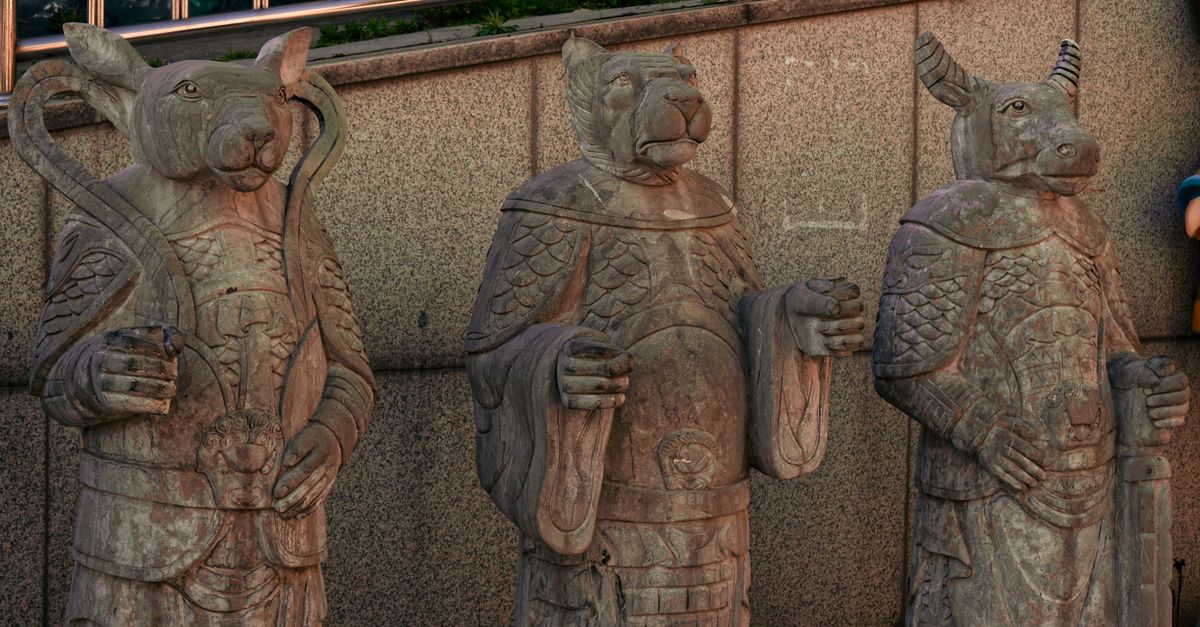
The Rat's San He Trine and Direct Opposition
San He (三合) is the traditional name for a three-animal trine: a group of three zodiac animals that share a triangular relationship in the twelve-position cycle. The browser stores four such trines as literal reference fixtures: Rat, Dragon, and Monkey; Ox, Snake, and Rooster; Tiger, Horse, and Dog; Rabbit, Goat, and Pig. For the Rat, that means Dragon and Monkey are the only other animals inside its trine, and the two of them together give the Rat two unordered trine pairs. Liu Chong (六冲) is the traditional name for the six direct oppositions on the cycle, separated by six positions. The Rat's opposite position on the twelve-position cycle is the Horse, and that is the only direct opposition the browser will report when the Rat is selected.
Because the two relation sets never overlap by construction, the Rat cannot be both a trine partner and an opposition partner with the same animal. Dragon and Monkey are trine partners; the Horse is the opposition; everything else in the Rat's eleven unordered pairs is left out of the model. The same twelve-position cycle is used by the Chinese Zodiac Calculator, but the calculator maps a supported Gregorian year to an animal and warns about the Lunar New Year boundary. This browser asks for two already-known animals and does no calendar conversion.
How to Read Every Rat Pair in the Browser
- Open the Chinese Zodiac Compatibility page and choose Rat in the first animal selector. Both selectors are native controls with a 44-pixel minimum height, so the choice is keyboard accessible and the layout stacks cleanly on narrow screens without any drag gesture.
- Choose a second animal in the second selector — any of Dragon, Monkey, Ox, Tiger, Rabbit, Snake, Horse, Goat, Rooster, Dog, or Pig. The browser does not infer a sign from a Gregorian year; it only reads the values you select.
- Read the label that appears between the two selectors. The label will read either "Traditional trine (San He)," "Direct opposition (Liu Chong)," or "Not classified by this limited two-rule model."
- Inspect the Rat's full trine group and direct opposite shown beneath its selector. For the Rat, the trine group is Dragon and Monkey and the direct opposite is the Horse, so you can read the same classification outside the badge.
- Use the Swap action to exchange the two controlled values. The result updates immediately from the same classifier, so pairing Dragon with Rat gives the same Traditional trine label as pairing Rat with Dragon. If your pair does not match, the classifier is doing something wrong.
Steps one through five are deliberately the entire user task. The two selections remain only in React page state — the widget does not request a name, birth date, gender, location, relationship history, account, upload, network service, cookie, or local storage — so you can repeat the walk for every animal that interests you without leaving a trace.
All 11 Rat Pairs at a Glance
The table below lists every unordered pair that includes the Rat, ordered so the trine and opposition outcomes come first and the eight unclassified outcomes follow. The Rat paired with itself is not treated as a two-sign pair in this model, which is why the list contains 11 rows and not 12. The labels are the exact words the browser returns for each selection, and the symmetry check works for every row: swapping the Rat and the other animal in the selectors gives the same classification in the same display order.
| Pair | Two-rule label |
|---|---|
| Rat + Dragon | Traditional trine (San He) |
| Rat + Monkey | Traditional trine (San He) |
| Rat + Horse | Direct opposition (Liu Chong) |
| Rat + Ox | Not classified by this limited two-rule model |
| Rat + Tiger | Not classified by this limited two-rule model |
| Rat + Rabbit | Not classified by this limited two-rule model |
| Rat + Snake | Not classified by this limited two-rule model |
| Rat + Goat | Not classified by this limited two-rule model |
| Rat + Rooster | Not classified by this limited two-rule model |
| Rat + Dog | Not classified by this limited two-rule model |
| Rat + Pig | Not classified by this limited two-rule model |
What "Unclassified" Means for the Rat
Eight of the Rat's eleven pairs fall into the unclassified bucket, which can feel like a lot when other sources on the open web list four, five, or six "Rat-compatible" animals. The browser's narrow scope is the reason: it only recognizes the four trines and the six oppositions listed in its source fixtures, and the Rat happens to sit at one end of only one of each. Anything that is not in the Rat's trine group and not the Rat's opposite is reported as outside the model. The phrase is the precise answer the tool offers, and you can read more about the broader category in the 48 unclassified pairs walkthrough.
Calling a Rat pair "unclassified" is not the same as calling it neutral, and it is also not the same as calling it compatible. Other traditions document different conflict names, including harms, punishments, and Six Harmonies, that the browser does not merge into the same table. English source labels vary too: the interface uses Rat, Ox, and Goat, while cited sources may write Mouse, Cow, or Sheep for the same cycle positions, and regional substitutions such as Cat or Boar are not silently equated because each variant requires its own cultural scope. The point of the narrow label is to keep the sourced answer visible rather than hiding it inside an averaged score.
Limits and What This Browser Will Not Do
The Chinese Zodiac Compatibility tool is a deliberate, narrow browser, and its limits are part of why the Rat result can be trusted inside its scope. It will not turn a sourced folk classification into a percentage. It will not rank the Rat against other animals. It will not predict whether a friendship, family relationship, or partnership will succeed. It will not infer a sign from a Gregorian or lunar birth year, and it will not move the Rat into a different trine group depending on the year. It will not collect a name, a birth date, gender, a location, a relationship history, an account, an upload, a cookie, or a local-storage value. Both selectors stay in React page state and disappear when the page is closed.
If you need to look up which animal corresponds to a specific year, the related Chinese Zodiac Calculator maps a supported Gregorian year to its animal and warns you about the Lunar New Year boundary. If you want a deeper cultural reading, full Four Pillars practice considers year, month, day, and hour branches, elements, and additional relationships that this cultural browser deliberately leaves out. The visible limitation statement on the page repeats that year-animal matching is not a scientific measurement and should not guide consequential relationship decisions.
A Transparent Way to Verify the Rat Result
Because the browser stores its twelve animals, four trines, and six oppositions as literal independent fixtures, the Rat result can be audited without trusting an unexplained badge. The four trines come straight from the twelve-position cycle; the Hong Kong Observatory's twelve-year animal cycle page documents that same cycle and is one of the cited reference sources behind the fixtures. Each animal appears in exactly one trine and one opposition, the twelve unordered trine pairs and six oppositions are counted by the test suite, and the symmetry of the result is checked every time you press Swap. If a Rat pair ever returned a different label after a Swap, the classifier would be doing something wrong, and the page would tell you.
The two-rule browser walkthrough explains the same audit step for any animal, not just the Rat, and pairs it with the verification approach. Together those two pieces let you confirm that the Rat's trine partners are Dragon and Monkey, that the Rat's direct opposition is the Horse, and that the remaining eight pairs are deliberately, openly outside the model the browser is willing to claim.