A Saturn Return is active the moment apparent geocentric Saturn longitude equals the longitude Saturn occupied at your birth, and the return can last several months while Saturn slowly crosses that point, sometimes producing two or three exact passes during a single cycle. To know whether you are currently in your Saturn Return, you need the moment you were born captured as three separate fields: the documented local calendar date, the local clock time, and the signed UTC or UTC-equivalent offset for that place and date, because a wall-clock time on its own does not identify a single instant. With those three inputs, the Saturn Return Calculator locks your natal Saturn longitude and lists every later crossing of that exact angle inside its supported 1700–2100 window, instead of guessing by age alone or quoting a vague sign-based bracket.
What "Being in a Saturn Return" Actually Means
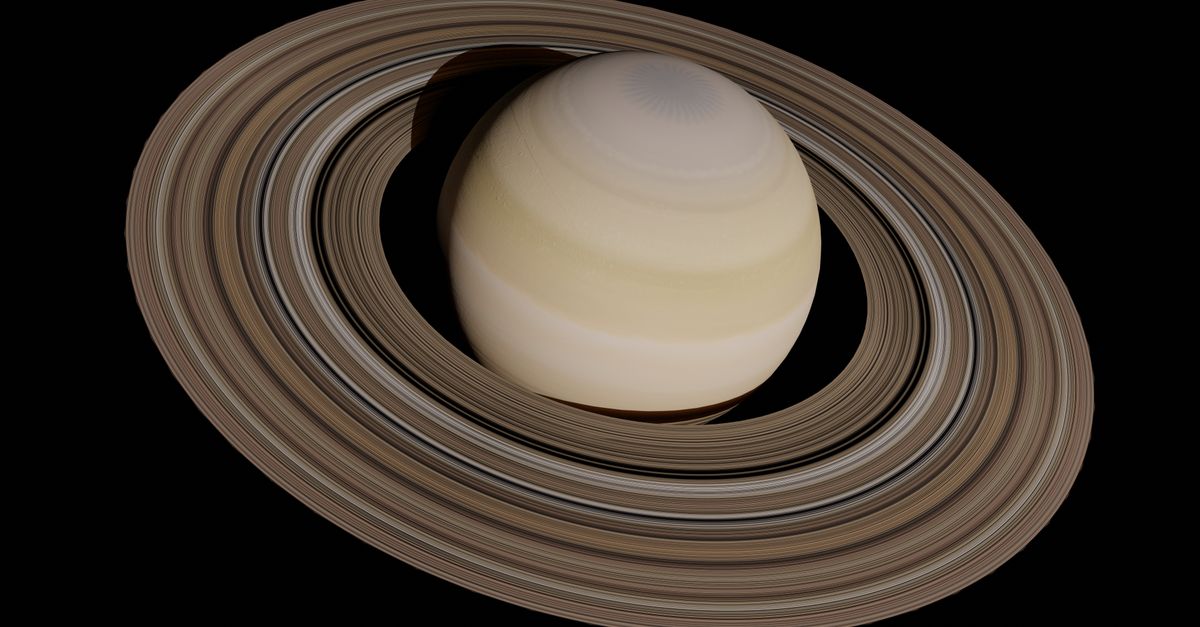
A Saturn Return is, in its most literal form, a geometric event. The relevant comparison is not your age, your generation, or the year you were born; it is the angle Saturn traces along the ecliptic at one specific documented instant. When that apparent geocentric longitude equals the longitude Saturn occupied at the moment recorded on your birth certificate, the return is exact. The cultural weight attached to that crossing is a separate matter; the astronomical fact is simply two longitudes matching within a documented tolerance.
That distinction matters because the question "am I in my Saturn Return" usually arrives with a calendar context already loaded. A friend in their late twenties announces a life upheaval, a coworker claims every relationship ends at twenty-nine, or a personal hunch insists the world has felt unusually heavy for months. None of those impressions can answer the question on its own. The answer is mechanical, and the only reliable way to reach it is to compare your natal Saturn longitude to where Saturn actually is on the dates you have in mind.
This is where the Saturn Return Calculator takes over. It locks the natal longitude from the birth fields you supply and then searches the supported window for every later crossing of that exact angle.
Why Age Alone Cannot Answer the Question
Saturn's orbital period is often quoted as roughly 29.5 years, and that figure is correct on average. It is not, however, constant enough to fix a return on a single birthday. Saturn's orbital speed varies as it moves between perihelion and aphelion, and the longitude it covers per Earth-year fluctuates with that eccentricity. Two people born one day apart can see their first exact return land on opposite sides of a calendar year, and the gap between a first and second return can stretch or compress by months depending on where in its orbit Saturn happens to be moving.
There is also the retrograde factor. When Saturn stations retrograde near the natal crossing, it can cross the same longitude three times in the same cycle: once direct, once retrograde, and then once direct again after turning around. An age-based rule of thumb collapses all three passes into a single window or hides the third pass entirely. A search tool that resolves the actual crossing dates preserves the cluster instead of smoothing it away.
If you have ever read a Saturn Return article that promises "your return will hit between ages 28 and 31" and felt the bracket was too wide to plan around, this is the reason: the average period only sets the center of the spread, and the spread itself is wider than one birthday.
How to Check If You Are in Your Saturn Return
The tool needs three pieces of information, all of which should come from a documented record of the moment you were born:
- Enter the birth date. Use the documented local calendar date from a birth certificate or hospital record.
- Enter the birth clock time. Type the local clock time shown on the document rather than a rounded memory estimate.
- Enter the documented UTC offset. The offset is a signed value from -12:00 through +14:00 and may include non-whole-hour values such as -03:30 or +05:45.
- Run the search to list every exact natal-longitude crossing inside the supported window.
The form refuses impossible Gregorian dates, impossible clocks, malformed offsets, and normalized instants outside 1700 through 2100. If any of the three fields fails validation, the result will not be guessed into existence; the tool will ask for a corrected input instead. For readers whose birth predates modern standard time zones, the signed offset you type becomes a proleptic UTC-like estimate rather than a historically recovered political fact, and the result carries that caveat by design.
Why a Single Return Can List More Than One Exact Date
Multi-pass clusters are not a glitch. When Saturn approaches the natal longitude while slowing toward its retrograde station, it can cross the angle, reverse direction, cross it again going backward, and then cross it a third time after turning direct. Each crossing is its own exact pass, and each one belongs in the answer to "am I in my Saturn Return." Listing only one of them hides the geometry the question is actually asking about.
The same logic explains why two people of similar ages can have returns that seem to overlap by months rather than match by days. The shape of the loop Saturn traces around the crossing depends on where in its orbit the station happens, and that varies from cycle to cycle. Inside the calculator, the sampling step detects every residual zero crossing while rejecting antipode wraps, then binary-refines each pass to settle on a precise date. You are seeing the actual geometry, not a rounded approximation.
| Approach | What it relies on | Result for "am I in it right now?" |
|---|---|---|
| Age-based rule of thumb | A fixed ~29.5-year cycle | A wide bracket that misses retrograde multi-pass clusters |
| Generic "Saturn in [sign]" article | The zodiac sign Saturn occupies this calendar year | A sign-based generalization, not a natal-longitude match |
| Saturn Return Calculator | Documented birth date, clock time, and UTC offset | Every exact longitude crossing inside 1700–2100, listed individually |
What the Calculator Will Not Try to Tell You
The result is a list of astronomical longitude coincidences, not a forecast. The tool refuses to invent an Ascendant, house cusps, aspects, midpoints, or a topocentric sky position because each of those products needs a geographic place and a different geometric contract. Latitude, longitude, elevation, GPS, and IP-based location are not inputs to the calculation; the observer origin is the center of the Earth.
This narrower scope also explains why a wall-clock time on its own is not accepted. A time without an offset can correspond to many different instants around the globe, so the signed offset is what fixes the calculation to one moment. If you do not have the offset for your birth date and place, the tool will not silently invent one. A missing or estimated field is treated as a missing field.
The entire computation runs in the browser using a pinned Astronomy Engine 2.1.19 adapter. Nothing is uploaded, no runtime network socket is opened, and the result reflects apparent Earth-center true ecliptic of date. The expected comparison values were authored from NASA JPL Horizons observer quantity 31 and independently from the IMCCE Miriade ephemcc API using the INPOP theory, and the dual-official gate rejects any circular difference larger than five thousandths of a degree.
Reading the Result Honestly
Once the calculator returns its list, the honest read is the mechanical one. Those dates are the exact instants when Saturn's apparent geocentric longitude equals your natal longitude inside the supported window. Whether each pass counts as "the" return for your purposes is a choice you can make, since a multi-pass cluster can be read as one long return or as several narrower crossings separated by weeks or months.
If you want a broader sense of timing outside the crossing list itself, you can use the Saturn Sign Calculator to inspect Saturn's tropical sign sector for a documented moment without mixing in house systems, and the Retrograde Planets Tracker to check whether Saturn is direct, retrograde, or near-stationary at any of the listed crossings. Each of those tools keeps its own narrow geocentric adapter, which is what allows them to be compared without drifting into products the Saturn Return Calculator refuses to compute.
For readers who want to compare the exact-date approach against a window-style reading of the same event, the guide Saturn Return Exact Date vs Window Explained walks through that distinction in detail. The entertainment framing still applies: the numbers are real astronomical coincidences within a documented tolerance, and they are not medical, legal, financial, safety, employment, or relationship advice. Treat every crossing date as an estimate bounded by the dual-official tolerance and keep that scope in mind as you read.