To determine which hemisphere a location sits in on a map, read its latitude against the Equator and its longitude against the 20°W and 160°E meridians. A latitude of 0° sits on the Equator; any positive latitude (north of the Equator) falls in the Northern Hemisphere and any negative latitude falls in the Southern Hemisphere. The east–west split is slightly trickier: the Western Hemisphere contains longitudes from 20°W westward to 160°E, while the Eastern Hemisphere covers the rest — 20°W eastward through 0° to 160°E. That cutoff exists because the prime meridian (0°) and the 180° line would otherwise split Africa and Europe between two hemispheres, so cartographers chose 20°W and 160°E instead to keep continents on the same side. The word "hemisphere" itself, though, has a second meaning: any half of a sphere, exactly the shape the geometry term describes. When you need to know the volume, surface area, or base area of a real-world hemisphere — a bowl, a dome, a tank, a planetarium roof — the geometry calls for a different tool: a calculator that turns one radius into every measurement you need. The Hemisphere Calculator fills that gap by accepting the radius and reporting all four numbers together.
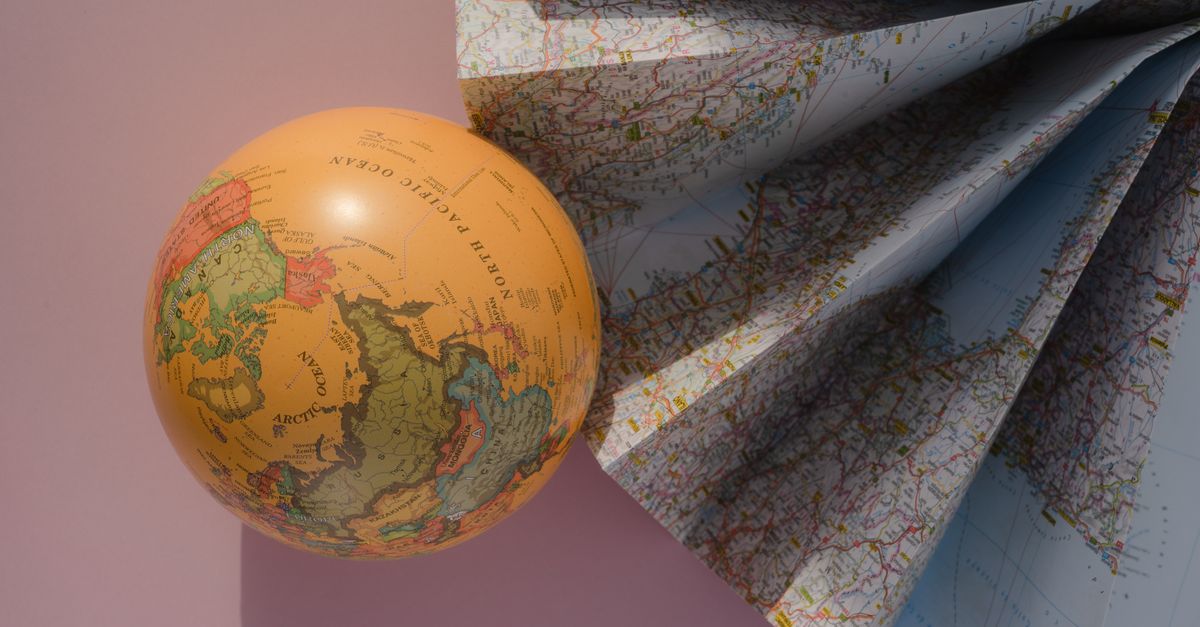
Two Meanings of 'Hemisphere': Geography and Geometry
The word "hemisphere" literally means "half sphere," and that single phrase covers both senses. In geography, a hemisphere is one of the four slices the Equator and the chosen meridians carve from the globe: Northern, Southern, Eastern, and Western. In geometry and everyday objects, a hemisphere is a solid half-ball — every point on the shape sits at most a distance r from a center, where r is the radius, and one flat circular face splits the otherwise rounded form. Every dome you have walked under, every bowl you have eaten from, and every hemispherical garden ornament is a hemisphere in this geometric sense.
Because the two meanings share a word, you will sometimes see search queries that mix them. The map-based question — "am I in the Northern or Southern Hemisphere?" — has a different answer than the geometry-based question — "how much water does this bowl hold?" — but both rely on understanding what a hemisphere is. Once you see the word split into its two uses, the right tool for each becomes obvious: a globe or an atlas for the geographic question, and a dedicated calculator for the geometric one. The rest of this article covers both.
How to Determine Your Hemisphere on a Map
To find the geographic hemisphere, you only need two numbers from any map that shows latitude and longitude: the latitude line and the longitude line at the point you are interested in. Latitude is the horizontal coordinate, marked along the side of most maps; longitude is the vertical one, marked along the top or bottom. Read the latitude first. If the value is positive or labeled N, the point lies in the Northern Hemisphere. If the value is negative or labeled S, it sits in the Southern Hemisphere. The Equator — 0° latitude — is the dividing line, and it is the same line shown on any globe as the "belt" around the middle.
Longitude requires a small extra step because the choice of meridians is somewhat arbitrary. The agreed boundary between the Eastern and Western Hemispheres runs from 20°W in the north to 160°E in the south on the western side, and from 160°E back down to 20°W on the eastern side. As a quick rule, if a point's longitude falls between 20°W and 160°E, it lies in the Eastern Hemisphere. If it falls between 160°E (going east through 180°) and 20°W, it lies in the Western Hemisphere. A simple mental shortcut: most of the Americas are west, most of Europe, Africa, Asia, and Oceania are east, with a small slice of eastern Russia and western Alaska on each side.
Some maps simplify the split by labeling only "Northern" or "Southern" or only "Eastern" or "Western." On a flat Mercator projection, the Equator is a straight horizontal line across the middle of the map and the dividing meridians curve up or down depending on where you look. On a globe, the divisions form perfect circles around the Earth. Either way, the latitude and longitude of a point settle the question — no calculation required.
| Hemisphere | Dividing Line | Bounded Range | Major Land Areas |
|---|---|---|---|
| Northern | Equator (0° latitude) | 0° to 90° N | North America, Europe, most of Asia, northern Africa |
| Southern | Equator (0° latitude) | 0° to 90° S | South America (most), sub-Saharan Africa (most), Australia, Antarctica |
| Eastern | 20°W to 160°E meridians | 20°W → 0° → 160°E | Europe, Africa, Asia, Oceania, Australia |
| Western | 160°E to 20°W meridians | 160°E → 180° → 20°W | North America, South America, western edge of Greenland |
How to Measure a Hemisphere with the Calculator
For the geometric hemisphere, the single number you need is the radius r — the distance from the center of the flat circular face to any point on the curved outer edge. With that one value, the Hemisphere Calculator returns four results at once.
- Measure the radius of the hemisphere. If you only have the diameter, halve it first (r = d ÷ 2). Use any consistent unit — centimeters, inches, meters — and stick with it for every result.
- Enter the radius in the radius field of the Hemisphere Calculator.
- Read the four outputs: volume V = (2/3)πr³, curved surface area = 2πr², flat circular base area = πr², and total surface area = 3πr². Each value is shown with its formula so you can verify the math.
There is no submit button — the tool recomputes the moment you finish typing. The entire calculation runs in your browser using Math.PI for full precision, and nothing is sent to a server, so you can experiment freely with different radii or quickly check a homework problem.
A worked example shows the workflow. A hemispherical bowl has a radius of 5 cm. Entering 5 into the calculator gives:
- Volume: V = (2/3)π(5)³ = 250π/3 ≈ 261.80 cm³
- Curved surface area: 2π(5)² = 50π ≈ 157.08 cm²
- Base area: π(5)² = 25π ≈ 78.54 cm²
- Total surface area: 3π(5)² = 75π ≈ 235.62 cm²
Notice that total = curved + base, because the calculator returns the curved part and the base separately, then adds them into the total. That separation is the most common source of confusion when measuring a hemisphere, so it pays to know exactly which number you need.
Curved vs Total Surface Area: What Each Number Means
The Hemisphere Calculator reports two different surface area values on purpose. The curved surface area, 2πr², measures only the rounded dome — the smooth outside of the half-ball, with no flat face included. The total surface area, 3πr², adds the flat circular base (πr²) to the curved dome, since 2πr² + πr² = 3πr².
Each value answers a different practical question. Choose the curved surface area when the flat side is open or attached to something else: the interior of a bowl or basin, the outside of a dome roof sitting on a building, the inside of a half-pipe, or a hemisphere joined to a flat wall or pipe. Choose the total surface area when the object is a closed half-ball and you need to paint, coat, wrap, or glaze the entire outer surface including the flat face — for example, a solid decorative hemisphere that will be dipped or finished all over.
| Measurement | Formula | What It Covers | Common Use |
|---|---|---|---|
| Volume | (2/3)πr³ | Full half-ball capacity | How much a bowl or tank holds |
| Curved surface area | 2πr² | Dome only | Material for an open dome or bowl interior |
| Base area | πr² | Flat circular face | Size of the closed bottom on a half-ball |
| Total surface area | 3πr² | Dome + base combined | Paint or coating for a closed hemisphere |
Where Hemisphere Calculations Show Up in Real Life
Hemisphere measurements come up anywhere a half-ball shape appears in the real world. Bowls, basins, and mixing bowls — capacity is the volume, and that tells you how much a bowl holds. Domed roofs — a planetarium dome, observatory cap, or architectural ceiling is a hemisphere, and the material needed to cover the outside is the curved surface area. Hemispherical tanks — half-round storage tanks hold volume = (2/3)πr³. Half-round decorative objects — finials, knobs, garden ornaments — total surface area matters when finishing or coating. Geometry homework — volume and surface area questions almost always come down to the radius.
In every case, the unit you enter for the radius carries through to every output. Entering centimeters gives a volume in cubic centimeters (cm³, equal to milliliters) and the three areas in cm². Inches give cubic inches and square inches. Meters give cubic meters and square meters. Mixing units inside one calculation produces a meaningless answer, so keep one unit from input to output.
Quick Sanity Checks Before You Trust the Number
A hemisphere is exactly half of a sphere with the same radius, so the volume must come out to half of (4/3)πr³. If you enter r = 5 and get a volume close to 130.9 instead of 261.8, you have accidentally halved the volume twice. Likewise, the curved surface area of a hemisphere (2πr²) is half the surface area of a full sphere (4πr²); if the curved number comes out equal to the total, the base area has been added twice.
A second sanity check uses a cone. A cone that shares the hemisphere's radius and has a height equal to r has volume (1/3)πr²·r = (1/3)πr³. The hemisphere holds (2/3)πr³, which is exactly twice that. So a hemisphere holds the same volume as two of these cones stacked base-to-base.
The Hemisphere Calculator accepts whole numbers and decimals, treats a radius of 0 as zero for every result, and flags negative or non-numeric entries so a typo never returns a misleading answer. Extremely large inputs that would overflow are caught rather than shown as a broken result. Once those checks line up, the number the tool returns is reliable to full floating-point precision.
Related reading: How a Baby Eye Color Calculator Maps Parents' Eyes to Odds.