To convert pressure to force, multiply pressure by the area over which it acts: F = P × A. With pressure in pascals (Pa) and area in square metres (m²), the result is force in newtons (N).
Pressure alone is not enough to determine force. A pressure reading describes force per unit area, so the same pressure acting over a larger area produces a larger total force. The calculation is direct for uniform pressure on a flat piston face, a contact surface, or another known area.
A pressure converter handles the first part of the job: converting the pressure unit. It cannot calculate force unless an area is supplied separately, so use its result in the F = P × A step rather than treating the converted pressure as the final answer.
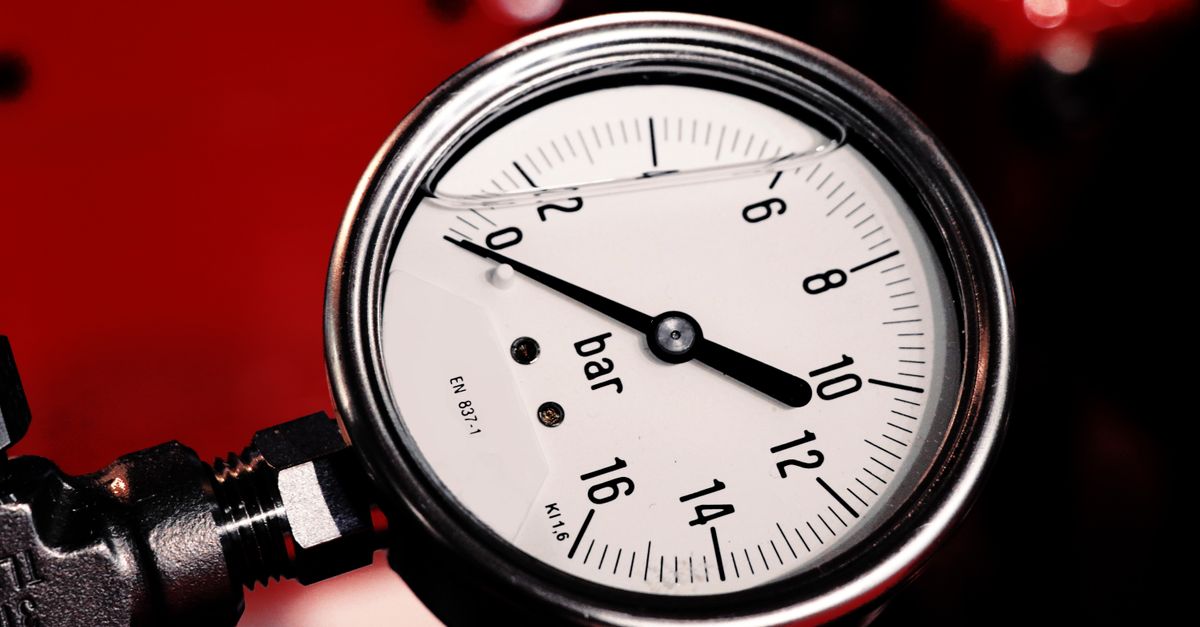
Why pressure needs an area
Pressure is a compound quantity because it combines force and area. The pascal makes the relationship explicit: one pascal is one newton pushing over one square metre.
- Pressure (P) is force distributed over area, measured in units such as Pa, kPa, bar, or psi.
- Area (A) is the loaded surface, measured in square units such as m², cm², mm², or in².
- Force (F) is the resulting push or load, measured in newtons (N) or force units such as lbf and kN.
Use the formula when pressure is reasonably uniform across the selected area. For a round piston, first calculate its face area as A = π(d ÷ 2)². For a non-circular surface, use the actual loaded area rather than the overall dimensions of the equipment.
Keep the pressure reference consistent as well. Gauge pressure describes pressure above ambient, while absolute pressure includes atmospheric pressure. Converting the unit should not silently change between those references; the calculated force corresponds to the reference used in the calculation.
Convert pressure to force step by step
- Identify the pressure and loaded area. Confirm the original pressure unit, the pressure reference if known, and the surface over which the pressure acts. Use the effective loaded area, not the total exterior area of the component.
- Enter the pressure in the converter. Open the Pressure Converter and enter the pressure value. The converter supports twelve units: Pa, kPa, MPa, hPa, bar, mbar, atm, psi, torr, mmHg, inHg, and kgf/cm².
- Select the original and target pressure units. Choose the unit printed on your gauge or specification, then choose Pa as the working unit. The result appears immediately because the converter updates as you type; no conversion button is required.
- Convert the area to square metres. For example, multiply an area in cm² by 0.0001, an area in mm² by 0.000001, or an area in in² by 0.00064516. An area already expressed in m² needs no conversion. Convert each linear dimension before squaring it when calculating area from dimensions.
- Multiply pressure by area. Calculate F = P × A, entering the pressure value in Pa and the area value in m². The resulting force is in newtons because Pa × m² = N.
- Check the result before rounding. Confirm that the area is appropriate, the pressure reference has not changed, and the final unit is force rather than pressure. Round the final answer only when a specific precision is required.
Match the formula to your unit system
Converting both inputs to SI units produces the clearest calculation, but compatible unit combinations can save a step. The factors in the middle routes account for differences in both pressure and area units.
| Pressure and area units | Calculation | Resulting force unit |
|---|---|---|
| Pa and m² | F(N) = P(Pa) × A(m²) | Newtons |
| kPa and cm² | F(N) = P(kPa) × A(cm²) × 0.1 | Newtons |
| MPa and mm² | F(N) = P(MPa) × A(mm²) | Newtons |
| psi and in² | F(lbf) = P(psi) × A(in²) | Pound-force |
The last route works because one psi is one pound-force per square inch. It is useful for imperial specifications, but the result is in lbf rather than newtons. Use an SI route or convert the resulting force separately when a specification requires newtons.
Choose one route and keep the units paired correctly. Combining pressure in kPa with area in m², for example, gives a result that cannot be labeled in newtons until the kPa factor is applied. The Pressure Converter is useful for obtaining the pressure value in Pa or another selected unit before you apply the area factor.
Pressure units at a glance
These reference relationships show the size of the common pressure units and the fields in which they are commonly used.
| Unit | Relationship to pascals | Common context |
|---|---|---|
| Pa | 1 Pa = 1 N/m² | SI reference unit |
| kPa | 1 kPa = 1,000 Pa | Metric engineering and weather |
| MPa | 1 MPa = 1,000,000 Pa | High-pressure engineering |
| bar | 1 bar = 100,000 Pa | Industrial work and tire pressure |
| psi | 1 psi is about 6,894.76 Pa | Tire gauges and North American engineering |
| atm | 1 atm = 101,325 Pa | Standard atmospheric reference |
| torr | 1 Torr = 1/760 atm, or about 133.32237 Pa | Vacuum and scientific measurement |
| mmHg | 1 conventional mmHg = 133.322387 Pa | Medicine and meteorology |
Torr and conventional mmHg are nearly identical but are not defined identically. Their difference is about one part in seven million, which is negligible for most everyday readings but important in precise scientific work. The converter keeps them separate and states that its factors trace to NIST Special Publication 811 or exact SI definitions.
For a cross-check against a specification, select “Show all units at once” in the Pressure Converter. It displays the entered pressure in all twelve units side by side, making it easier to compare the result with a datasheet or equipment label.
Worked example: 32 psi over 10 cm²
Suppose a component applies a uniform pressure of 32 psi over a loaded area of 10 cm². Use pressure in pascals and area in square metres:
- Convert the pressure: P = 32 psi × 6,894.76 Pa/psi = 220,632.32 Pa, using the displayed rounded conversion factor.
- Convert the area: A = 10 cm² × 0.0001 m²/cm² = 0.001 m².
- Calculate the force: F = 220,632.32 Pa × 0.001 m² = 220.63232 N, which rounds to about 220.6 N.
The dimensional check confirms the result: Pa × m² = N. Because the psi factor shown above is rounded, retain the converter’s higher-precision result when the final force must meet a tight tolerance.
Avoid errors before using the result
Most pressure-to-force mistakes come from unit pairing, area selection, or premature rounding. Check these points before submitting the result:
- Do not skip the area. A pressure value cannot become a total force by unit conversion alone.
- Convert square units correctly. Centimetres, millimetres, and inches describe length, so their conversion factors are squared when applied to area.
- Use the effective loaded area. A piston calculation uses the piston face, while a contact-pressure calculation uses the actual contact region.
- Keep gauge and absolute pressure separate. The Pressure Converter changes units; it does not add atmospheric pressure to a gauge reading.
- Avoid rounding intermediate values. Keep the full converted pressure and area through the multiplication, then round the final force.
- Do not confuse Torr with conventional mmHg. The difference is usually negligible, but the units remain separate for precision.
The Pressure Converter runs entirely in your browser, so nothing is uploaded to a server. It updates the conversion as you type, and the page continues working offline once it has loaded. Use it for the pressure-unit portion of the calculation, then apply the correct area factor and dimensional check yourself.
If you need to work in the opposite direction, the inverse relationship is P = F ÷ A. See how to convert force to pressure: formula and steps for that calculation.