Converting baking measurements to weight means trading a fluid ounce, cup, or tablespoon — units of volume where 1 US cup equals exactly 236.5882365 mL — for an ounce, pound, or gram — units of mass where 1 pound equals exactly 453.59237 grams — so a recipe stays precise regardless of how you scoop, settle, or pack an ingredient. The most important fact to hold onto: every volume-to-volume and weight-to-weight step in a recipe is mathematically exact because the underlying factors come from the US fluid ounce definition and the 1959 International Yard and Pound Agreement rather than rounded kitchen shorthand. The catch is that cups and grams live in different measurement dimensions, and crossing from volume to weight is impossible without knowing the density of the specific ingredient you are measuring. A free browser tool like the Cooking Measurement Converter handles all three within-dimension conversions — volume to volume, weight to weight, and temperature to temperature — using those exact factors, and it stays out of the volume-to-weight problem on purpose so the answers it gives remain trustworthy. For ingredient-specific cups-to-grams values, you still need a density chart; for every other unit change in a baking recipe, this tool gives a definitive answer in your browser with no upload.
Why Bakers Prefer Weight Over Volume
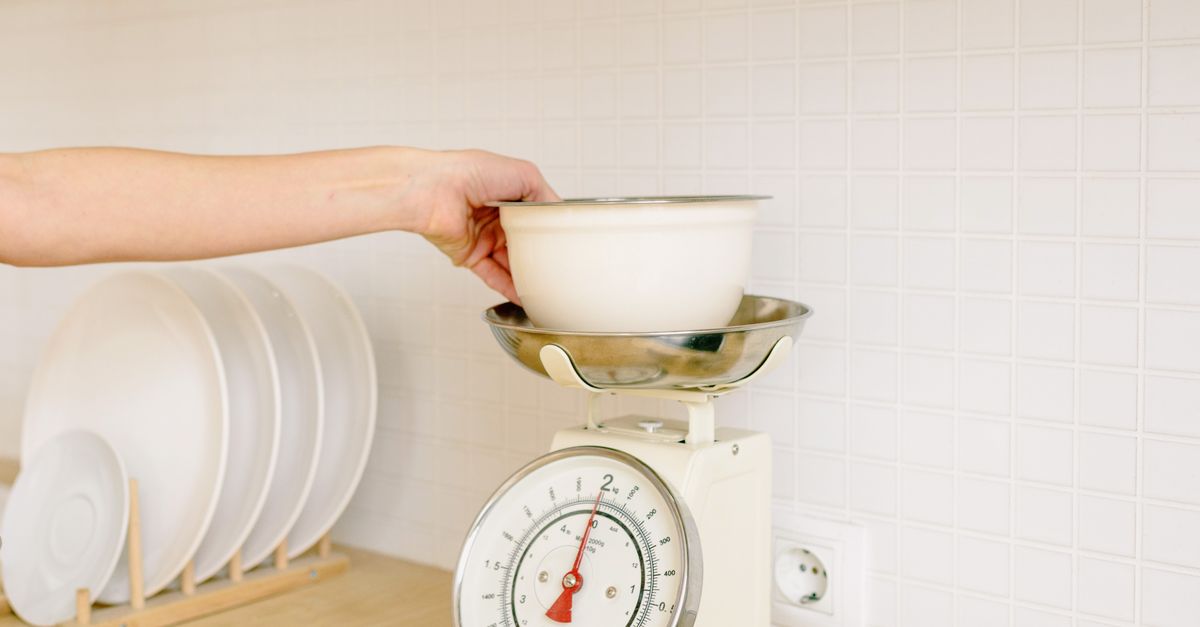
Professional bakers and most of the world's home bakers measure dry ingredients in grams rather than cups because grams measure mass, and mass does not change with how you handle a scoop of flour, a packed brown sugar dome, or a softly levelled spoon of cocoa. Two cups scooped the same way can hold different weights of flour depending on humidity, how the flour settled in storage, and how firmly you swept the top. A kilogram of flour is a kilogram of flour regardless of those variables, so any recipe expressed in grams reproduces more reliably when you run the same bake again.
That reliability matters because baking is essentially chemistry. Flour provides gluten structure, sugar controls spread and browning, butter sets the fat ratio, and each ingredient sits at a specific proportion to the others. A 10 percent drift in flour weight is the difference between a tender cake and a tough one, and small drifts stack when a recipe is scaled up. Once a baker has weighed the ingredients once, the recipe behaves more like a formula than a guess, which is why most serious baking cookbooks, websites, and competition guidelines publish recipes in grams.
The volume system that dominates American home cooking — teaspoons, tablespoons, fluid ounces, cups, pints, quarts, gallons — has its own value. Cups are fast for liquids, they line up neatly with measuring spoons and dry measuring cups, and almost every American recipe starts with them. Switching over to grams means converting these familiar volumes to a less familiar mass, which is where a reliable cooking converter becomes useful.
The Volume-to-Weight Caveat
It is tempting to ask a converter to turn 1 cup into a single gram number and call it done, but that answer can only be an ingredient-specific answer. A US cup of water weighs about 236.6 grams because water has a density of roughly 1 gram per milliliter. A US cup of all-purpose flour weighs between roughly 120 and 160 grams depending on how it was scooped. A US cup of honey weighs about 340 grams. A US cup of melted butter weighs about 227 grams. There is no single number that covers every ingredient, because density varies by ingredient, and density is the bridge between volume and weight.
The math behind this is straightforward. Mass equals volume multiplied by density (m = V × ρ). When the volume is one cup (236.588 mL), the gram value is 236.588 multiplied by the ingredient's density in grams per milliliter. For water that is 236.588 × 1.0 ≈ 236.6 g, for sifted flour it is 236.588 × 0.53 ≈ 125 g, for honey it is 236.588 × 1.44 ≈ 340 g. A converter that pretends to know the right gram value without that density input is producing a number that is correct for some ingredients and wrong for many others.
This is why the Cooking Measurement Converter deliberately stays within each measurement type. It will convert a cup into milliliters, tablespoons into fluid ounces, ounces into grams, and pounds into kilograms — all unit changes that have a single exact answer — but it will not pretend to convert cups into grams. For the volume-to-weight step, bakers need a recipe-specific ingredient chart, and our Cups to Grams in Baking guide covers the ingredient densities that fill that gap. Combining both resources — the converter for unit math, a chart for ingredient density — produces accurate gram values for any baking recipe.
How to Convert Baking Measurements With the Cooking Converter
The Cooking Measurement Converter is a single-page tool that runs entirely in your browser, so you can use it on a phone propped up against a mixing bowl or on a laptop sitting open next to the oven. The workflow below handles every unit change you need to convert a baking recipe between metric and US customary units, and between Celsius, Fahrenheit, and UK gas mark oven settings.
- Open the Cooking Measurement Converter in your browser and choose a conversion type from the top selector: Volume, Weight, or Temperature. The tool never mixes these categories because the answer depends on which kind of measurement you are working in.
- Type the amount you want to convert into the Amount box. For a recipe that calls for 2 cups of milk, enter 2; for 180 grams of butter, enter 180; for a 350 °F oven, enter 350.
- Pick the unit you are converting From in the left dropdown, and the unit you are converting To in the right dropdown. For 2 cups of milk in metric, choose cup on the left and milliliter (mL) on the right. For 180 g of butter in ounces, choose gram on the left and ounce on the right.
- Read the converted result that appears in the result field. Two cups of milk becomes 473.176 mL; 180 g of butter becomes about 6.349 oz. The factors used are exact, derived from the US fluid ounce definition and the 1959 international yard and pound agreement, so the math is not rounded kitchen shorthand.
- If you need to reverse the direction — for example, to check that 473 mL of milk rounds back to roughly 2 cups — click the swap button to flip the From and To units in one click.
- Click Copy result to put the converted value on your clipboard, then paste it into a notes app, a recipe card, or a shopping list without retyping.
The same steps work for oven temperature. Pick Temperature as the conversion type, enter 180, set From to Celsius and To to Fahrenheit, and the result is 356 °F; switch To to gas mark and the result snaps to gas mark 4, the nearest British oven mark on the standard chart. Every step stays on the page — no sign-up, no account, no upload — so it works in a kitchen with patchy wifi, and the page keeps running even if your connection drops.
Exact US Volume and Weight Factors
Conversions produced by the Cooking Measurement Converter use the underlying factors shown below. These are not rounded kitchen estimates — they are the official definitions behind the units, so a recipe scaled up to feed a crowd stays as precise as the original batch.
| US Volume Unit | Equivalent in mL (exact) |
|---|---|
| Teaspoon (tsp) | 4.9289215938 mL |
| Tablespoon (tbsp) | 14.78676478125 mL |
| US fluid ounce (fl oz) | 29.5735295625 mL |
| US cup | 236.5882365 mL |
| US pint | 473.176473 mL |
| US quart | 946.352946 mL |
| US gallon | 3785.411784 mL |
| Liter (L) | 1000 mL (exact) |
Every value above comes from the definition that 1 US fluid ounce equals exactly 29.5735295625 mL, as documented on the Wikipedia fluid ounce reference. The teaspoon and tablespoon are derived as 1 fl oz divided by 6 and 1 fl oz divided by 2, the cup is 8 fl oz, and the pint, quart, and gallon follow the US customary 2-4-8-16 ladder.
| Weight Unit | Equivalent in grams (exact) |
|---|---|
| Ounce (oz) | 28.349523125 g |
| Pound (lb) | 453.59237 g |
| Kilogram (kg) | 1000 g (exact) |
The weight factors come from the 1959 International Yard and Pound Agreement, which fixed 1 pound at exactly 453.59237 grams and 1 ounce at exactly 28.349523125 grams. With these exact values, an 8-ounce stick of butter is exactly 226.796185 grams, a 1-pound bag of flour is exactly 453.59237 grams, and a 2.5-pound loaf batch scales without rounding error creeping into the final weights.
Scaling Recipes by Switching Units
The most common reason to convert baking measurements to weight or volume is to scale a recipe up or down. Halving a batch of cookies, doubling a cake for a party, or turning a metric European recipe into US cups all come down to one consistent unit per ingredient before the math works. A clear, repeatable workflow:
- Pick a target unit for each ingredient. Most bakers keep liquids in volume (mL or cups) and dry ingredients in weight (grams or ounces). Butter sits on either side because a stick is 8 tablespoons of volume or 113 g of weight.
- Convert every original unit to the target unit before scaling. Use the Cooking Measurement Converter to switch cups to mL, ounces to grams, pounds to kilograms, and °C to °F. This avoids mixing steps that can compound rounding.
- Multiply each converted value by the scaling factor — 0.5 for halving, 2 for doubling, 1.5 for a 50 percent larger batch. Because the conversions are exact, the only rounding happens at the scaling step, where you can choose the precision you actually need.
- Re-convert if the new recipe needs to land back in the original units. Convert grams back to cups for an American blog, or convert mL back to fluid ounces for a UK site. The swap button on the tool makes this a one-click step.
A short worked example: a recipe calls for 1 cup of milk. Using the exact factor, 1 US cup = 8 US fl oz = 8 × 29.5735295625 mL = 236.5882365 mL. To halve the batch, the new milk value is 236.5882365 × 0.5 = 118.294 mL. To double it, the value is 236.5882365 × 2 = 473.176473 mL, which is exactly 1 US pint. Because the underlying factor is exact, the doubled cup lines up cleanly with a whole-pint measure, which is one of the small payoffs of using a converter grounded in official definitions.
Accuracy, Defaults, and Privacy
The Cooking Measurement Converter defaults to US customary units for both volume and weight, which matters because the cup on the screen is not the same cup used in UK or Australian recipes. A US customary cup is about 236.6 mL, a UK imperial cup is about 284.1 mL, and a metric cup is exactly 250 mL. Most recipes online are American, so US customary is the safest default, and the interface labels this clearly so the system in use is never ambiguous. The tool does not silently switch to UK or metric cups.
Accuracy comes from the conversion factors themselves. Volume routes through milliliters using the exact US fluid ounce definition (1 US fl oz = 29.5735295625 mL), and weight routes through grams using the 1959 International Yard and Pound Agreement. Temperature uses the reversible formula °F = °C × 9/5 + 32, and the UK gas mark scale is treated as a discrete ladder that snaps to the nearest mark (gas 1 ≈ 140 °C up to gas 9 ≈ 240 °C) rather than a continuous temperature.
Privacy is built into how the tool runs. Every calculation happens in plain JavaScript inside your browser tab, so nothing is uploaded, nothing is logged, and there is no account to sign into. The page keeps working after the first load even if the wifi drops, so you can use it mid-recipe without worrying about a server round-trip. For the volume-to-weight step that the tool intentionally does not handle — cups to grams — pair the converter with an ingredient density chart so you can drop each cup value into the right gram row.