The cross-sectional area of an oval duct is found with the ellipse formula A = π·a·b, where a and b are the two semi-axes — the half-widths of the long and short dimensions measured from the center of the duct opening. The math is identical to any ellipse: multiply the two semi-axes together, then multiply by π. If the duct is 200 mm on its long axis and 100 mm on its short axis, the semi-axes are 100 mm and 50 mm, and the area is π × 100 × 50 = 5,000π ≈ 15,708 mm² (about 0.0157 m²). For an HVAC engineer sizing ductwork, that area is the flow area used in friction-loss, velocity, and CFM calculations. Doing the math by hand is fine for a single fitting, but most projects have dozens of oval runs to size — which is where a dedicated Ellipse Area Calculator becomes the practical tool for the job. Type the two semi-axes, and the result appears instantly along with the worked formula, so you can copy the number straight into your duct schedule or air-handling spreadsheet.
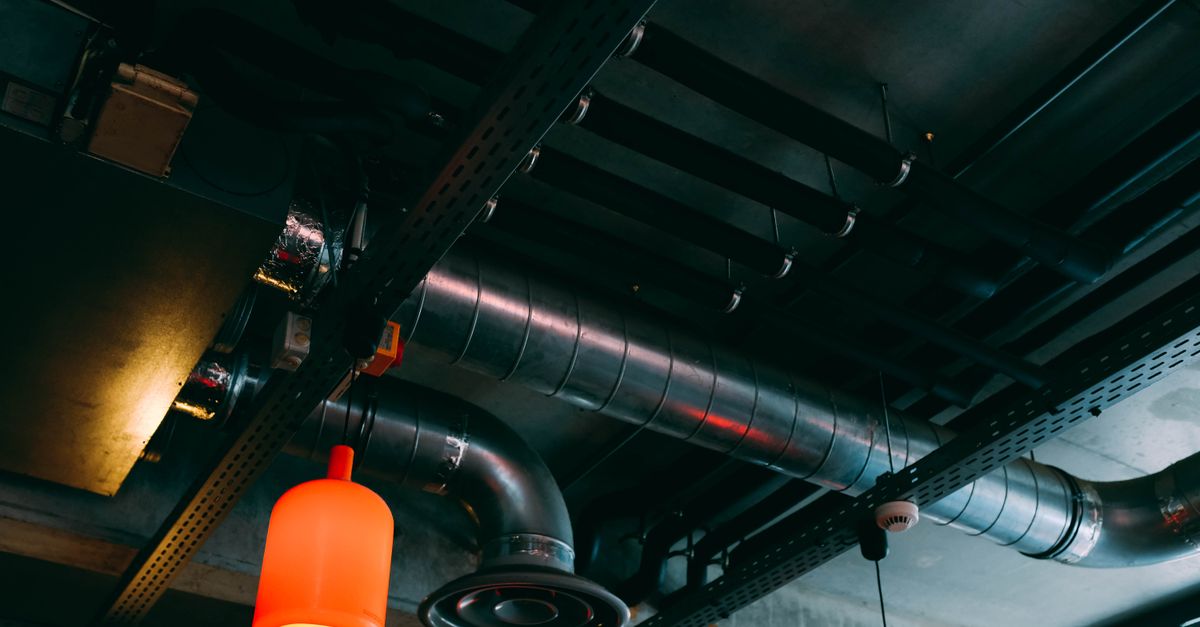
Why HVAC Systems Use Oval Ducts and the Ellipse Formula
Oval ducts are standard in commercial HVAC, especially where ceiling or riser space is tight. A round duct is the most aerodynamically efficient shape for moving air, but it does not fit into shallow ceiling voids. A rectangular duct of the same height squeezes more cross-section into the void, but creates more surface friction at the corners. An oval (technically an ellipse in cross-section) is the compromise: more flow area than a rectangle of equal height, lower friction than an equally wide rectangle, and a flat side that mounts flush against a slab.
Whatever the reason for choosing it, the flow area of the oval cross-section is the number an engineer needs first. That flow area is the same geometric quantity as the area of an ellipse, and the formula has not changed since antiquity:
A = π · a · b
where a is the semi-major axis (half of the longest full width) and b is the semi-minor axis (half of the shortest full width). A circle is the special case where a = b = r, and the formula collapses to the familiar πr². If you already have the full width and height of the duct from a datasheet, divide each by 2 before you start — entering the diameters instead of the radii is the single most common mistake in this calculation, and it propagates into every downstream airflow number.
Calculating Oval Duct Area in Three Steps
- Measure the oval duct's longest and shortest full widths. Use the manufacturer's datasheet, or measure across the duct opening at its widest point and at its tallest point. For a typical flat-oval duct these might be 200 mm on the long axis and 100 mm on the short axis.
- Divide each full width by 2 to get the semi-axes. Half of 200 mm is 100 mm, half of 100 mm is 50 mm. Open the Ellipse Area Calculator and enter a = 100 (mm) in the first box and b = 50 (mm) in the second box. The unit can be anything — mm, cm, m, inches, feet — as long as both axes use the same one.
- Read the area below the inputs. The tool displays the result immediately, along with the substitution A = π × 100 × 50 = 5,000π ≈ 15,708 mm². It also shows the perimeter (≈ 484.5 mm using Ramanujan's approximation) and the eccentricity (≈ 0.866) so you have a full geometric description of the duct from a single pair of entries.
The Most Common Mistake: Semi-Axes vs Full Widths
The formula A = π·a·b is built around the half-widths, not the diameters. If an oval duct is 200 mm × 100 mm overall, the semi-major axis a is 100 mm, not 200, and the semi-minor axis b is 50 mm, not 100. Entering the full axes by accident makes the area come out four times too large:
- Correct (semi-axes): π × 100 × 50 = 5,000π ≈ 15,708 mm²
- Wrong (full axes): π × 200 × 100 = 20,000π ≈ 62,832 mm²
That 4× error silently propagates into every downstream calculation: airflow velocity, friction loss per meter, equivalent round diameter, and final CFM all come out wrong by the same factor. Always check that each number you typed into the tool is half of the corresponding full diameter of the duct before you copy the result into your schedule.
A quick sanity check: for any flat-oval duct where the long axis is twice the short axis (the common 2:1 ratio), the area still comes from A = π·a·b using the semi-axes. For a 200 × 100 mm duct the semi-axes are 100 mm and 50 mm, giving π × 100 × 50 = 15,708 mm². When in doubt, run the numbers through the Ellipse Area Calculator rather than rely on mental shortcuts.
Perimeter and Eccentricity: Two Outputs You Get for Free
An ellipse has no exact elementary formula for its perimeter — the true value is an elliptic integral. The calculator reports the perimeter using Ramanujan's second approximation, C ≈ π(a+b)(1 + 3h/(10 + √(4 − 3h))), with h = ((a − b)/(a + b))². For ordinary oval ducts this approximation is accurate to many decimal places. When a = b the oval becomes a circle, h becomes 0, and the formula returns exactly 2πa — so the tool degrades gracefully to the familiar circumference formula.
Perimeter matters in HVAC for estimating duct skin surface area when sizing insulation or heat-loss calculations. For a long oval duct run, multiply the perimeter by the duct length to get the skin area in mm² or in². The same number also feeds equivalent round diameter calculations used by SMACNA and ASHRAE lookup tables.
The eccentricity, e = √(1 − (b/a)²) using the longer axis as a, tells you how stretched the oval is. A value of 0 is a perfect circle; values approaching 1 are long and thin. For a typical flat-oval duct with the proportions 2:1, the eccentricity is √(1 − 0.25) ≈ 0.866 — moderately elongated. The same number that describes the shape of an oval duct also describes the shape of a planet's orbit, which is exactly why the same formula handles both.
When You Actually Need Oval Duct Area
Calculating oval duct area comes up in a predictable set of jobs across HVAC design and installation:
- Sizing for airflow: CFM = velocity × area. Once you know the target velocity (typically 700–900 ft/min for supply air in commercial ductwork) and the duct area, you can size the duct for a given CFM, or back-calculate velocity from a known CFM and a fixed duct size.
- Friction-loss calculations: Equal-friction or static-regain methods both use cross-sectional area to derive the friction rate per 100 ft of duct. Equal-friction tables assume a round duct, so oval sections are converted to an equivalent round diameter based on area.
- Material takeoff and insulation: Duct surface area depends on perimeter × length, and lining or external wrap quantities are quoted per square meter of skin. Insulation thicknesses are added to the outer dimensions for the area calculation.
- Code compliance: Some standards quote minimum duct sizes in equivalent round diameter, which is back-calculated from the cross-sectional area the oval actually carries.
Oval vs Rectangular Duct: A Quick Comparison
How does an oval duct stack up against a rectangular duct of the same height? The table below summarizes the trade-off qualitatively — exact numbers depend on the specific dimensions, which is why engineers size each run with the calculator rather than from a generic chart.
| Property | Round / Oval Duct | Rectangular Duct |
|---|---|---|
| Airflow efficiency (friction per unit area) | Higher — smoother walls, no corners | Lower — corners add friction loss |
| Space required for a given flow area | Compact when round; flat-oval fits shallow voids | Wider for the same area; flush to slab |
| Cross-section formula | A = π · a · b (ellipse) or πr² (circle) | A = width × height |
| Insulation / skin area per unit length | Lower for the same flow area | Higher — more perimeter for the same area |
| Best calculator for the cross-section | Ellipse Area Calculator | Rectangle Area Calculator |
For most low-velocity supply runs in shallow ceiling voids, flat-oval ducts carry 10–20% more flow area than a rectangular duct of the same height, with friction losses in between the round and rectangular cases. For fabric-duct or acoustic-sensitive installations, oval may also be preferred for its smoother airflow profile. Whatever the design choice, the underlying flow-area math is the ellipse formula above — and the same Ellipse Area Calculator gives the number you need to size the run.
A Worked Example: 8″ × 4″ Oval Duct
To verify the calculation by hand, take an oval duct with full dimensions 8 inches by 4 inches. The semi-axes are a = 4 in and b = 2 in. Substituting into A = π·a·b gives:
A = π × 4 × 2 = 8π ≈ 25.13 in²
The Ellipse Area Calculator returns the same area, plus the perimeter (≈ 19.38 in using Ramanujan's approximation) and eccentricity (≈ 0.866). At 800 ft/min supply velocity — a typical commercial supply-air target — the CFM carried by this duct is:
CFM = velocity × area = 800 ft/min × (25.13 / 144) ft² ≈ 800 × 0.1745 ≈ 139.6 CFM
Plugging the two semi-axes into the tool gives that 25.13 in² in the time it takes to type the values, leaving the velocity-to-CFM conversion to a separate step. For international projects where the source dimensions are in millimeters, the same calculation runs identically with a = 100 mm and b = 50 mm — the calculator is unit-agnostic and just evaluates π × a × b with whatever numbers you type, as long as both axes are in the same unit. If the result needs to be converted from square inches to square feet, square meters, or any other area unit, hand it to a dedicated area converter so the unit math stays separate from the geometry.
Related reading: How to Calculate Flooring for a Room: Area, Waste, Boxes.
Related reading: How to Calculate Irregular Hexagon Area Step by Step.