Fahrenheit readings can be turned into Celsius using a single linear formula: °C = (°F − 32) × 5/9. Subtract 32 from the Fahrenheit value to remove the offset between the two scales, then multiply by 5/9 (or 0.5556) to convert the Fahrenheit interval size to the Celsius interval size. As one worked example, 98.6 °F (normal human body temperature) becomes (98.6 − 32) × 5/9 = 66.6 × 5/9 = 37 °C, the figure widely used in medical references. The formula is exact because both scales divide their range between the freezing and boiling points of water into equal pieces — Fahrenheit into 180 parts and Celsius into 100 — giving the 100/180 = 5/9 ratio. Most readers don't need to memorize the arithmetic, however. A browser-based tool such as the Temperature Converter applies the same NIST-published equations, validates against absolute zero, and returns a labeled equation you can paste into a worksheet, lab notebook, or recipe.
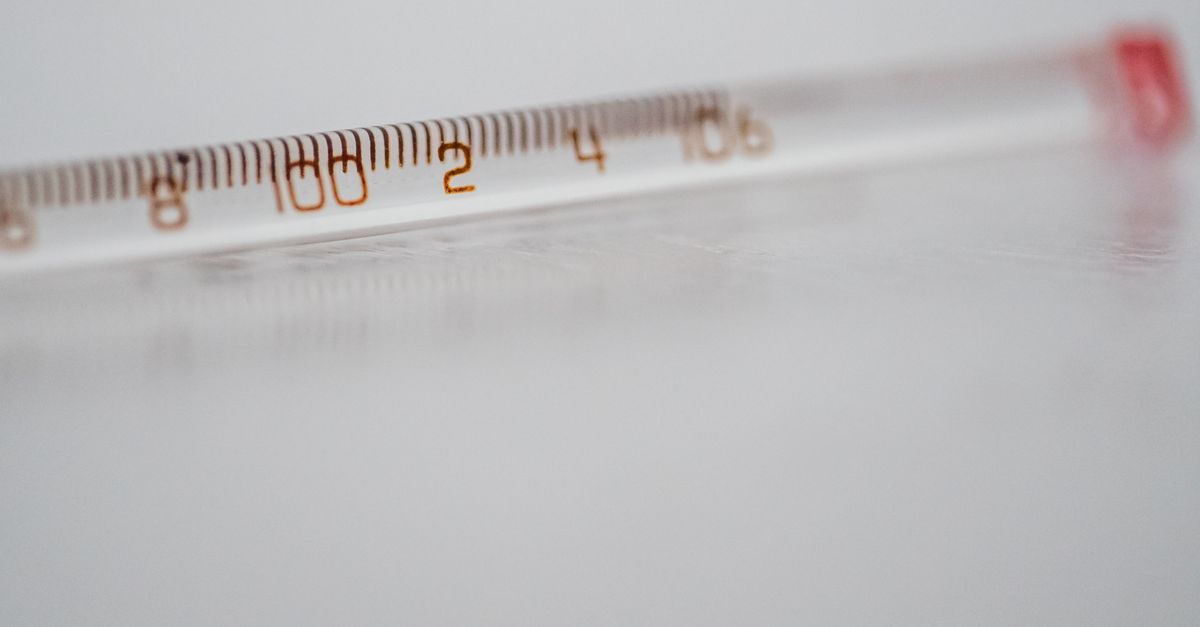
How the Fahrenheit and Celsius scales relate
Fahrenheit and Celsius are both offset scales — neither starts at absolute zero — so a conversion has to handle two things at once: where the scale starts and how big each unit is. Under ordinary reference conditions, water freezes at 0 °C and 32 °F, and it boils at 100 °C and 212 °F at standard atmospheric pressure. The 32-degree gap is the offset. The 180 Fahrenheit degrees between freezing and boiling versus the 100 Celsius degrees between the same two points is the interval ratio: 100/180 reduces to 5/9, which is why a Fahrenheit interval is smaller than a Celsius interval.
Combining the offset and the interval gives the familiar formula °C = (°F − 32) × 5/9. The same relationship rewritten in the other direction is °F = °C × 9/5 + 32, and a deeper analysis of why both forms are equivalent and where they come from historically is laid out in the related guide on the Celsius to Fahrenheit formula. The two scales also relate to the absolute scales — Kelvin in SI units and Rankine in US customary engineering units — through the same offsets, which is why any one-path converter that anchors on kelvin can serve all four scales at once.
How to convert Fahrenheit to Celsius with the Temperature Converter
- Open the Temperature Converter in your browser so the page loads locally with no upload or account step.
- Type your Fahrenheit reading into the input field. Ordinary decimal numbers like 98.6 work, as does scientific notation such as 1.5e2 for 150.
- Set the source selector to Fahrenheit and the destination selector to Celsius. The interface spells each scale out in full to avoid symbol confusion between °F, °C, K, and °R.
- Read the labeled equation that appears immediately below the input. The original value you typed is preserved on the left side, and the converted value is shown on the right with its unit.
- If you also need the reverse conversion, click the swap control to reverse the two selected scales; the equation updates in the browser with no server round-trip.
- To use the result in notes, lab worksheets, recipes, or technical documentation, click the copy action. It places a labeled equation on your clipboard, and switching scales or editing the input clears the previous copy confirmation so the interface never implies an older equation is still selected.
Reference points for sanity-checking a Fahrenheit to Celsius conversion
Before trusting a converted value, it helps to compare it against a few widely cited reference points. The figures below come from the scale offsets published in NIST Special Publication 811 and the BIPM SI Brochure, and they are the same anchors the Temperature Converter uses internally. For environmental or pressure-dependent work, treat these as scale reference points only — actual freezing and boiling behavior depends on pressure, composition, purity, and measurement convention.
| Physical reference | Celsius (°C) | Fahrenheit (°F) | Kelvin (K) | Rankine (°R) |
|---|---|---|---|---|
| Absolute zero | -273.15 | -459.67 | 0 | 0 |
| Water freezing (standard) | 0 | 32 | 273.15 | 491.67 |
| Water triple point | 0.01 | 32.018 | 273.16 | 491.688 |
| Water boiling (standard atm) | 100 | 212 | 373.15 | 671.67 |
A quick mental shortcut: any Fahrenheit reading above 32 °F converts to a positive Celsius number, and any Fahrenheit reading below −459.67 °F is physically impossible because it would fall below absolute zero. The familiar weather range — say, 70 °F — maps to about 21 °C, which most readers find easier to verify against the table than to compute from the formula. Historically, the water triple point was assigned 273.16 K to define the kelvin; the current SI definition fixes the Boltzmann constant instead, but the 273.16 K anchor remains a useful conversion point.
Absolute readings versus temperature intervals
Temperature conversions come in two flavors, and they use different arithmetic. Converting an absolute reading — the value you read off a thermometer — requires both the offset and the interval ratio, which is why 1 °C reads as 33.8 °F rather than 1.8 °F. Converting an interval or change in temperature requires only the interval ratio: a 1 °C change has the same size as a 1 K change and equals a 1.8 °F change, while a 1 °F change equals a 5/9 °C change. The Temperature Converter works on absolute readings only, which is the typical use case when you have a thermometer value and want it expressed on another scale. If your problem is a temperature difference — for example, an engineering tolerance or a cooking range — apply the interval ratio directly rather than feeding the difference into the converter as if it were a reading.
The distinction also shows up in how the symbols are written. Kelvin uses the symbol K with no degree sign, because it is an absolute SI unit; Celsius, Fahrenheit, and Rankine use °C, °F, and °R respectively. The converter's selectors spell each scale out in full to reduce symbol confusion, and the displayed equation preserves the original entered value on the left side so you can confirm what was actually typed before reading the converted result.
Validation and safety checks the converter applies
Behind the simple interface, the Temperature Converter applies several checks that catch inputs which would otherwise produce meaningless output. Every accepted input must be a finite absolute temperature entered as ordinary decimal or scientific notation. Empty text, non-decimal strings, Infinity, and non-finite scientific notation all produce explicit messages instead of a misleading number. The input must also be at or above 0 K after conversion to kelvin; that rejects any Fahrenheit value below −459.67 °F, any Celsius value below −273.15 °C, any Rankine value below 0 °R, or any negative kelvin. The bound matters because a syntactically valid number can still be physically outside the scale, and the converter surfaces that as a specific absolute-zero error rather than retaining a stale result from a previous conversion.
A separate guard caps magnitude at 1e100. This is a software numeric guard intended to prevent meaningless floating-point extremes and is not a physical maximum. Output formatting keeps up to twelve significant digits, strips trailing zeros, normalizes negative zero to 0, and switches to scientific notation for very large or very small nonzero results so long runs of zeros do not hide useful digits. JavaScript numbers use IEEE 754 double precision, so values with many significant digits may be rounded at roughly fifteen to sixteen decimal digits even though the defining scale offsets and ratios are applied directly. For formal metrology wording about the kelvin definition and scale relationships, the NIST SI units for temperature guidance is the appropriate reference.
Carrying measurement uncertainty through a conversion
A converter cannot make a thermometer more accurate than it already is. The temperature you typed in is the temperature you get out, just expressed on a different scale, and any uncertainty in the original reading travels with the converted value. For calibrated laboratory work, regulatory reporting, or safety-critical engineering, keep the instrument calibration, reference conditions, and required significant figures alongside the converted number. If you need formal wording about the kelvin definition, the historical 0.01 °C to 273.16 K water triple point anchor, or the current SI definition through the Boltzmann constant, the NIST and BIPM publications linked through the converter are the appropriate references. For everyday use — a recipe, a weather forecast, a thermostat setting — the converted value and a sensible number of significant digits are usually enough.