A grams-to-cups conversion requires the ingredient's density: cups = grams ÷ grams per cup, and the cup size must match the source.
Grams measure weight, while cups measure volume. Because an ingredient's density determines how much weight occupies a given volume, a cup of flour cannot represent the same number of grams as a cup of sugar, honey, or water. A trustworthy answer therefore requires an ingredient-specific density or gram-per-cup value.
The Cooking Measurement Converter deliberately does not perform that cross-type conversion. It can convert grams to ounces, pounds, or kilograms, and it can convert cups to milliliters, fluid ounces, teaspoons, or tablespoons. It cannot calculate grams to cups without an ingredient's density.
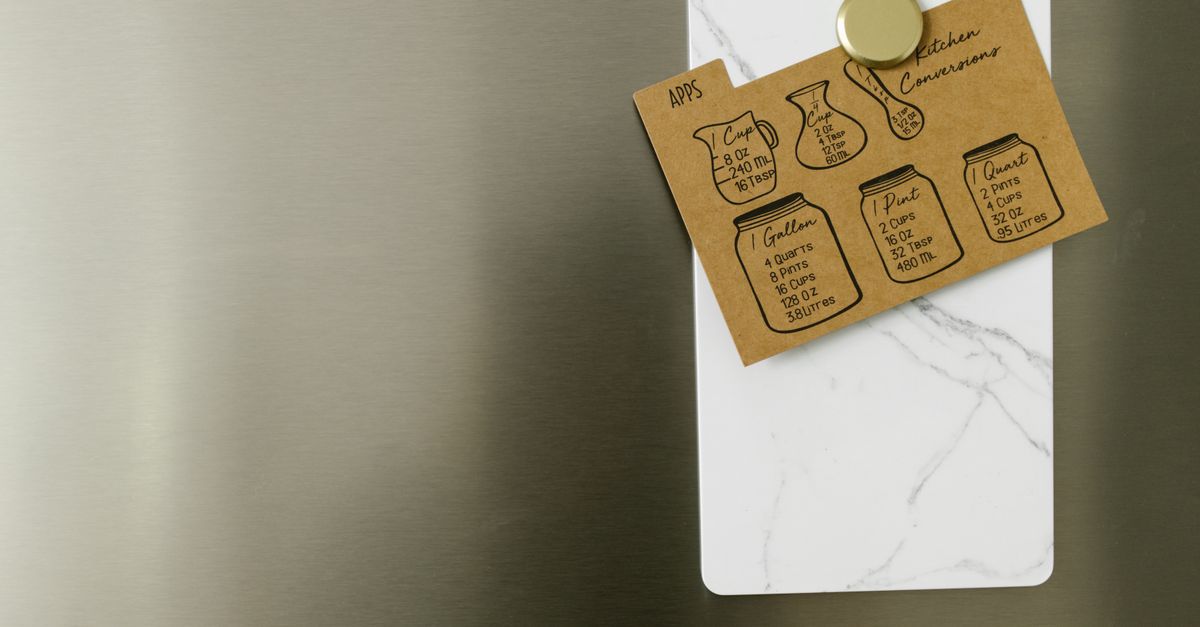
The measurement-type rule behind grams-to-cups conversions
Every kitchen measurement belongs to one of three independent types: volume, weight, or temperature. Volume includes cups, tablespoons, teaspoons, fluid ounces, pints, quarts, gallons, milliliters, and liters. Weight includes grams, kilograms, ounces, and pounds. Temperature includes Celsius, Fahrenheit, and UK gas mark.
A conversion is reliable when both measurements belong to the same type. Grams can become ounces because both measure weight. Cups can become milliliters because both measure volume. Grams and cups do not belong to the same type, so their relationship must include density rather than a universal unit factor.
- If you know grams per cup: cups = grams ÷ grams per cup.
- If you know density in grams per milliliter: first multiply density by the cup volume in milliliters to obtain grams per cup, then divide the recipe weight by that value.
Keep the ingredient, density, and cup definition together. A density value paired with one cup size cannot safely be used with another cup size.
Convert grams to cups with a repeatable workflow
- Identify the exact ingredient. Look for flour, granulated sugar, honey, milk, or another specific ingredient rather than searching for a generic “cup to grams” number. Different ingredients—and potentially different forms of the same ingredient—do not necessarily share a density.
- Find an ingredient-specific density source. Use a dedicated ingredient chart or a reliable recipe-specific weight reference that provides either grams per cup or grams per milliliter. This ingredient information is the part the cooking converter intentionally leaves out.
- Confirm the cup standard used by that source. Check whether the gram-per-cup value is based on a US customary cup, a UK imperial cup, or the 250 mL metric cup. Do not divide by a US cup figure when the source uses another system.
- Perform one final division. To show the arithmetic without assigning a density to a real ingredient, suppose a chart lists 120 g per US cup. For a recipe quantity of 240 g, the calculation is 240 g ÷ (120 g per cup) = 2 cups. These numbers are illustrative; the ingredient chart supplies the real denominator.
- Convert the resulting cup amount to another volume unit if needed. Open the cooking converter, choose Volume, enter the amount, set cups as the From unit, and select milliliters, liters, fluid ounces, teaspoons, or tablespoons as the To unit. Read the result and use Copy result if you want to paste it elsewhere. The swap button reverses the direction.
- Stay in Weight mode when cups are not actually required. To convert a gram quantity directly to ounces, pounds, or kilograms, choose Weight, enter the amount, set grams as the From unit, and select the desired weight unit as the To unit. This gives an exact weight-to-weight result without introducing an ingredient assumption.
Cup size changes the numerical answer
The word “cup” does not identify one universal volume. The cup size used by the ingredient source must remain consistent from the density lookup through the final recipe measurement.
| Cup standard | Volume of one cup | How to treat it |
|---|---|---|
| US customary | 236.5882365 mL, approximately 236.6 mL | The default cup used by the cooking converter |
| UK imperial | About 284.1 mL | Use only when the recipe or ingredient source specifies it |
| Metric | Exactly 250 mL | Use when the source specifies the metric cup |
The converter's cup definition is based on eight US fluid ounces and uses exact US customary factors rather than rounded kitchen estimates. If an ingredient chart uses metric cups, retain that label in your notes instead of presenting the result as a US cup. You can enter the metric volume in milliliters when the converter supports that unit, while keeping the original cup standard visible in your recipe.
What the cooking converter handles directly
Choosing the correct conversion type is the main safeguard against an incorrect result. The available task comparison is:
| Requested task | Measurement type | Direct conversion | Reliable route |
|---|---|---|---|
| Grams to ounces, pounds, or kilograms | Weight | Yes | Choose Weight, then select the From and To units |
| Cups to milliliters, tablespoons, teaspoons, or fluid ounces | Volume | Yes | Choose Volume, then select the From and To units |
| Grams to cups | Weight to volume | No | Obtain the ingredient's density first, then use the division formula |
| Milliliters to fluid ounces | Volume | Yes | Choose Volume and keep both units in the volume family |
| Celsius to Fahrenheit | Temperature | Yes | Choose Temperature and select the oven units |
Weight ounces and fluid ounces are different measurements. An ounce is a unit of mass, while a fluid ounce is a unit of volume. The interface keeps those choices separate, which prevents a weight value from being mistaken for a liquid volume.
The tool uses exact conversion factors, including the US fluid-ounce definition for volume and the 1959 international yard and pound agreement for weight. Every calculation runs locally in the browser, and nothing entered into the converter is uploaded. Temperature conversions also remain separate; a UK gas mark is a discrete oven setting that snaps to the nearest mark on its standard chart.
Choose the route that matches your recipe
Start by identifying what you actually need rather than converting every unit in the recipe:
- You have grams and need another weight: Use the converter's Weight mode. This is the appropriate route for grams to ounces, pounds, or kilograms.
- You have milliliters and need cups: Use Volume mode to convert the liquid volume, then confirm that the recipe's cup standard matches the tool's US customary default.
- You have grams and need cups: Find the ingredient's density or grams-per-cup value first. Divide the grams by that value, keeping the cup standard attached to the answer.
- You have a cup measurement and need grams: Reverse the same density-based method. Multiply cups by the ingredient's grams per cup rather than applying a generic factor.
If your actual destination is ounces or pounds rather than cups, How to Convert Baking Measurements to Weight provides the weight-only workflow without introducing an unnecessary volume conversion.
An accuracy checklist before you scale
Before changing a recipe, check each part of the conversion chain:
- Ingredient: Confirm that the density or weight reference is for the same ingredient you are measuring.
- Cup system: Match US customary, UK imperial, or metric cups consistently.
- Measurement type: Do not treat grams, ounces, and pounds as volume, or cups, teaspoons, and fluid ounces as weight.
- Formula: Use the ingredient's gram-per-cup value as the denominator rather than treating one cup as a fixed number of grams.
- Rounding: Round only the final amount, and retain enough precision to match the accuracy of your scale or measuring cup.
- Tool output: Read the From and To labels before copying a result, especially when working with ounces and fluid ounces.
For the shortest reliable process, obtain an ingredient-specific density, confirm the cup definition, and divide grams by grams per cup. Use the cooking converter for conversions that remain within one measurement type. That separation is the feature that keeps an otherwise plausible answer from being confidently wrong.
If you're weighing options, Convert Cooking Measurements to Grams: Weight or Volume? covers this in detail.