A key press counter on a laptop is a browser tool that records keydown events delivered to a focused capture area, then displays the running total, a sorted per-key frequency table, and the most recent ten labels received. The counting happens entirely inside the current browser tab and depends on a single boundary: the visible capture area must have keyboard focus, which you give it by clicking inside the dashed outline. While that area is focused, the page intercepts ordinary keystrokes to prevent accidental scrolling or button activation, but Tab stays free so you can always leave the area using the keyboard alone. Keystrokes typed elsewhere on the page or in another application are never counted. Anything the browser or operating system intercepts first, including many system shortcuts, will also fail to produce a record. Treat the running numbers as a picture of browser events, not a measurement of the physical keyboard sitting under your hands.
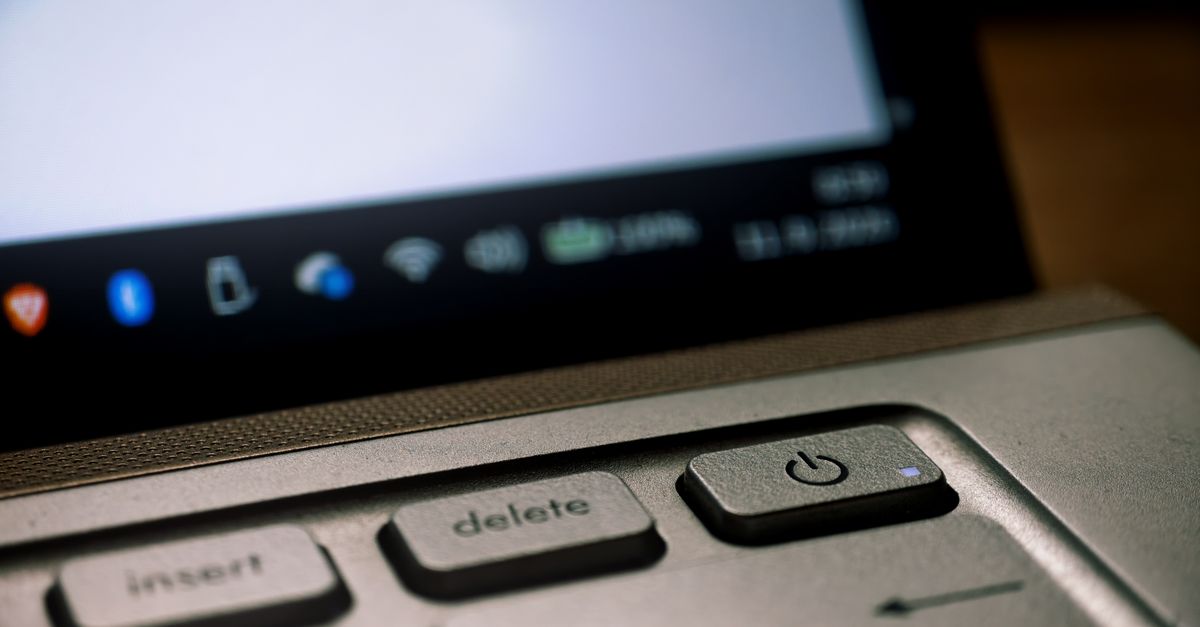
What a Laptop Key Press Counter Measures
On a laptop, a key press counter is built around one strict rule: it only counts events delivered to its own capture element while that element has keyboard focus. The capture element is the dashed area you see on the page; clicking inside it transfers focus there, and from that moment on the page listens for keydown events on that single element. Anything else - typing in a different tab, into another application on your laptop, or even into another field on the same page - falls outside the listener and produces no record.
This design matters because laptops combine a built-in keyboard with whatever external keyboard or input method you might plug in or pair. The counter cannot tell the difference. What it sees is a stream of browser keydown events whose labels come from the browser's KeyboardEvent.key value, not from scan codes, layout tables, or the physical switch under the keycap. A built-in laptop chiclet and a USB mechanical keyboard attached to the same laptop will look the same to the counter, because the browser hands the page a single normalized label per event.
That label is also cleaned up before it reaches the frequency table. A literal space character becomes the word "Space" so the table stays readable. A single visible character is shown in uppercase when the browser supports locale conversion, and named values such as "ArrowUp" stay as written. Control characters, surrogate code points, and Unicode line or paragraph separators are removed; an empty result is stored as "Unknown". Any label longer than forty Unicode code points is trimmed before storage. The result is a frequency map that describes what the browser reported, in a form a human can scan.
How to Count Key Presses on Your Laptop
- Open the Key Press Counter page in your browser and locate the dashed capture area.
- Click inside the capture area once so it gains keyboard focus; a focused outline or similar visual cue will appear.
- Press neutral test keys with the capture area focused; avoid passwords, recovery codes, or any sensitive input.
- Leave the held-key repeat toggle off to count one event per physical press, or turn it on when you want every browser event marked repeat to count.
- Watch the total, the recent ten labels, and the sorted frequency table update as you type.
- Press Tab whenever you want to move focus out of the capture area using the keyboard alone; other keys stay captured.
- Select Reset counter when you want the total, the frequency map, and the recent history to return to zero for a fresh session.
The first click is the step readers most often skip. Until the capture area is focused, no keystroke is counted, not even if you are typing directly at it. The visual cue varies by browser, but the behavior is the same: focus is a single property attached to one element, and the counter's listener only runs while that element holds it.
Neutral test keys mean letters that carry no information you care about, such as repeated presses of "j", "k", or the spacebar. The frequency table is meant to show distribution and order, not to log content. Even though the tool processes everything locally and does not upload any label, treating the capture area like any other test surface keeps you out of habits that might lead you to type something sensitive into a stranger's form.
Tab deserves a separate note. The page deliberately leaves Tab available inside the capture area so keyboard users can move focus to the next control without a mouse. Tab is never recorded as a label. Once you Tab out, keystrokes resume their normal behavior on the next focused element, and the counter stops receiving events until you click back inside.
Reading the Total, Recent Labels, and Frequency Table
The total is the simplest field. Every accepted keydown event adds exactly one to the total, and every accepted event also adds one to the counter for its normalized label. With repeat counting off, the total rises by one per physical press, or more precisely, per non-repeat event the browser delivers. With repeat counting on, the total rises by one per accepted event, which includes every event marked repeat.
The frequency table is sorted by descending count, then alphabetically by label for stable ties. Two labels with the same count will always appear in the same relative order within the current session, which makes the table useful for confirming patterns such as "A appeared three times and Space appeared twice" without ambiguity. Counts accumulate only within the current session; refreshing the page starts a new frequency map.
The recent history shows only the last ten accepted labels, in order. Anything older scrolls off. This is a deliberate boundary: it lets you confirm the last few keys you pressed without preserving a complete reconstruction of everything typed. If you need a longer view, the frequency table is the field that survives, because each accepted event increments the count for its label regardless of how many older labels have already scrolled out of the recent view.
| Input to the capture area | Stored label after normalization |
|---|---|
| Literal space character | Space |
| Single visible character (where locale supports it) | Uppercase form |
| Named values such as ArrowUp, Enter, Escape | Named value as written |
| Control, surrogate, line or paragraph separator code points | Removed (empty result becomes Unknown) |
| Label longer than 40 Unicode code points | Trimmed to 40 code points |
Held-Key Repeat Counting: When the Toggle Changes the Numbers
Browsers commonly deliver an initial keydown event when you press a key, then a stream of additional events marked repeat while the key remains held. The Key Press Counter treats that repeat flag as the source of truth: with the toggle off, events marked repeat return the existing state unchanged - the total stays where it was and the frequency table is not touched. With the toggle on, every received repeat event increments the total and that key's frequency.
This matters when you compare two totals that came from different toggle states. A held "k" with the toggle off contributes one to the total for "K". The same held "k" with the toggle on contributes one for the initial press plus one for each repeat event the browser chose to deliver. The exact repeat rate depends on the operating system's keyboard repeat delay and rate, not on the counter, which simply trusts whatever the browser reports.
The tool does not measure physical debounce, polling rate, or scan code timing. It does not independently determine whether repeated events came from a held physical key, key chatter, an automation script, an input method, or accessibility software. The repeat flag is a browser-level signal, not a hardware signal. If you need to characterize chatter or switch behavior directly, you are looking at a different question than this counter is built to answer.
What the Counter Cannot Tell You About Your Laptop Keyboard
The Key Press Counter reports what the browser saw, not what your laptop keyboard did. That distinction is sharp in three areas. First, scan codes, layout correctness, and switch health are not part of the data the page receives. Second, browser and operating system shortcuts can be intercepted before any web page sees them, so not every physical action is guaranteed to create a record. Third, composed text from an input method may not correspond one-to-one with physical switches, especially on systems where a single keypress produces a multi-character string.
Mobile keyboards, when a laptop is running in tablet mode or paired with a phone, can produce different labels and editing behavior. Synthetic events from browser extensions, remote-desktop software, on-screen keyboards, and accessibility tools all flow through the same handler and influence the events the page receives. None of those layers are visible in the frequency table, so the table is best read as a record of browser-visible activity rather than a profile of hardware behavior.
If your goal is to verify that every key on your laptop keyboard still generates a press at all, a layout-based keyboard tester is the more direct tool. The Key Press Counter and a layout tester answer different questions: the tester lights keys to help you locate ones that do or do not generate events, while this counter focuses on quantity and distribution. For most readers the practical pattern is to use a keyboard tester to confirm physical coverage and a key press counter to study how often and in what order accepted events arrive.
Privacy and Local-Only Behavior on a Laptop
Everything the Key Press Counter shows you comes from a handler attached to its own visible capture element. There is no hidden document-wide listener. Accepted labels and counts are not uploaded to any server, saved to an account, copied to the clipboard, or retained after the page is refreshed. The widget does not draw a physical layout, identify a keyboard model, calculate words per minute, or score accuracy.
That local-only contract is the reason the earlier step recommends neutral test keys. Because nothing leaves the tab, the risk of typing into the capture area is not exposure; it is the habit of typing into a test field at all. Recovery codes, passwords, private messages, and one-time tokens should never be typed into any test area on any page, regardless of how the page describes its privacy. The counter is built for distribution and order, not for content, and there is no reason to feed it content.
If you want a fresh start, the Reset counter control clears the total, the frequency map, and the recent history in the current session. Closing the tab or refreshing the page has the same effect, because nothing is persisted between sessions. The reliable contract is exactly what the controls show: explicit repeat policy, label cleanup, immutable count updates, a ten-label recent view, stable frequency sorting, and a manual reset that returns the session to zero.
If you're weighing options, Mouse Scroll Test on Laptop: Verify Every Direction covers this in detail.
If you're weighing options, Document the Steps You Use With Multi Counter covers this in detail.