The Fibonacci sequence is the zero-based indexed list 0, 1, 1, 2, 3, 5, 8, 13, 21, 34, 55, where each term after the first two equals the sum of the two preceding it, and it appears in nature as the recurring counts of flower petals, sunflower seed spirals, pinecone scales, and shell chambers. When you go looking for these patterns, the practical task is double-checking what you see against an authoritative list of values so you know whether a count you observed is genuinely one of the terms. Many casual sources skip the zero and start at 1, 1, which makes it harder to compare a petal count or a spiral count to the right index. The most reliable approach is to count what you find in nature, then check that number against an indexed Fibonacci reference generated with exact arithmetic. The Fibonacci Sequence Generator produces a complete zero-based list from F(0) through F(999) in your browser using BigInt arithmetic, so any number from a single petal count to a large spiral tally can be matched against the right index. That local, copy-ready list is what turns a casual observation into a verified one.
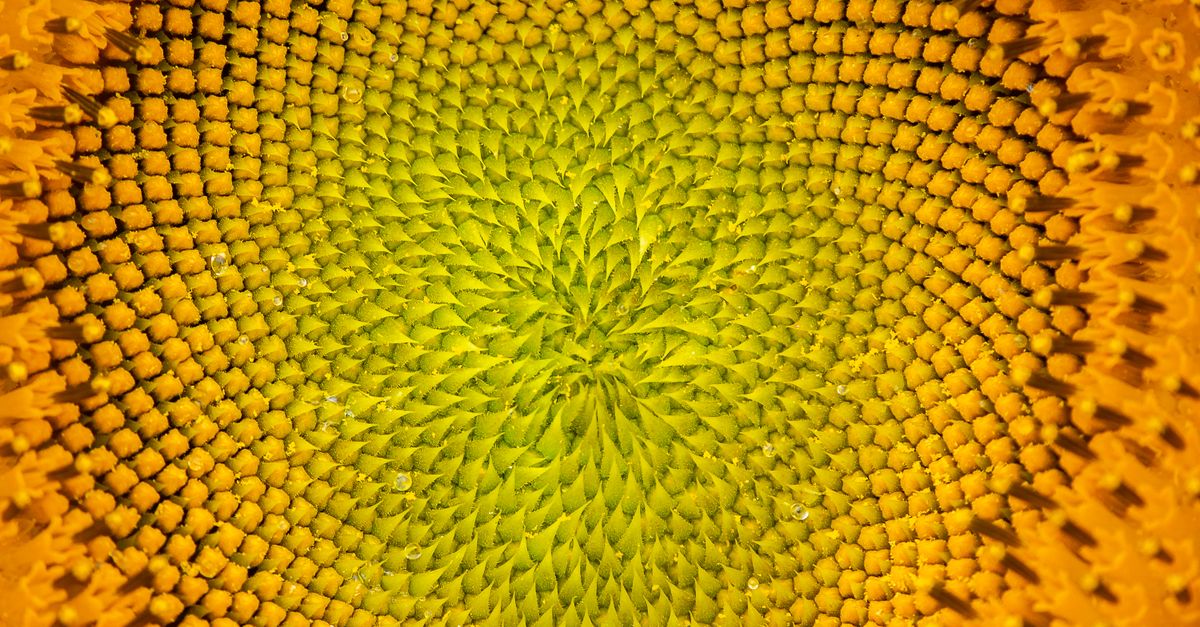
Where Fibonacci Numbers Show Up in Nature
The most reliable places to look are objects that grow by adding identical repeating units around a center. The Fibonacci numbers show up in three commonly cited families of natural objects:
- Flower petals: petal counts often land on small Fibonacci terms. Three, five, eight, thirteen, twenty-one, and higher numbers such as thirty-four, fifty-five, and eighty-nine all appear in different species.
- Seed and scale spirals: pinecones, pineapples, and sunflower heads arrange their seeds or scales in two interlocking spirals, one winding clockwise and the other counter-clockwise. The two spiral counts almost always sit next to each other in the sequence.
- Branch and leaf arrangements: stems, leaf veins, and tree branches tend to space new growth by the golden angle, which is closely tied to consecutive Fibonacci ratios.
These patterns are observations, not guarantees. Variation across species and individuals is normal, and a single specimen off by one will not refute the broader trend. The pattern is most visible when you compare many specimens side by side and look at the most common counts rather than the extremes.
How to Count Fibonacci Patterns When You Find Them
A consistent counting method matters more than any calculator. Different starting positions and directions will give different numbers, and only one of those numbers usually matches a Fibonacci term on a reference list.
- Pick a single observation unit. For petals, count only the outermost ring of petals, not the inner modified petals or sepals underneath. For seed spirals, count one direction at a time, not both at once.
- Mark your starting point. The number will change if you start one row over, so pick the most obvious edge (a torn petal, an exposed seed, a scale that sticks out) and stick with it.
- Count in one direction only. For spirals, pick either clockwise or counter-clockwise and count back to the same starting line. The two opposing spiral counts are what should be consecutive Fibonacci numbers, not the same number twice.
- Record the count as a single integer. Petal counts are easy to remember (3, 5, 8, 13, 21). Spiral counts run much higher (21, 34, 55, 89, 144) and benefit from being written down before you start looking them up.
- Compare against a reference list. Once you have a number, the next step is to confirm it sits at the expected index on an exact Fibonacci reference.
Generate an Exact Reference List to Check Your Observation
The simplest way to confirm what you counted is to compare it against an indexed list generated from the standard zero-based definition used by NIST DLMF §24.15(iv) and recorded as OEIS A000045. The Fibonacci Sequence Generator builds that list locally in your browser using exact BigInt arithmetic, so even large indices like F(100) or F(500) appear as full decimal strings rather than rounded approximations.
The table below shows how an indexed reference lines up with what you see outdoors.
| What you observe in nature | What the generator provides | Why it helps |
|---|---|---|
| A petal count of 3, 5, or 8 on a single flower | F(4) = 3, F(5) = 5, F(6) = 8 in the indexed list | Confirms the count is a Fibonacci term and shows its zero-based index. |
| A sunflower with 34 and 55 spirals in opposite directions | F(9) = 34 and F(10) = 55 on adjacent rows | Lets you check that the two opposing spiral counts are consecutive Fibonacci terms. |
| A pinecone with 8 and 13 spirals | F(6) = 8 and F(7) = 13 visible together | Confirms the typical 8-by-13 pairing in one quick lookup. |
| A large spiral tally of 144 or higher | Exact decimal values up to F(999) | BigInt arithmetic keeps every digit intact where ordinary rounding would distort the number. |
- Open the Fibonacci Sequence Generator in your browser and enter a whole-number term count from 1 through 1,000. A request for one term returns only F(0); a request for ten terms returns F(0) through F(9).
- Generate the sequence and read the summary line. The summary always states both the number of generated terms and the final index, so you cannot lose track of which F(n) you have reached.
- Scan the output for the index that matches your observation. Each row is formatted as F(index) = decimal value, so F(5) = 5 is the row you want for a five-petal buttercup, and F(9) = 34 is the row for a thirty-four-spiral sunflower.
- Copy the result if you want to keep a written record. Use the copy action for an exact newline-separated list, or select the visible text manually if clipboard access is unavailable.
For readers who want a deeper conceptual walkthrough of the zero-based definition, the concept of the Fibonacci sequence from F(0) onward explains why the zero seed matters and how the recurrence builds every term.
Why an Exact List Beats a Mental Recitation
For small indices the sequence is easy to remember: 0, 1, 1, 2, 3, 5, 8, 13, 21, 34, 55, 89, 144. Past that, mental arithmetic fails quickly. Here is a worked check on F(6) using the recurrence F(n) = F(n-1) + F(n-2):
- F(0) = 0
- F(1) = 1
- F(2) = F(1) + F(0) = 1
- F(3) = F(2) + F(1) = 2
- F(4) = F(3) + F(2) = 3
- F(5) = F(4) + F(3) = 5
- F(6) = F(5) + F(4) = 8
By F(10) the count is 55, by F(20) it is 6,765, and by F(50) it has more than ten digits. Standard JavaScript Number values lose exact integer precision past F(78), so any hand-calculated value above that threshold may be rounded without warning. The generator sidesteps this by storing every value as a BigInt and writing it as plain decimal text, which is what makes it trustworthy for verifying large spiral counts in mature pinecones or large sunflower heads.
What the Generator Will Not Confirm for You
The tool is a reference list, not a biology study. It will not measure a sunflower head, draw a spiral, decide which spirals count, or tell you whether a particular daisy is a Fibonacci daisy. It also will not test whether a number you observed belongs to the sequence on its own, factor values into primes, compute golden ratios, or claim that a numerical match proves a natural law. Use it to confirm the number. Use a field guide, a microscope, or a peer-reviewed study to confirm the biology.
Reading a Spiral vs. Counting a Spiral
Many people see the spiral shape in a nautilus shell or a sunflower and assume the spiral itself is the Fibonacci feature. The relevant number is not the curve, but the count of arms in the spiral pattern. A sunflower head typically shows two families of spirals winding in opposite directions, and the counts of those two families are neighboring Fibonacci numbers. If you count 21 spirals one way and 34 the other, both belong to the sequence, sitting at F(8) and F(9). If you count 22 and 35, you have missed the pattern on that specimen, but the species still follows the pattern on average.
The same caution applies to pinecones. A single cone rarely shows perfect 8 and 13 counts, but across many cones from the same tree the average pair sits next to each other in the sequence. Treat each observation as a single data point and the reference list as the dictionary. Matching the number is the easy step. Drawing a conclusion about why nature arranges itself that way is a separate question that no number generator can answer.
Related reading: Generate a Fibonacci Sequence From a Term Count.