The Stop the Clock Game is a free browser-based perfect timing game where you stop a running timer inside a visible millisecond window across five fixed rounds. Each round announces a target interval before the clock starts, and a stop on either edge of that interval counts as a hit. Every successful round awards exactly 200 points, so five successful stops produce the fixed maximum of 1,000 points with no random bonus and no penalty. After every stop, the game reports your normalized whole-millisecond reading, the signed error relative to the target center, and the deterministic point award, so every result is auditable. The five center targets are 1.500, 2.250, 3.000, 3.750, and 4.500 seconds, each surrounded by a 200-millisecond inclusive window. The game runs entirely in the browser, requires no download or account, and stores only your best completed score on the device if local storage is available. It is built as a recreational timer with transparent rules, not as a measurement of reaction, focus, or reflexes.
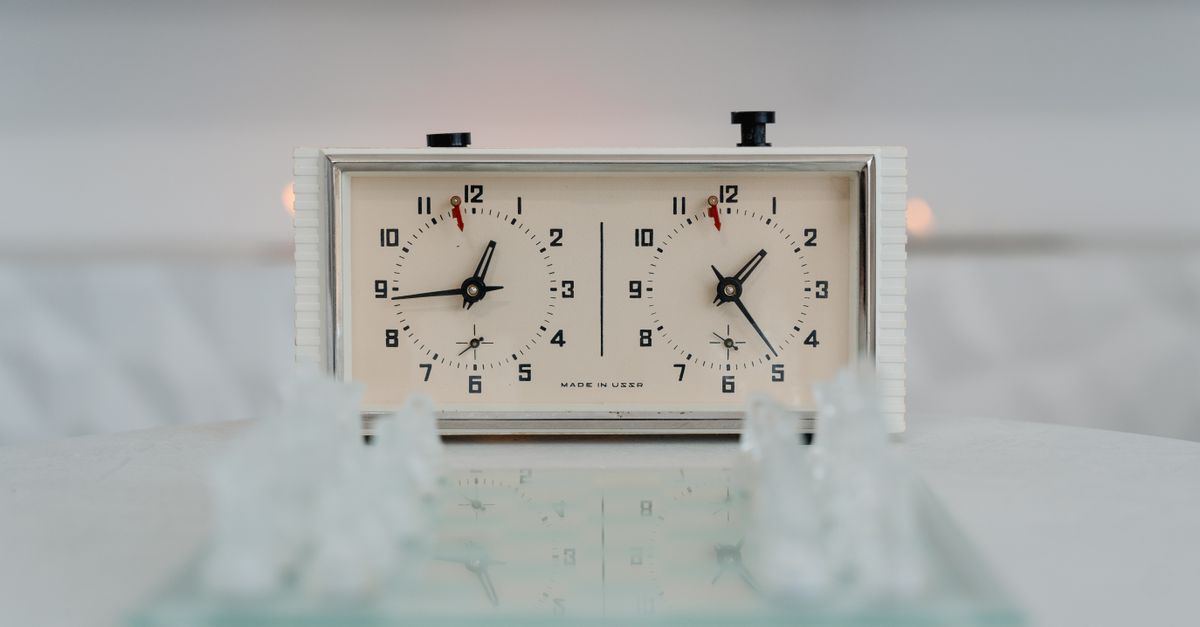
Five visible timing windows and how each one is built
Each round of the Stop the Clock Game announces an inclusive target window before the timer begins. The window extends 100 milliseconds earlier and 100 milliseconds later than the round's center target, and a stop on either edge counts as a successful hit. The center targets are original product settings rather than an external timing standard, and they are the same in every run.
| Round | Center target | Earliest stop | Latest stop | Window width |
|---|---|---|---|---|
| 1 | 1,500 ms | 1,400 ms | 1,600 ms | 200 ms inclusive |
| 2 | 2,250 ms | 2,150 ms | 2,350 ms | 200 ms inclusive |
| 3 | 3,000 ms | 2,900 ms | 3,100 ms | 200 ms inclusive |
| 4 | 3,750 ms | 3,650 ms | 3,850 ms | 200 ms inclusive |
| 5 | 4,500 ms | 4,400 ms | 4,600 ms | 200 ms inclusive |
For example, a stop at 1.400 seconds on the first round is a hit, while 1.399 or 1.601 is a miss. The exact center value of 1.500 reports zero error and is treated like any other in-window stop. Because the edges are inclusive, you never have to second-guess whether the boundary belongs to the window. The target changes each round, but nothing about the rule is random, and every rule is shown before the clock starts.
How the deterministic 200-point scoring works
Scoring in the perfect timing game is binary, transparent, and produces no surprises. The scoring engine keeps elapsed-time evaluation in a pure function: it accepts a round definition plus the elapsed milliseconds recorded when you press Stop, rounds that input to the nearest whole millisecond, calculates the signed error relative to the round's center target, applies the inclusive tolerance, and returns elapsed, error, hit status, and points together.
The scoring rule is straightforward. If the absolute error is at most 100 milliseconds, the result is a hit and you earn 200 points. If the absolute error is greater than 100 milliseconds, the result is a miss and you earn zero. There is no partial credit, no multiplier, and no tiebreaker. Worked example for round one with an elapsed stop of 1.582 seconds: rounded elapsedMs equals 1,582; error equals 1,582 minus 1,500 equals 82 milliseconds late; absolute error 82 is at most 100; the result is a hit; the awarded score for the round is 200 points. The error sign tells you whether you stopped early or late, so in this example the post-stop summary reports "82 ms late" without ambiguity.
Because the engine is a pure function, it can be tested directly. Production code does not expose an elapsed-time injection event, a listener, a query parameter, or a global test interface that could supply a forged value, so a real press of Stop is the only way to land a result. Frame rate never adds points, chooses a window, or decides a hit. A slow repaint may make the visible digits update less often, but the scoring decision still uses the elapsed measurement supplied to the scoring function.
How to play the perfect timing game
- Read the visible target interval for the current round. The window extends 100 milliseconds earlier and 100 milliseconds later than the center target, and both edges count as hits.
- Press the Start button. A performance.now reference records the UI start point, and requestAnimationFrame updates only the visible digits on screen.
- Keep your finger or cursor over the same focused Stop button so you do not waste time hunting for it. The game does not install a global Enter, Space, or arrow-key handler, so keyboard activation always uses whichever button actually has focus.
- Press Stop when the displayed timer value falls inside the announced interval. A stop on either edge of the window is a hit, and a stop one millisecond outside is a miss.
- Review the post-stop summary. It shows your normalized whole-millisecond reading, how many milliseconds early or late you were relative to the center, and the deterministic 200- or 0-point result.
- Choose Next Round after a hit. Choose Restart instead if you accumulated two distinct normalized misses, which deadlocks the run.
- Clear all five targets for exactly 1,000 points. On the fifth hit the game freezes as complete and records the 1,000-point best score through the shared local game shell.
Cancellation safety and the boss key
The Stop the Clock Game treats interruption as a first-class state, not as an edge case. Pressing Escape during an active round atomically calls the cancelClock transition, cancels the animation frame, clears the stored start reference, resets the visible reading, and returns the round to its Start state. Cancellation records no attempt, no miss bucket, no deadlock step, and no score, so leaving an active timer unattended never creates a hidden result.
Moving the document into a hidden state, which happens when you switch tabs or minimize the window, also cancels the round the same way. Returning to the page requires an intentional new Start. Double-tapping Escape opens a shared boss screen without changing the running rule, round, failures, target, or score, which is useful if you need to step away briefly without losing your run.
The implementation also guards several UI races that are easy to miss in a timer. A synchronous start reference blocks a second Start before React has time to redraw the button, preventing two animation-frame loops. The reference is cleared before a stop result is submitted, so a repeated Stop has no effect. Restart cancels any outstanding frame, clears the stored start, resets the display to zero, and recreates the exact round-one state. Negative or non-finite elapsed inputs leave the running state unchanged and do not create a result.
Miss normalization, deduplication, and Restart
Misses are normalized by direction and a 50-millisecond error bucket so that tiny differences in raw elapsed values do not punish you twice for the same mistake. Each miss records whether it was early or late and rounds the absolute error to the nearest 50-millisecond bucket. Repeating the same normalized miss does not add a second failure, even if the raw elapsed value differs slightly. A second distinct early-or-late 50-millisecond timing bucket deadlocks the run and requires Restart.
A successful stop clears failed signatures before the next round, so each visible target begins with a clean two-miss allowance. Completed games, deadlocked games, double Start attempts, Stop before Start, and actions after a successful result are frozen. A successful result remains visible until Next Round is activated, and Start cannot run again while a hit is waiting to advance. The five-round route therefore stays transparent: hit five windows, earn 1,000; miss twice in distinct ways, restart.
A recreational game, not an ability test
The Stop the Clock Game is a recreational estimation game, not a reaction-time test, medical device, accessibility assessment, attention evaluation, cognitive screen, coordination measure, reflex diagnosis, or employment or educational test. The score should not be interpreted as evidence about a person's ability or health. Browser scheduling, display refresh, input hardware, power management, and operating-system latency can all influence a manual stop, and the fixed windows and scores exist only to make the game understandable and repeatable.
Everything runs in the browser. Timer values, attempts, miss signatures, and scores are not uploaded. If browser storage is available, the shared game shell stores only the best completed score on that device; blocked storage simply removes that convenience. No account, network calculation, paid API, sensor, permission, downloaded package, or new dependency is required. The accessible layout, with a 44-pixel minimum button height and a timer type that scales down cleanly for a 390-pixel mobile viewport, keeps the same deterministic rules reachable on a phone.
Players who enjoy this format often gravitate toward other precise-timing browser challenges. Rhythm Tap Game tests beat anticipation with visual cues, while Bomb Defuse Game turns countdown management into the main objective. For a completely different kind of precision, Slingshot Launcher rewards pixel-unit aim rather than millisecond timing, which makes it a useful contrast for anyone who wants to keep their timing instincts sharp while shifting the underlying skill.
Related reading: Complete the Symmetry: Mirror Five Patterns to 1,000.
Related reading: 3D Tetris: A 6-Piece Route to 1,000 Points.