An intermediate idler gear does not change the final speed ratio magnitude between the driver and the target in the ideal same-module external-gear model used by Gear Rotation Puzzle. The idler contributes one factor to the numerator and one matching factor to the denominator of the propagated ratio, so its own tooth count cancels out completely. Only the driver and target tooth counts survive in the end-to-end speed magnitude. What the idler does change is the final rotation direction, because every external mesh reverses the sign of angular speed. After an odd number of external contacts the target spins opposite to the driver, after an even number of contacts it spins the same way. The puzzle tests that distinction with five deterministic fixtures, an exact 200-to-1,000 scoring route, and a contact tolerance of 0.75 game units for declared edges. Candidate gears arrive in different sizes that match visible socket distances, so the layout question is genuinely about physics rather than arithmetic.
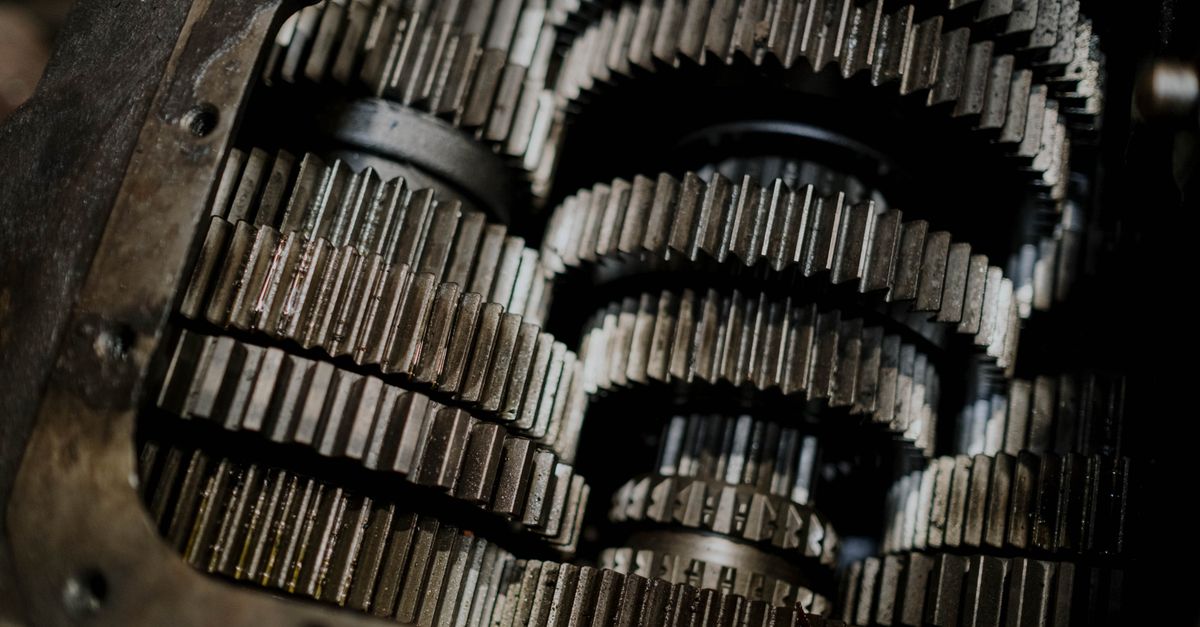
Why the Idler Tooth Count Cancels Out
Every external mesh between two ideal same-module spur gears follows the same propagation rule. The signed angular speed of a neighbor equals the negative signed angular speed of the current gear, multiplied by the ratio of the current tooth count to the neighbor's tooth count. A classic MIT gears and linkages lecture describes this as the classical relationship for ideal meshed spur gears, where the pitch-line velocity at the contact point is identical for both gears. In Gear Rotation Puzzle the rule is written as omega_neighbor = -omega_current × teeth_current / teeth_neighbor, which is the form used by the puzzle's breadth-first propagation from the driver.
When the rule is applied to a simple three-gear train, the idler's tooth count appears once in a numerator and once in a denominator. Two ratios multiply: (driver teeth ÷ idler teeth) × (idler teeth ÷ target teeth). The idler term cancels, leaving driver teeth ÷ target teeth as the magnitude. That is exactly why an intermediate idler changes direction parity but not speed ratio in the ideal external-gear model. The same mathematical cancelation is described in basic references for mechanical power transmission, which treat the end-to-end ratio as a product that telescopes across the train and reduces to the ratio of the driver tooth count to the target tooth count.
Direction Reversal: The Only Job an Idler Really Does
In the puzzle, every contact between two gears counts as one reversal. A driver spinning clockwise at +1 becomes counterclockwise at the first meshing neighbor. That neighbor's mesh with the next gear flips the sign again, and so on. The parity rule is simple: after an odd number of external meshes the target spins opposite to the driver, and after an even number of meshes it spins in the same direction. Reference material on external gear stages confirms that equal and unequal two-gear meshes always reverse, and that arbitrary idlers preserve or flip the final direction based on chain length.
| External meshes in the chain | Final direction vs driver |
|---|---|
| 1 | Opposite |
| 2 | Same |
| 3 | Opposite |
| 4 | Same |
The contact graph itself decides whether a layout is even possible. The puzzle solver does not compare a hidden answer list. It builds the graph from geometry, runs breadth-first propagation starting at the driver with signed speed +1, and visits every geometric neighbor to assign direction and tooth-count-adjusted speed. If a later path reaches an already-assigned gear with a contradictory direction or speed, the layout has a parity or ratio conflict. Submitting a layout that asks one gear to rotate both ways is rejected, and the feedback tells you whether the target is disconnected, an intermediate gear is isolated, or a direction conflict exists.
Putting the Theory Onto the Board: How to Play Gear Rotation Puzzle
Playing Gear Rotation Puzzle is a placement loop rather than a math quiz. The clockwise driver sits fixed on the left, the target gear waits on the right, and several empty sockets divide the space between them. Each candidate gear arrives in a specific size with a fixed tooth count, and you must put every candidate into exactly one socket so the touching geometry creates a single continuous path from driver to target. To see the rule in action, open the Gear Rotation Puzzle tool and walk through the loop below.
- Pick a candidate from the rack with number keys 1 through 4, or by tapping or clicking the visible candidate.
- Place the held candidate into one of the four sockets, addressed by Q, W, E, or T from left to right.
- Fill every socket, then press Enter or tap the test control to evaluate the full train.
- If the layout fails, tap the occupied socket to return the gear to the rack, then move it elsewhere. The game allows exactly one distinct failed full layout before closing the run, and submitting the identical assignment again does not consume the remaining chance.
- Press R to restart the entire run. Five correct levels award exactly 1,000 points with no time bonus, no hidden multiplier, and no penalty for exploring placements.
For a deeper walkthrough of the same five levels from a related angle, the Connect Gears Game: Build a Reversing Train to 1,000 guide covers the construction order step by step.
Reading Speed and Direction Across a Three-Gear Train
Consider a driver with 20 teeth spinning clockwise at signed speed +1, an idler with 10 teeth, and a target with 40 teeth. Step one: the idler receives speed −(+1) × 20 ÷ 10 = −2, meaning it spins counterclockwise at twice the driver's speed. Step two: the target receives speed −(−2) × 10 ÷ 40 = +0.5, meaning it spins clockwise at half the driver's speed. The idler's tooth count of 10 appears once in the numerator of the first step and once in the denominator of the second step, so the product (20 ÷ 10) × (10 ÷ 40) telescopes to 20 ÷ 40 = 0.5.
Without the idler, a direct driver-to-target mesh would have produced speed −1 × 20 ÷ 40 = −0.5, meaning counterclockwise at half the driver's speed. The magnitude is identical; only the sign differs because the number of meshes changes from 1 to 2. That parity flip is the only effect the idler can introduce in this ideal same-module external-gear model, and it is exactly the effect the puzzle uses to separate one candidate placement from another in the same level.
What Conflicts Look Like on the Board
The puzzle exposes three failure states. A disconnected target means the placed gears form more than one component and the target sits outside the one that contains the driver. An isolated gear means a candidate was placed in a socket whose contact distance to every neighbor exceeds the 0.75 game-unit tolerance, so the gear rotates nothing. A direction conflict means a later path reached a previously assigned gear and asked it to spin the other way, which is impossible in the ideal model. An odd triangular contact graph is the clearest case: three external meshes form a loop of three reversals, so returning to the starting gear asks it to rotate both ways.
A square layout, by contrast, has four external meshes in its loop, an even number, so each gear's expected direction remains consistent with what was assigned when it was first visited. That is why loops of even length pass and loops of odd length fail. The contact distance check is also a frequent source of failure: a gear that looks close enough but whose pitch circles do not actually meet within tolerance remains disconnected. The fix is to use the visible gear sizes, compare them to the candidate's own diameter, and place each gear so the gap between centers visibly matches the sum of the two pitch radii. Independent reference tests confirm the separation rule by showing that gears placed too far apart leave the target stopped, which the game reports as a disconnection.
What This Puzzle Does Not Model
The game deliberately models only ideal same-module external spur gears for educational play. It omits torque, power loss, tooth stress, backlash, profile interference, shaft alignment, lubrication, noise, wear, materials, safety factors, tolerances, and dynamic loads. The scope is shown beside the board and in the cited methodology. Treating the puzzle output as a real transmission design would be a category error: a 2:1 ratio under ideal mesh in the browser game does not imply a 2:1 ratio in a manufactured gearbox with the same tooth counts. Real gearboxes involve efficiency, contact ratio, and bending stress that this game does not compute.
Reference tests in the puzzle's verified methodology cover equal and unequal two-gear meshes, two- and three-stage trains, arbitrary idlers, speed increases, speed reductions, and direction parity. Additional geometric cases confirm that an odd triangular contact graph conflicts, an even square stays consistent, and separated gears leave the target stopped. Expected signed speeds are literal test values rather than outputs generated from the production solver, so anyone auditing the rule can re-derive the same magnitudes without running the game. Everything runs locally in the browser, so the puzzle shares no data, requires no account, and offers no remote service. A second distinct failed assignment is a deadlock, and Restart returns the run to level one with an empty board, zero score, and no held candidate.
For a deeper look, see Are Minimum Color Targets Verified in Four Color Map Puzzle.