Crossword puzzles build word recall, shared-letter reasoning, and focused attention by forcing you to match ordinary-English clues against a fixed grid of black and white squares. Reporting from Harvard Health covered studies in which participants were asked to work on word puzzles four times a week for half an hour, a frequency that frames crossword habit as routine rather than a one-off game. The benefits people describe in long articles—vocabulary growth, sustained attention, and confidence with everyday words—come from doing a puzzle carefully, checking what you wrote, and reasoning about crossings, not from racing a clock. A small, dictionary-backed grid is a useful place to start that habit. Every clue paraphrases a real dictionary sense, every answer carries a primary entry plus an independent cross-check, and the check policy leaves room to repair a single mistake before locking the run. So when readers look for crossword puzzle benefits, the most reliable version of those benefits is a slow, verified solve on a real word grid that you can finish in one sitting, with no score penalty for taking your time and no clock shouting at you to hurry.
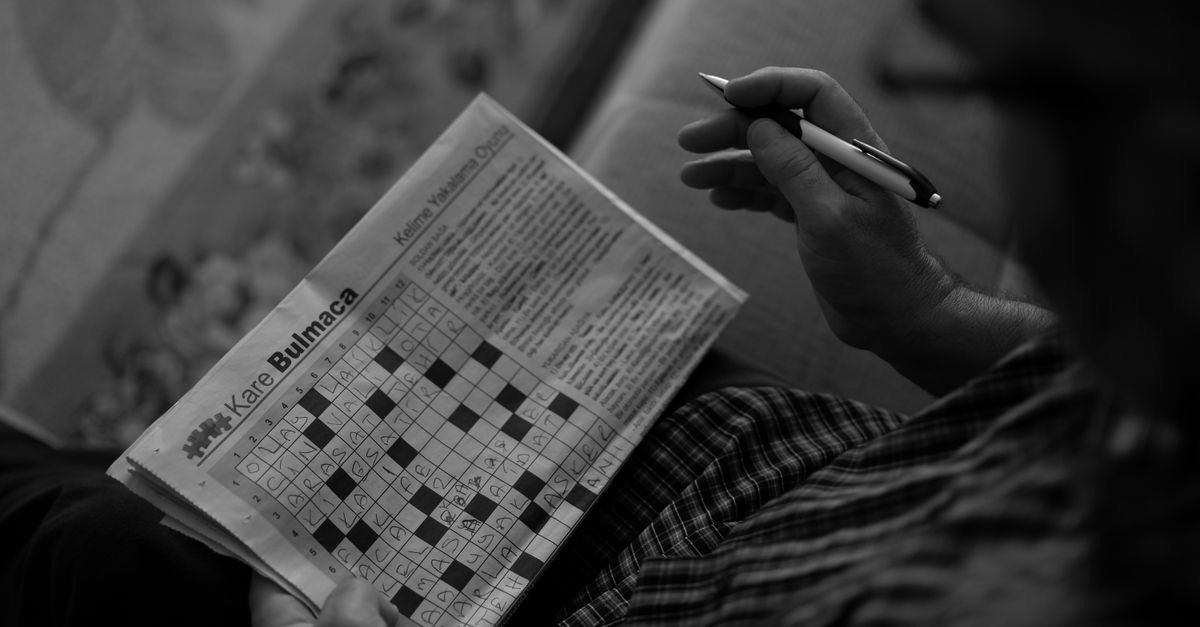
What a Crossword Actually Exercises
The benefits of crosswords are usually described in fuzzy terms like mental stimulation or brain training. It is more useful to think about which skills a grid actually taxes. A traditional black-and-white crossword asks for at least four separate things at once, and the small 5 by 5 grid from the Crossword Puzzle browser game preserves every one of them.
- Word recall. You reach into memory for everyday words that fit a paraphrase of a known sense. That effort, repeated across eight entries, is what most writers mean when they say crosswords improve vocabulary.
- Letter-level reasoning. Where two words cross, the shared square must hold one letter that satisfies both directions at once. That shared-letter constraint is a separate cognitive load from the clue itself.
- Focused attention. A 25-cell puzzle still rewards you for reading every clue before writing a single letter. Spreading attention across clues and a partial grid is its own quietly demanding skill.
- Editing under uncertainty. When one answer looks shaky, you can revise it without restarting, because the grid does not penalize second thoughts. That is exactly why the two-error repair policy matters for repeat practice.
None of these exercises depend on speed. The Crossword Puzzle removes the timer entirely and scores a finished grid at exactly 1,000 points whether you took four minutes or forty. That makes the small 5 by 5 grid a fair place to compare your performance across attempts, not a race where speed alone decides the outcome.
How to Play the 5 by 5 Crossword Puzzle
The puzzle is laid out as a 5 by 5 grid of black and white cells. Six cells are black and never accept input. The remaining nineteen white cells hold five Across entries and three Down entries, totalling eight distinct words with shared crossings. Each Across answer runs left to right; each Down answer runs top to bottom. Seven clue numbers are printed, because clue 1 begins both an Across word and a Down word.
Here is the play-by-play for a single session.
- Choose an Across or Down clue from the clue list, then tap or click its first white square to position the cursor. You can also tap any white square directly without going through the clue button.
- Type your answer with the on-screen 26-letter pad or with your physical keyboard. The cursor advances in row-major order from left to right, then top to bottom, and skips over every black square. With a keyboard, the Arrow keys also move one square up, down, left, or right when the destination is white; movement stops at the boundary or a block.
- Use the crossing squares to keep an Across entry and its intersecting Down entry consistent. The shared letter is what lets you confirm a guess, so solve one direction, then read the same letter from the other direction's clue to verify it.
- Backspace, Delete, or the on-screen Erase button removes the selected letter. If the selected square is already empty, erase steps back and clears the previous white square instead.
- Press Enter, or tap Check grid, when all nineteen white squares contain a letter. An incomplete grid reports that the puzzle is unfinished and records no mistake. Entering the same wrong grid twice does not count as a second error, because the checker fingerprints each completed attempt.
- Press Restart at any point to clear the board, restore the six black squares, put the cursor back on 1 Across, and reset the score and mistake counters to zero.
For a smooth first run, start with the three Down answers because each one runs the full height of the grid and leaves a letter in nearly every row. The shared letters then anchor the shorter Across entries, including the three three-letter rows at positions 1, 5, and 7.
Why the Answer List Doubles as a Vocabulary Workout
A crossword is only as good as the word list behind it. The Crossword Puzzle uses eight ordinary English words—three short and five longer—with one primary dictionary page per answer plus an independent cross-check page on a second dictionary site. That evidence pair is what turns the puzzle from a guessing game into a vocabulary check. Below is the full Across and Down inventory, the exact lengths, and the plain-English glosses you will see in the clue cards.
| Direction | Number | Length | Answer | Clue gloss |
|---|---|---|---|---|
| Across | 1 | 3 | HOT | High temperature |
| Across | 4 | 5 | BELOW | Lower position, as defined on the Cambridge Dictionary entry for below |
| Across | 5 | 3 | ADD | Joining something to make more |
| Across | 6 | 5 | GREAT | Larger-than-average extent or amount |
| Across | 7 | 3 | TRY | Making an effort to do something |
| Down | 1 | 5 | HEART | The blood-moving organ |
| Down | 2 | 5 | OLDER | Comparative age |
| Down | 3 | 5 | TODAY | The present day |
Every length in this table is an exact product value, not a rough estimate. The grid holds 25 cells: 6 blocks, 19 white cells, and 15 crossing points where one Across and one Down meet. All 19 open cells are covered by the eight entries, every shared cell agrees letter for letter, and the four outer-edge cells of the two five-letter Across words are still covered by those entries even though no Down word touches them.
What this means for the crossword puzzle benefits you came for: every clue paraphrases a real dictionary sense, so any word you complete is a real piece of English usage, not a brand name or a made-up term. A single finished grid is, in effect, a short vocabulary drill on eight words.
Scoring, Checking, and the Two-Error Repair Policy
A correct and complete grid scores exactly 1,000 points. The score does not depend on the device, the number of erases, the order in which you tackled the clues, or whether you typed with your fingers or a physical keyboard. That determinism is one of the more practical crossword puzzle benefits for anyone who wants to track a personal best over many sessions, since the best score is saved locally in your browser with no account and no network call during play.
The check policy is built around a repairable mistake rather than instant failure.
- Incomplete grids are free. Pressing Check grid with any white square still empty reports that the puzzle is unfinished and counts no mistake.
- First mistake is repairable. A first fully populated incorrect grid records one mistake but stays editable, so you can fix a crossing letter and resubmit.
- Repeats do not double-count. The checker fingerprints each wrong full grid. Pressing Check grid twice on the exact same wrong arrangement is treated as one mistake, not two, because the fingerprint is identical.
- A second distinct mistake deadlocks the run. A different fully populated wrong grid records the second mistake and freezes the board, including cell selection, letter entry, erase, and Arrow movement, until you press Restart.
- Restart resets everything. All six black squares return, all nineteen white squares empty, the cursor lands on 1 Across, the stored fingerprints clear, and the score returns to zero.
The repeat-press protection matters more than it sounds. A double-tap on a touch device, or a sticky Enter key, can fire Check grid twice in a row. Without fingerprinting, that alone would consume both allowed mistakes and end the run on what was really one wrong grid. By ignoring the duplicate, the policy preserves room for a real edit and a real retry, which is closer to how an editor works in practice than an instant knockout.
Building a One-Session Habit for Real Benefits
The crossword puzzle benefits people describe in long articles tend to build up over weeks, not minutes, but a single session can already train a useful habit. The pattern below takes a small amount of attention and does not require a long sit-down.
- Begin with clue 1 Down, then 2 Down, then 3 Down. Each Down answer spans every open row and gives you anchor letters in five of the eight entries.
- Use those anchor letters to fill 1 Across (three letters), 5 Across (three letters), and 7 Across (three letters). The three short rows usually resolve from the crossings alone.
- Move to 4 Across and 6 Across, the two five-letter rows. The crossing letters in those rows are already constrained by the Down entries, so they should fall into place from the crossings; the four outer cells, two on each row, come straight from the clues.
- Read every row and column aloud before pressing Enter. Reading aloud reveals the kind of small spelling slip—the bellow-instead-of-below mix-up, for example—that no entry tool can catch.
- Press Enter once. If the grid is correct, take a breath and study what each clue taught you about the word sense. If the grid is wrong, change only the letters that disagree with the clues and press Enter again.
This routine takes a single sitting and leaves you with eight words you have read, written, cross-checked, and revised against a published dictionary page. That combination is what turns crossword puzzle benefits from a claim into a habit. If you would like to keep the same routine on a phone, the phone and keyboard guide for this same puzzle lists the exact touch buttons and key bindings used to recreate the session on a small screen.
When the Grid Becomes Easier, That Is the Point
The Crossword Puzzle is recreational, not an intelligence test, an educational placement exam, or a medical screen. The vocabulary and shared-letter reasoning you build here are meant to feel like light exercise. If you finish the puzzle faster on a second attempt, that is the routine paying off. If you finish it more slowly the next day, that is normal variation rather than a setback. Because the score is fixed at 1,000 for any correct solve, the metric worth tracking over time is your confidence with the eight clues, not a clock or a streak.
If you're weighing options, Edge Match Puzzle for Beginners: Reach Your First 1,000 covers this in detail.