The Pattern Completion Test is a five-round complete the pattern game where each correct answer adds exactly 200 points, and solving every round produces a final score of 1,000. Two mistakes end the run before you finish, and Restart returns the score, mistake count, and question position to their starting state. Each round displays a written rule, four completed sequence frames, a question mark in the fifth slot, and four possible continuations you can choose from with a tap, a click, or the number keys 1 through 4. The five rules—alternation, rotation, quantity, movement, and combined attributes—are disclosed product fixtures, not hidden answers, which means the same input always produces the same result. The exercise is entertainment and practice rather than an intelligence test: the title refers to the interaction format, and the page does not estimate reasoning ability, school readiness, memory, cognitive health, or any clinical condition. If you want a single, transparent way to practice pattern completion in a browser, the Pattern Completion Test is built for exactly that task.
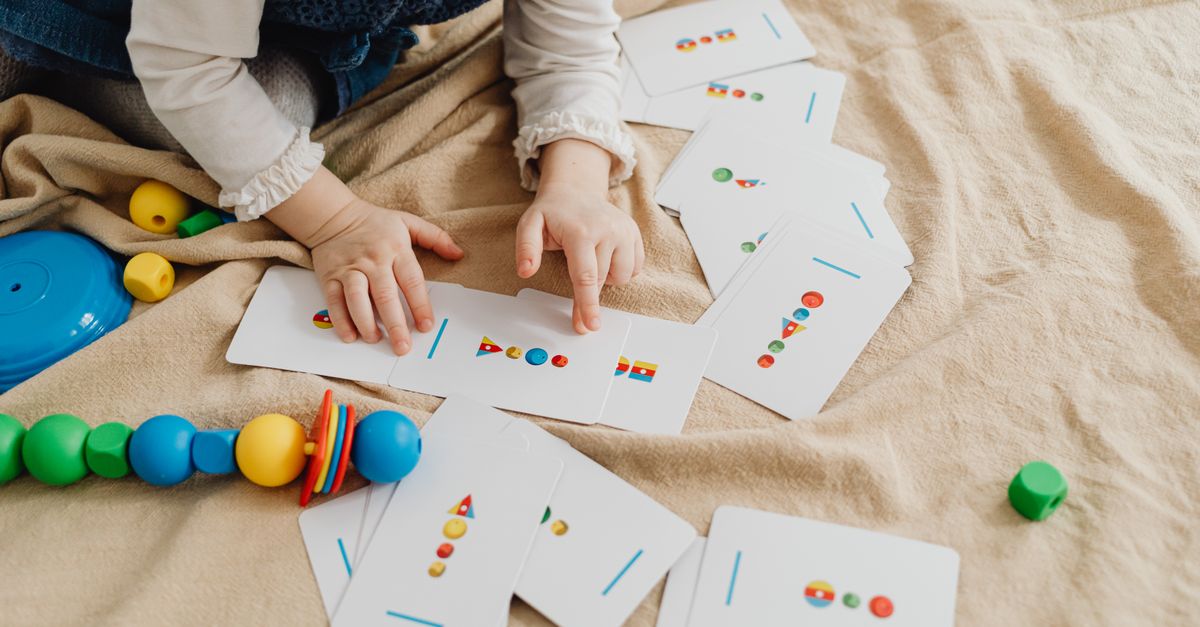
The Five Rules Behind the Pattern Game
The complete the pattern game uses five product-authored rules, each appearing in a fixed order across a run. The rules cover different visual relationships on purpose, so the questions read more like a short practice set than a single repeated trick. Below is the full fixture set, taken directly from the published answer key inside the game.
| Round | Rule type | What changes across the four frames | Disclosed fifth-frame answer |
|---|---|---|---|
| 1 | Alternation | Shape alternates circle, square, circle, square | One circle |
| 2 | Rotation | Arrow turns 90° clockwise: up, right, down, left | One up arrow |
| 3 | Quantity | Triangle count rises by one each frame: 1, 2, 3, 4 | Five triangles |
| 4 | Movement | Marker crosses a 3×3 board: top-left, top-center, top-right, middle-right | Bottom-right cell |
| 5 | Combined attributes | Shape alternates circle, square while quantity rises 1, 2, 3, 4 | Five circles |
Because the rules and answer labels are disclosed, the exercise is reproducible and auditable rather than mysterious. The same five questions, in the same order, with the same four options each appear on every run. This is why you can plan a route, teach the pattern to someone else, or verify a score from the outside. The four options within every question are unique, so a correct choice is always available without deduping your own answer. The five rules intentionally cover different visual relationships without claiming that they form a validated ability battery, and the public answer key is available directly inside the game, so there is no hidden scoring model or external norm.
How to Play One Round of the Pattern Game
Each round is a short, repeatable interaction. The shape of the round does not change from run to run, so once you know the steps you can move through it quickly without losing track of the rule.
- Read the published rule at the top of the round, then inspect the four fixed sequence frames before looking at the four possible continuations. The rule is the single source of truth for that question, and the four frames are the only evidence you have.
- Predict the next frame from the rule alone, then look at choices 1 through 4. This is the part most players skip, and it is the part that turns the round from guessing into genuine pattern completion.
- Choose one of the four options by tapping the answer button, clicking it with a mouse, or pressing the number key 1, 2, 3, or 4. A correct choice advances the round; a wrong choice leaves the round in place and increments the mistake counter.
- Move to the next round after a correct answer. Continue until all five questions are answered correctly, which lands you at 1,000 points, or until two mistakes are made, which ends the run.
Because a wrong choice leaves the current question on screen, you can use a mistake as a free hint. Read the rule again, trace the four frames, and pick a different answer. The mistake counter still goes up, but the rule is reprinted on screen, so you can finish the run after a single error if you stay within the two-mistake limit. The game never subtracts points, invents a partial intelligence score, or reshuffles answers between runs, so any run that reaches five correct answers still finishes at exactly 1,000 because the game never subtracts points.
Score Math, Mistakes, and the 1,000-Point Finish
The complete the pattern game uses a strict addition-only score: every correct answer adds 200 points, and points are never subtracted. Five correct answers therefore always produce exactly 1,000. The game does not invent partial intelligence scores, convert your total into a percentile, or compare your run to a population. It also does not adjust for age, time, or device. You can see the whole math in the equation below.
Score after N correct answers = N × 200. With N fixed at 5, the maximum possible score is 5 × 200 = 1,000.
Mistakes behave differently. The first mistake does not end the run, but it counts toward a two-mistake dead-end. Once you record the second mistake, the run is locked. Later answer input is ignored until you press Restart, and the same is true once the fifth answer is correct. This terminal-state freeze prevents score farming and gives local and production browser checks a deterministic result, which is one of the reasons the questions stay fixed rather than shuffled.
Restart resets three things: the score, the mistake count, and the question position. After Restart, you are back at round one with 0 points, 0 mistakes, and the first alternation question on screen. A locally stored best score is kept inside the browser when storage is available, and it is not uploaded anywhere. Because the rules and answer labels are product fixtures, the exercise is reproducible and auditable rather than mysterious, and that reproducibility is what makes the deterministic terminal state meaningful.
Keyboard, Touch, and Accessibility
The game shell exposes every choice through three equivalent input paths. Keyboard users press 1, 2, 3, or 4 to pick an answer, and the same keys work on any standard layout. Pointer and touch users can tap or click the answer buttons directly. The buttons carry visible focus treatment and descriptive labels for assistive technology, so the choice you make is announced alongside its position rather than carried only by the visual layout.
The shared game shell also includes a Restart control and a double-Escape boss key. Everything runs inside the current browser tab, and the page adapts from narrow phones to wider screens without horizontal scrolling. The layout uses the site's existing color tokens and game shell, so the visual design stays consistent with the rest of the site. There is no animation loop, no package dependency, no remote question service, no account gate, no timer, no advertising decision, and no paid API. If you would like a deeper walkthrough of mouse-free play, the phone and keyboard guide covers the same input paths in more detail.
For the movement question, the marker position is exposed in the accessible label rather than only in the visual placement, which means the question is solvable from the label alone. The shared shell never uploads answers, scores, device details, or activity history, so you can practice without leaving a record behind. The word test in the title describes the interaction format, not a standardized assessment, and the page does not estimate intelligence, reasoning ability, school readiness, memory, cognitive health, or any clinical condition.
Strategy Tips for Each Rule Type
Each rule type in the complete the pattern game asks you to track a different visual variable, and the trick is to lock onto that variable before scanning the answer options.
- Alternation: name the two categories out loud, such as circle versus square, then read off the existing sequence. The fifth frame is whichever category is next in the repeating pattern.
- Rotation: pick a fixed reference direction, like north, and rotate the arrow forward one step. With a 90° clockwise rule, the answer cycles up, right, down, left, up.
- Quantity: count the items in each frame and check that the count increases by exactly one. The fifth frame is the next integer in the count.
- Movement: trace the path on a 3×3 grid and look for the next cell in the route. A row sweep plus a column descent gives you the next cell without guessing.
- Combined attributes: track two variables at once. Write down the shape and the count for each existing frame, then predict both for the fifth frame before you look at the four options.
For any rule, the most productive habit is to predict the answer before looking at the four choices. The choices are designed to confirm a correct prediction, not to guide one. When you do get a wrong answer, treat the printed rule as a study guide rather than a failure, and trace that one rule again before tapping a new option. Because a wrong choice leaves the current question in place and increments the mistake counter, you can review the displayed rule, adjust your trace, and try again without losing the round.
For a deeper look, see Visual Pattern Quiz: Five 3×3 Grids to 1,000 Points.