The minute hand on any analog clock sweeps 6 degrees per minute because 60 minutes cover a full 360-degree turn, while the hour hand moves 30 degrees per hour plus a continuous 0.5 degrees per elapsed minute. Clock Time Puzzle uses those exact rates to compute the angle of both hands for every five-minute step you set, then checks your submission against the verified angle pair for each of five target times. Solving all five targets in the fixed order — 3:00, 6:30, 9:45, 12:00, and 2:25 — scores exactly 1,000 points, with 200 points awarded per exact clock. The puzzle renders on a real Canvas with continuous hand angles and cited formulas, so each setting is checked against the same geometric rules taught in classroom math. Nothing is hidden behind an account, an upload, or a network call, and the entire puzzle runs locally in the browser. The status panel keeps the target time, the selected time, both angle formulas, and the running score visible at every step, so a clock practice game built this way doubles as a small geometric audit you can read in plain numbers.
Clock Time Puzzle treats clock reading as geometry rather than as a reaction test. Each card shows a target time written in plain digits, then lets you adjust the selected hour from 1 through 12 and the selected minute in five-minute steps from 00 through 55. The Canvas redraws both hands from your selection on every change, and the live angle readout uses the same formulas that score the puzzle. That means the value you see while setting up is the same value that gets compared on submit, with no animation loop, drift, or smoothing to mask the underlying math.
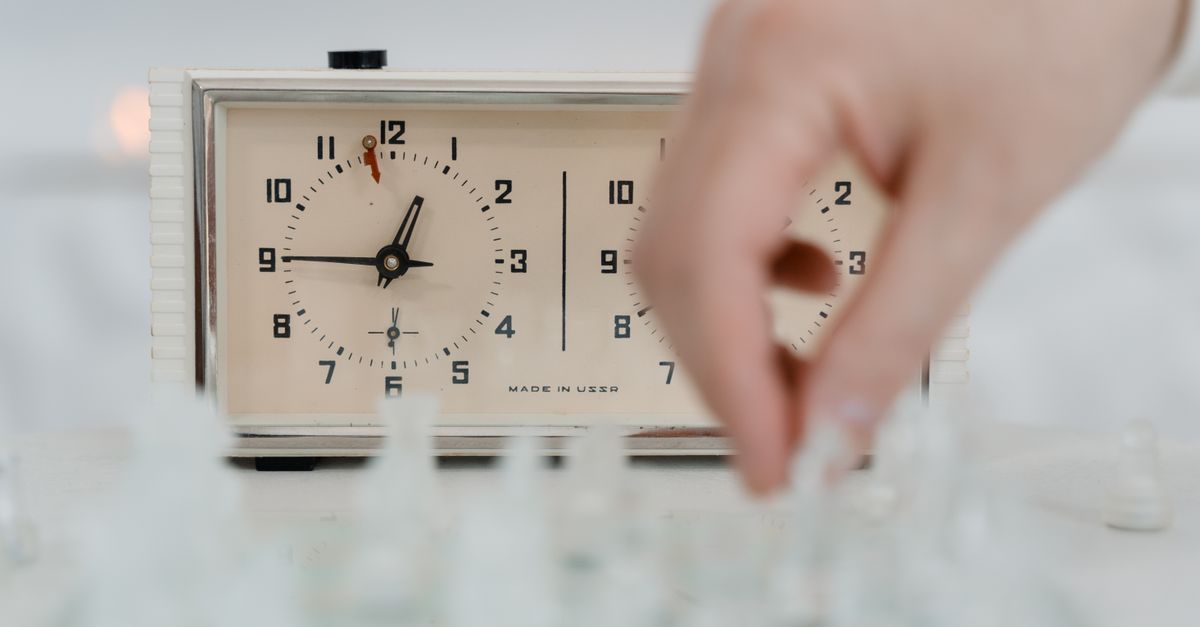
How Clock Hand Angles Are Calculated
Two formulas govern the game. The minute angle is 6 × minute, because the minute hand makes one full turn of 360 degrees in 60 minutes and 360 divided by 60 equals 6. The hour angle is 30 × (hour modulo 12) plus 0.5 × minute, because the hour hand makes one full turn in 12 hours while continuing to drift between hour marks at one-half degree per elapsed minute. The University of Cambridge NRICH explanation of clock face angles walks through both rates and uses 20:14 as a worked example, while an independent Rutgers University explanation confirms the continuous hour-hand formula and the six-degree minute-hand relationship.
You can verify the formulas yourself with the route's hardest setting, 2:25, by substituting minute = 25 and hour = 2:
minuteAngle = 6 × 25 = 150 degrees hourAngle = 30 × (2 mod 12) + 0.5 × 25 = 60 + 12.5 = 72.5 degrees
So at 2:25 the minute hand sits at 150 degrees and the hour hand sits at 72.5 degrees — a difference of 77.5 degrees that you can confirm visually against the Canvas clock face and match against the table below.
Hours outside 1 through 12, minutes outside 0 through 55, noninteger values, and minutes not divisible by five are atomic no-ops in the product controls, so the same formula always returns the same angle for any legal submission. The lower-level angle function separately validates the conventional 0–23 hour and 0–59 minute range used for the nine literal evidence vectors — 12:00, 3:00, 6:30, 9:45, 12:30, 3:15, 8:24, 20:14, and 2:25 — without changing what the Canvas displays.
The Five Target Times and Their Verified Angles
The fixed route asks for 3:00, 6:30, 9:45, 12:00, and 2:25 in that order. Each card shows its target time in digital form, and the corresponding angle pair is reproduced below in minute/hour order. The values come directly from the formulas above and from the nine literal angle pairs the independent test suite asserts; the puzzle does not generate its own expected values.
| Round | Target time | Minute angle (°) | Hour angle (°) | Points for exact match |
|---|---|---|---|---|
| 1 | 3:00 | 0 | 90 | 200 |
| 2 | 6:30 | 180 | 195 | 200 |
| 3 | 9:45 | 270 | 292.5 | 200 |
| 4 | 12:00 | 0 | 0 | 200 |
| 5 | 2:25 | 150 | 72.5 | 200 |
| Total | — | — | — | 1,000 |
Notice that 12:00 and 3:00 both produce a minute angle of 0, but their hour angles are 0 and 90 respectively, which is exactly why the formula has to compute both hands separately for every setting rather than trusting the digital readout alone.
How to Set All Five Clocks to 1,000 Points
- Open Clock Time Puzzle. The first card shows 3:00 as the target time, with the Canvas clock drawn at 12:00.
- Adjust the hour with Up and Down arrow keys or the on-screen hour buttons until the digital readout and Canvas hand both show 3:00. The minute stays at 00.
- Submit the selection with Enter. The minute angle reads 0 degrees and the hour angle reads 90 degrees, so you earn 200 points and advance to round 2.
- Round 2 targets 6:30. Move the minute five steps at a time with Right and Left arrow keys until the readout shows :30. The hour stays at 6 because 30 minutes past six is still within the same hour block on a five-minute grid.
- Submit. The minute angle is 180 degrees and the hour angle is 195 degrees, awarding another 200 points.
- Round 3 targets 9:45. Step the hour to 9 and the minute to :45 using the same controls.
- Submit. The minute angle reads 270 degrees and the hour angle reads 292.5 degrees, and the third 200 points land.
- Round 4 targets 12:00. Step the hour up to 12 and the minute down to 00.
- Submit. Both hands point to 0 and 0, and the fourth 200 points are awarded.
- Round 5 targets 2:25. Step the hour back to 2 and the minute forward five steps to :25.
- Submit. The minute angle is 150 degrees and the hour angle is 72.5 degrees, scoring the final 200 points and bringing the run to exactly 1,000.
Keyboard Controls, Mistakes, and Restart Rules
Keyboard controls stay consistent across all five rounds. Up and Down arrow keys move the hour by one step through 1, 2, 3, and so on up to 12, and Left and Right arrow keys move the minute in five-minute steps from 00 through 55. Enter submits the current selection. Pressing R restarts the puzzle when focus is outside an editing control. Touch and pointer play work the same way through the on-screen buttons, so the game is fully usable on a phone, tablet, or laptop without a separate mode.
Mistakes are recoverable, but the second distinct mistake closes the file. Submitting a wrong setting counts as one error identified by round, hour, and minute. If you submit the exact same wrong setting again, it is a no-op — the game deduplicates identical wrong submissions so a single misclick does not end your run. A second, distinct wrong setting, however, deadlocks the current card. Both completion and deadlock freeze the time adjustment and submission controls, so the final state of every run is stable and inspectable. Pressing R restores the first card to 12:00, the score to zero, and the error count to zero.
Status, target time, selected time, formula, current angles, mistake count, feedback, and score remain visible at all times, so you always know which round you are on, what the geometric check expects, and how many points remain. The shared game shell also tracks a best score across runs and supplies a Boss Key for privacy during shared screens.
Why This Game Differs From Random Clock Drills
Random online clock games typically use animated timer rounds, randomized target times, or reaction-based scoring that distracts from the underlying geometry. Clock Time Puzzle commits to a single, fully disclosed route so every angle pair you see is one of the nine literal vectors the independent test suite asserts, including 12:00, 3:00, 6:30, 9:45, 12:30, 3:15, 8:24, 20:14, and 2:25. The differences come down to a few practical contrasts.
| Feature | Random clock drills | Clock Time Puzzle |
|---|---|---|
| Target times | Randomized each round | Fixed: 3:00, 6:30, 9:45, 12:00, 2:25 |
| Scoring | Reaction-based or hidden | 200 per exact match, 1,000 total |
| Angle formula | Often hidden from the player | minute = 6m, hour = 30(h mod 12) + 0.5m, cited |
| Independent verification | Rare | Nine literal vectors and five target times independently tested |
| Account, upload, timer | Often required | None — entirely in-browser, no timer dependency |
| Educational framing | Standardized quiz or reaction test | Educational entertainment; not a teaching assessment |
Because the formulas are visible and the route is fixed, you can replay the puzzle with intent — practicing the harder pairs like 9:45 (292.5 degrees on the hour hand) until the geometry feels intuitive, rather than racing a clock. Independent tests own the literal angle pairs and the five target times rather than generating expected values from production code, and they cover five-minute wrapping, repeat deduplication, two distinct wrong settings, illegal input, restart, the exact 1,000 total, and terminal freezing. The shared shell, best score tracking, and Boss Key support round out the experience without changing the geometry.
Related reading: Bartender Game: Match Three Fictional Ratios to 1,000.
Related reading: Connect the Numbers Game: Reach 1,000 Points in Order.