No, the same unordered number pair cannot be used twice in Dominosa. Each pair of tiles you join into a domino must form a value combination that has not appeared anywhere else on the board, and order does not matter, which means a 1-2 domino and a 2-1 domino count as the same pair and only one of them is allowed. The disclosed two-by-three board reads 0 0 1 on the top row and 1 2 2 on the bottom row, and the clean solution pairs the three vertical columns into 0-1, 0-2, and 1-2, three distinct unordered pairs that together cover all six cells. Trying to repeat any of these pairs is prohibited by the unordered-pair uniqueness rule, because after one 0-1 pair is taken, the remaining tiles still include one 0 and one 1 that could physically form a second pairing, but the game rejects any reuse of a previously accepted unordered combination. The browser game enforces the rule by tracking every accepted unordered pair as a sorted key, refusing any new selection whose key already appears in that set, and marking the run as failed after two invalid selections. This is what makes Dominosa a constraint puzzle rather than a free tiling exercise: coverage of the board is not enough, and uniqueness of the pair set is the real goal.
If you want to experience the rule in action, the keyboard-first Dominosa board exposes it clearly with the six-cell default puzzle.
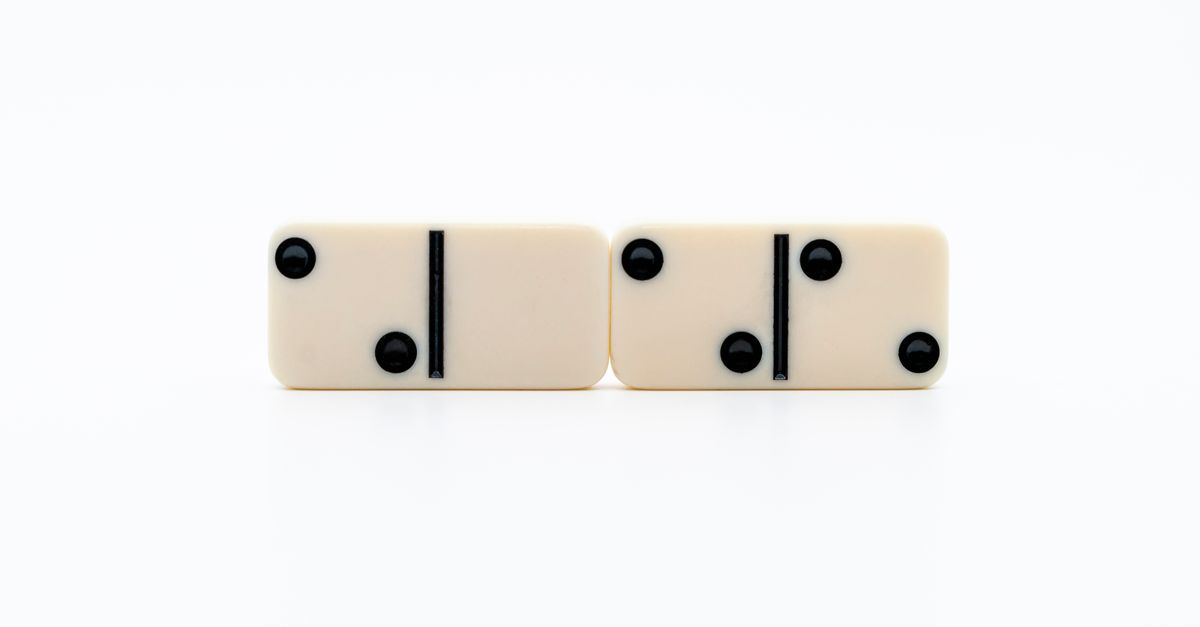
Why the Same Number Pair Cannot Appear Twice
Dominosa is a small constraint puzzle built around a single hard rule: every domino you place must carry a value pair that has never appeared before in the current run. The board consists of six numbered tiles arranged in a 2 by 3 grid, and your task is to cover all six cells with three adjacent dominoes. Because the board has six cells and each domino covers exactly two, you need exactly three dominoes in any valid solution. With only three unordered pairs in play, repeating one of them would force the other two to cover four cells using fewer than three distinct unordered values, which is impossible under the uniqueness rule. The game is engineered so that this rule is enforced automatically: after every accepted domino, the new pair is added to a sorted-key set, and any subsequent selection whose two values sort to an existing key is rejected as an invalid move.
The rule is what separates Dominosa from a generic match-adjacent-tiles exercise. Coverage alone is insufficient when a duplicated pair would violate uniqueness, and that single rule is why some tempting openings can quietly make the board unsolvable. For instance, the default board contains two 0s that sit next to each other on the top row, which makes a horizontal 0-0 pair look like a natural opening. Placing it commits the value pair [0, 0], which still leaves the four remaining tiles 1, 1, 2, 2 to be tiled with two more dominoes using only unused unordered pairs. That remainder has no valid completion, so the recursive solver used by the game flags the board as deadlocked and ends the run. This is the practical cost of repeating or misusing a pair: it does not just lose you a turn, it can end the entire game.
What "Same Pair" Actually Means
The phrase "same number pair" in Dominosa refers specifically to unordered value pairs. Order does not matter, so 1-2 is treated as the same value pair as 2-1, and 0-0 is treated the same regardless of which direction you read the tiles. The implementation sorts the two tile values into a canonical key such as [1, 2] or [0, 0] before adding it to the used-pair set, which means a player can never sneak in a duplicate by reversing the visual order of the two tiles. This is the part of the rule that catches beginners most often, because the eye naturally reads the first selected tile first and the second selected tile second, and it is tempting to assume that switching the selection order changes the pair. It does not.
To make the unordered rule concrete, here is how the disclosed board behaves under each interpretation:
| Selection order | Tile values | Sorted key | Counts as |
|---|---|---|---|
| Top-left, top-middle | 0, 0 | [0, 0] | 0-0 |
| Top-middle, top-left | 0, 0 | [0, 0] | Same as 0-0 |
| Top-right, bottom-right | 1, 2 | [1, 2] | 1-2 |
| Bottom-right, top-right | 2, 1 | [1, 2] | Same as 1-2 |
A second 1-2 attempt after the first is accepted is therefore not a different pair, it is the same unordered pair, and the game refuses it. Already covered tiles are disabled and cannot be reused, which closes off the workaround of trying to re-pick the same two cells in a different order. For readers who want to check the related adjacency rule, the guide on pairing diagonal tiles in Dominosa covers the second half of what makes a placement legal.
How to Cover the 2x3 Board With Three Unique Pairs
To complete a Dominosa run on the default board, follow these steps in order.
- Move the outlined cursor to the top-left cell, which shows 0, using the arrow keys.
- Press Space or Enter to anchor that first tile. The cursor outline changes to indicate an anchored selection.
- Move one step to the right with the right arrow key so the cursor sits on the top-middle cell, which also shows 0.
- Press Space or Enter again to form the 0-0 domino. The pair is recorded as [0, 0] and the two cells are covered.
- Notice that the four remaining tiles are 1, 1, 2, 2, and on the remaining cell positions the only adjacent pairings would either duplicate the 1-2 unordered pair or leave the remaining 1 tiles non-adjacent, so the recursive solver flags the board as deadlocked. Restart and use the vertical approach instead.
- After restarting, anchor the top-left cell (0), then move down to the bottom-left cell (1), and press Space or Enter to form the 0-1 pair.
- Anchor the top-middle cell (0), move down to the bottom-middle cell (2), and press Space or Enter to form the 0-2 pair.
- Anchor the top-right cell (1), move down to the bottom-right cell (2), and press Space or Enter to form the 1-2 pair and finish the board.
This sequence pairs each vertical column with a different unordered pair, covers all six cells, and ends the run at exactly 1,200 points. Mouse and touch users can select the same visible cells by clicking or tapping, and selecting the anchored tile a second time cancels the anchor before you commit a domino. If two cells are not orthogonally adjacent or their unordered pair has already been used, the selection fails; two such failures create a terminal failure state.
The Disclosed Solution Explained
The disclosed solution pairs the three vertical columns. The left column combines the top-left 0 with the bottom-left 1 to make the pair 0-1. The middle column combines the top-middle 0 with the bottom-middle 2 to make 0-2. The right column combines the top-right 1 with the bottom-right 2 to make 1-2. Together those three unordered pairs are all distinct and cover every cell exactly once. They satisfy both halves of the rule at the same time, which is coverage plus uniqueness.
A tempting alternative is to start with the horizontal 0-0 across the top row, but that opening fails because on the remaining cell positions the four tiles 1, 1, 2, 2 cannot be tiled without either duplicating the 1-2 unordered pair or leaving the remaining 1 tiles non-adjacent. The recursive solver used by Dominosa exhaustively confirms this: it tests the empty board, confirms a completion exists, then accepts the 0-0 opening and proves that no valid remainder tiling exists, which is why that move ends the run as a deadlock rather than just an invalid selection. The take-home is that picking the most obvious local pair can quietly destroy the only legal global tiling.
How Deadlock Detection Catches Unsolvable States
Dominosa runs an exhaustive completion search after every accepted domino, not just when a selection is invalid. The solver looks at the first uncovered tile, tries each uncovered orthogonal neighbor whose unordered pair is still unused, and recursively checks the rest of the board under the same rule. If no perfect unique-pair tiling remains for any branch, the run is marked deadlocked immediately and the board freezes. This prevents the frustrating situation in which the board still has empty cells and the cursor still moves, but no legal sequence of placements can finish the puzzle. The deadlock check operates on the same state the interface uses, so what the player sees and what the solver sees cannot drift apart.
The two failure modes are distinct. An invalid selection happens when two cells are not orthogonally adjacent or when their unordered pair has already been used, and two of those add up to a terminal failure. A deadlock happens when every remaining placement option leads to a dead end, even though individual placements are legal in isolation. The disclosed solution above avoids both because every accepted pair is fresh, every pair is orthogonally adjacent, and every recursive branch from the start state reaches a fully covered board with three distinct unordered pairs.
Scoring, Mistakes, and Restart Behavior
Each accepted domino awards 400 points. Three valid dominoes complete the board at exactly 1,200 points, which is the maximum possible score on the default puzzle. Two invalid selections create a terminal failure state that locks the board, and a deadlock detected by the solver does the same. The Restart control clears every domino, selection, mistake, and point, returning the board to its starting state without changing the underlying values. Best score stays in local browser storage and is not transmitted anywhere, so you can experiment freely without affecting anyone else's run.
The board uses semantic buttons and a CSS grid, with the same site surface, foreground, line, accent, and danger tokens used elsewhere on the page. There is no canvas, image, drag requirement, random generator, timer, audio, upload, account, hardware permission, download, or network request, so the entire game runs from the keyboard including selection, cancellation, Restart, and the shared Boss Key. Double-press Escape replaces the game with the spreadsheet-style Boss Key view, and repeating the same double-press restores the unchanged board. A useful solving habit is to list the unordered pairs already used, then inspect the most constrained uncovered cells before committing a domino. On the default teaching board, vertical pairs expose the core rule clearly, and the same reasoning applies to larger Dominosa boards where coverage alone is insufficient when a duplicated pair would violate uniqueness.
Related reading: Connect Numbers in Sequence? Numberlink Pairs Them Instead.