People with the same birthday date can have different Moon phases because the phase is set by the exact birth instant, not the birthday date alone.
Two people share the same geocentric Moon phase when their birth records resolve to the same instant. NASA describes the lunar phase cycle as about 29.5 days, so even several hours can change the exact angle and illuminated fraction; a birth close to a display-band boundary can even receive a different phase label. If “same birthday” means the same month and day but different birth years, those are separate dates in the lunar cycle and require separate calculations.
At one instant, the geocentric phase is the same for everyone on Earth. The Moon’s appearance from a particular horizon is different from its geocentric phase: local visibility, moonrise, and weather are not part of this calculation. That is why a birthday Moon phase calculator can work from a birth instant and time offset without asking for a birthplace.
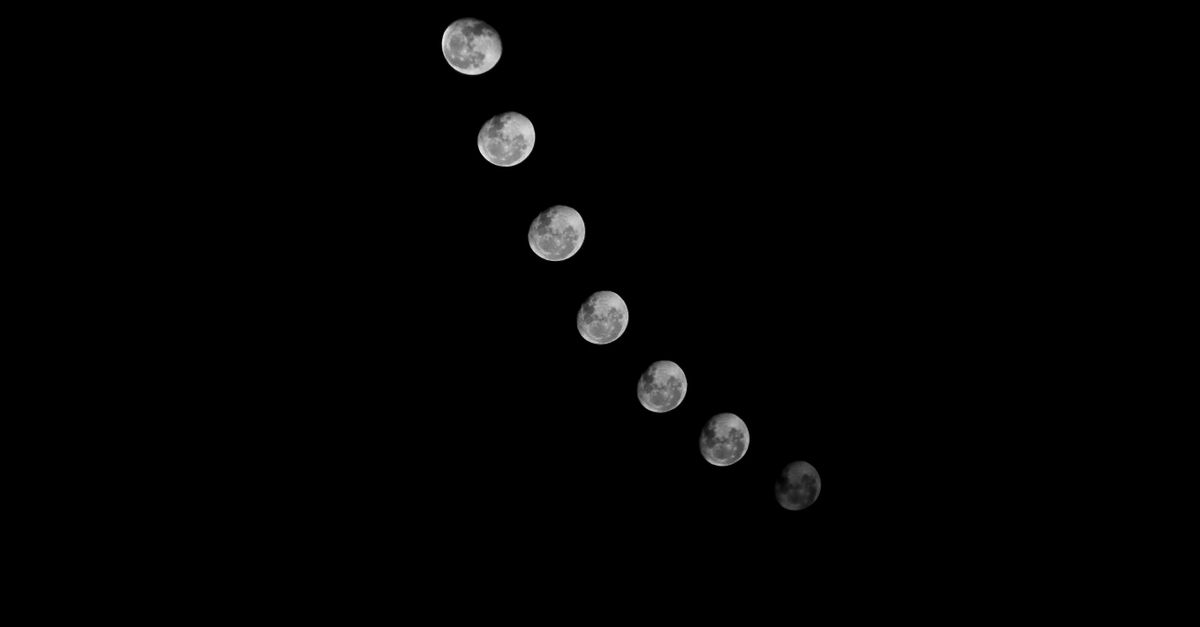
What makes a shared birthday match or differ
The useful comparison is not simply the month and day shown on a calendar. It is the normalized birth instant produced from the full date, clock time, and documented offset.
| Shared-birthday situation | What it means | What to enter or check |
|---|---|---|
| Same date and year, but different clock times | The exact angles and illuminated fractions may differ. The broad eight-stage labels may still match unless the births are near a band boundary. | Calculate each person with their own local birth time and documented offset. |
| Same month and day, but different birth years | These are different dates in the lunar cycle, so a shared phase must not be assumed. | Enter each full date, including year, and compare the resulting angles and labels. |
| Same local date and clock time, but different offsets | The local clock entries can represent different UTC instants. | Compare the normalized calculation times, not only the local entries. |
| Same date, clock time, and documented offset | These records resolve to the same instant and therefore the same geocentric phase. | Confirm that the entered local time and normalized calculation time agree. |
| Birth time is unknown | No single exact phase can be established. | Use the labeled approximation and retain its boundary warnings. |
These distinctions explain many apparent disagreements between birthday Moon results. A label alone cannot reveal whether two records use the same year, clock time, offset, or estimation mode. Start with the normalized instant, then compare the angle, illumination, broad label, and nearby primary events.
What the phase means in astronomy and symbolism
The astronomical meaning is the Moon’s changing geometry relative to the Sun and Earth as seen from Earth’s center. The familiar symbolic themes are interpretive traditions rather than measured personality traits. The four primary events have exact angular definitions:
| Primary event | Moon–Sun longitude difference | Common symbolic theme |
|---|---|---|
| New Moon | 0° | Beginnings or a reset |
| First Quarter | 90° | Decisions, action, or developing effort |
| Full Moon | 180° | Culmination or a fuller perspective |
| Last Quarter | 270° | Release, reassessment, or preparation |
The eight-stage names used by the Birthday Moon Phase Calculator are a separate Lizely display convention. They divide the cycle into equal 45-degree bands with boundaries set 22.5° on either side of each primary angle. New Moon wraps across 337.5° to 22.5°, while the other seven bands cover the remaining angles. These equal-width labels are not official USNO or NASA classifications.
Within those bands, waxing means the illuminated fraction is increasing and waning means it is decreasing. A crescent is less than half illuminated, while a gibbous phase is more than half illuminated. Consequently, two people can have the same broad label but different exact angles and illumination. People born just before and just after a band boundary can receive adjacent labels even though their birth dates are identical.
Calculate shared birthdays without guessing
For a defensible comparison, run the calculation separately for each person and retain the original source details.
- Collect the complete birth information. Enter the full birth date, including the year, the local clock time, and the signed UTC or UTC-equivalent offset documented for that place and moment. A present-day browser time zone may not reproduce historical daylight-saving or political time-zone rules.
- Run the exact calculation. Open the Birthday Moon Phase Calculator, select the exact workflow, enter the local fields and documented offset, and calculate the instant estimate. Exact mode requires all three kinds of information; it is not the appropriate choice when the clock time is merely guessed.
- Use approximation mode only when the time is genuinely unknown. Deliberately select the unknown-time option and read the “Phase-boundary approximation” warning. It calculates local noon, compares the start and end of the offset-defined local day, and shows both possible broad labels if they differ.
- Check for a primary event inside the local day. The approximation identifies whether a New Moon, First Quarter, Full Moon, or Last Quarter occurred during that day and warns that an unknown birth time could fall before or after the event.
- Review every output together. Compare the entered local time, normalized calculation time, phase angle, illuminated fraction, eight-stage label, and nearby primary events. A matching label with different angles or illumination is not a contradiction; it means the births occupied the same broad band.
Repeat the process for the second person and compare the normalized records. If either time is unknown, describe the result as an estimate rather than presenting local noon as the verified birth instant.
Why two birthday Moon results can disagree
Most apparent conflicts can be traced to different inputs or different levels of classification:
- Different years: the same month and day in different years identifies two different calendar dates.
- Different or rounded clock times: a precise time and a recorded “morning” or “overnight” estimate may resolve to different instants.
- Different UTC offsets: two identical local clock entries do not represent the same instant when their offsets differ.
- Exact versus unknown-time mode: local noon is an explicit approximation, not a recovered birth time.
- Primary event versus broad band: an exact angular event and a 45-degree display label answer related but different questions.
- Historical time conventions: an early date may require a UTC-equivalent convention that does not correspond to a modern standardized civil time zone.
Local visibility should not be used to settle a phase disagreement. Geocentric phase is shared at a given instant; whether the Moon appears above a particular horizon is a separate observation and is not calculated here.
Moon phase is not a Moon sign
A Moon phase describes the Moon’s position in its brightening-and-dimming cycle. A Moon sign instead divides the Moon’s zodiacal longitude into 30-degree sectors. Two people can share a broad phase while occupying different Moon signs, and two people can have the same Moon sign at different points in the cycle. For a direct comparison of those concepts, see Birthday Moon Phase vs Moon Sign: What’s the Difference?
What accuracy and time caveats to keep in view
The exact workflow rejects invalid dates, clock times, and offsets, as well as normalized instants outside the supported range of 1700 through 2100. For early dates, an entered offset is a documented UTC-equivalent convention, not evidence that modern UTC or a standard civil time zone existed then. The resulting time remains visibly identified as a proleptic UTC-like estimate.
The calculation runs locally through the pinned Astronomy Engine 2.1.19 implementation. Birth input is not uploaded, stored, or sent to USNO, NASA, a CDN, or a paid service, and neither official service is called when a visitor uses the page. Once the page assets are loaded, the calculation can work without a network connection.
Accuracy is tested rather than simply implied. The validation set contains 12 literal, minute-resolution USNO events covering all four primary phases, a leap year, year rollovers, and the 1700 and 2100 limits. The pinned implementation finds every tested event within two minutes of its fixture. That result validates those cases but does not promise second-level or professional-observatory precision for every birth input. The USNO primary-phase tables can also serve as an external reference.
Treat the output as an astronomical estimate, not a source of personality, compatibility, luck, fate, or life advice. It is also not suitable for navigation, safety, tides, religious observance, local visibility, or other time-critical decisions.
If you're weighing options, How Do I Plan the Steps to Use Chinese Number Meanings? covers this in detail.