Saturn spends roughly two and a half years in each Western tropical zodiac sign, because the planet completes one full orbit of the ecliptic in about 29.46 years and the tropical zodiac divides the full 360° circle into twelve equal 30° sectors. Dividing 29.46 by 12 yields about 2.46 years per sign, which is the figure most astrology and astronomy references round to "about 2.5 years." The exact duration in any given sign is not perfectly fixed: Saturn's orbit is slightly elliptical, and the planet is retrograde for roughly 4.5 months each year, so the apparent stay near sign boundaries can stretch or compress depending on where stations fall relative to the 0° Aries anchor. Western tropical sectors are a cultural labeling convention rather than a physical constellation map, so a Saturn-sign lookup is best read as a coordinate calculation with a name on top. For a specific documented moment, the Saturn Sign Calculator takes a local date, clock time, and signed UTC offset, then reports Saturn's apparent geocentric tropical longitude, the 30° sector label, the degree within that sector, and the normalized instant used for the calculation.
That "about 2.5 years" headline is the right answer to the headline question, but a reader who came for a number usually wants three more things: which sign Saturn is in right now or was in at a birth moment, why the duration shifts from sign to sign, and how to verify the answer against an independent source. This article covers all three, with a concrete calculator walkthrough in the middle.
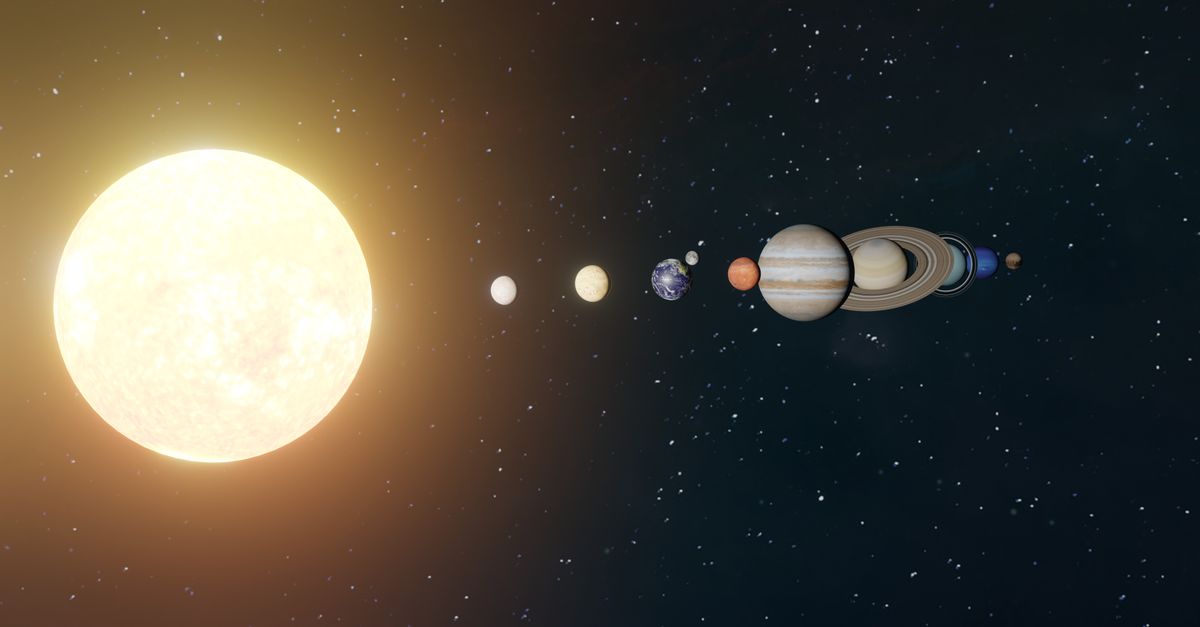
Why Saturn Spends About 2.5 Years in Each Sign
The two-and-a-half-year figure is a division, not a measurement. Saturn's sidereal orbital period around the Sun is approximately 29.46 years. The Western tropical zodiac slices the ecliptic into twelve equal sectors of 30° each, starting at the March equinox point as 0° Aries. Assuming Saturn moved at a uniform apparent rate, 29.46 ÷ 12 ≈ 2.455 years, which is the "about 2.5 years" most readers have seen quoted.
The real duration wanders because Saturn does not move at a uniform apparent speed. Two effects are responsible. First, the planet's heliocentric orbit is elliptical, so its apparent geocentric ecliptic motion varies across the year. Second, the planet goes retrograde — appearing to move backward against the ecliptic — for roughly 4.5 months of every year, looping back across a small band of longitude before resuming direct motion. When a retrograde loop straddles a 30° boundary, the planet can re-enter the previous sector or linger in the new one longer than the simple division suggests, which is why birth-date Saturn-sign lookups near a sign change require an actual instant calculation rather than a year-range table.
The tropical label itself is independent of those mechanics. The names Aries, Taurus, Gemini, and so on are a Western convention that fixes 0° at the March equinox, with each label covering the next 30° of ecliptic longitude. Those labels are not the IAU constellation outlines, and they drift slowly relative to the sidereal zodiac used in Indian astrology. For Western tropical work, the rule is mechanical: 0–30° ecliptic longitude is Aries, 30–60° is Taurus, and so on through 330–360° as Pisces.
What the Saturn Sign Calculator Returns
The Saturn Sign Calculator is a single-page calculation tool that takes three fields — local date, local clock time, and an explicit signed UTC offset — and produces four results for that instant: the tropical sector name (Aries through Pisces), the apparent ecliptic longitude in degrees, the degree-within-sector position, and the normalized instant the calculation actually used. The output is the same shape the Moon, Mercury, Venus, Mars, and Jupiter tools return, so a reader can compare classical planets without switching calculation contracts.
Three output details matter for verification:
- Apparent geocentric longitude — the angle is taken from the center of the Earth to Saturn against the true ecliptic of date, with aberration applied. This matches the coordinate shape NASA JPL Horizons observer quantity 31 reports, which is why the calculator's expected values are authored against Horizons and IMCCE Miriade as independent oracles, not against the offline adapter itself.
- Tropical sector — twelve equal 30° half-open sectors starting at 0° Aries. Near a sector boundary, a printed label can flip between two adjacent signs based on tiny time, offset, or ephemeris differences.
- Boundary warning — when the apparent longitude is within 0.05° (five hundredths of a degree) of an edge, the calculator flags the result so the reader knows to treat the printed sign with caution.
The entire calculation runs inside the visitor's browser using a pinned Astronomy Engine 2.1.19 adapter, which means no birth city, IP address, GPS reading, or runtime network request leaves the device. The reader's only inputs are the three text fields.
How to Find Saturn's Sign at a Specific Moment
To check which sign Saturn was in at a specific documented date and time, work through these four steps inside the Saturn Sign Calculator:
- Enter the local date. Use the calendar field to put down the year, month, and day as written on the document you are checking — birth certificate, journal entry, or event log.
- Enter the local clock time. Type the wall-clock reading shown on that document. The form rejects impossible clocks, so 25:00 or 13:60 will not submit.
- Enter the documented UTC offset. Type the signed offset for that place and date, including non-whole-hour values. For example, +00:00 for UTC, -05:00 for U.S. Eastern Standard Time, or +05:30 for India Standard Time. A wall-clock time does not identify one instant without this offset, so the field is required.
- Calculate to read the output. Click the calculate control to see Saturn's tropical sector, longitude, degree within the sector, and normalized instant. If a boundary warning appears, treat the printed sign as one of two adjacent candidates and re-run with a more precise time or offset if you have one.
If the documented moment predates modern standard time, read the result as a proleptic UTC-like estimate based on the offset convention you typed. The calculator does not silently reconstruct historical political zone databases or daylight-saving transitions, so an 1850s birth moment entered with -05:00 is treated as a -05:00 offset against UTC, not against local mean time.
Why a UTC Offset Matters More Than a Birth City
A common confusion with sign lookups is that a city name feels like a more meaningful input than a numeric offset. For Western tropical Saturn — and for the Moon, Mercury, Venus, Mars, and Jupiter tools built on the same shared adapter — a city is not an input. The Saturn calculator takes an Earth-center origin, which means the observer is the center of the Earth and geographic latitude, longitude, elevation, and GPS are irrelevant to the longitude value. What does matter is the offset used to convert a local clock reading into a single instant on the UTC axis.
This is also why the calculator refuses to invent an Ascendant, house cusps, midpoints, aspects, or a topocentric sky position: those products need a place and a different geometric contract. A Saturn-sign result is one number, in degrees, with a label. A birth chart is many.
For readers who want to dig deeper into how the sign label flips near a Saturn-sign change by birth date, the Saturn Sign Change by Birth Date guide walks through boundary cases with the same calculator.
Boundary Cases and the Five-Hundredth-Degree Warning
Saturn does not stop at sign boundaries, so any instant-level lookup has a thin shell of cases where the answer is unstable. Inside 0.05° of a sector edge, a one-second change in time, a one-minute change in offset, or the difference between two ephemeris implementations can flip the printed label. The calculator surfaces a warning in this shell so the reader does not walk away with a sign that another equally valid calculation would print differently.
This is also why the calculator's evidence package is authored against two independent oracles — NASA JPL Horizons observer quantity 31 and IMCCE Miriade using the INPOP theory — and why the dual-official gate fails any result with a circular difference larger than five thousandths of a degree. The offline adapter under test is not the expected-data source; it is only the implementation being checked. The expected values for the supported UTC years 1700 through 2100 are the oracles.
Two practical consequences for readers:
- For moments near a known Saturn-sign change: re-run with the most precise time and offset you can document. The boundary warning is a prompt, not a refusal.
- For moments far from any boundary: the printed sign is robust across adapters, offsets within a minute, and time within an hour. The simple "about 2.5 years per sign" mental model is enough.
Approximate Transit Times for Classical Planets
The "2.5 years" figure is specific to Saturn because it is specific to Saturn's 29.46-year orbit. Other classical planets move through the tropical zodiac at very different speeds, which is why a Saturn-sign lookup is not interchangeable with a Moon-sign lookup or a Sun-sign lookup. The table below lists approximate transit times drawn from widely cited planetary motion facts; for any single moment, the exact figure comes from the corresponding calculator rather than from a memorized average.
| Planet | Approximate time in one tropical sign | Why the range |
|---|---|---|
| Moon | About 2.5 days | Fast apparent motion across the ecliptic |
| Sun | About 30 days | One full year divided by twelve sectors |
| Mercury | Variable, roughly 14 to 30 days | Frequent retrograde loops near the Sun |
| Venus | Variable, roughly weeks to months | Longer retrograde arcs than Mercury |
| Mars | About 6 to 7 weeks | Outside Earth's orbit, smaller apparent retrograde effect |
| Jupiter | About 1 year | 12-year orbit divided by twelve sectors |
| Saturn | About 2.5 years (2.46 years from the 29.46-year division) | 29.46-year orbit plus retrograde variation |
For a quick Saturn-specific check, the Saturn Sign Calculator returns the exact label and longitude for any documented moment within the supported years 1700 to 2100. For a quick Moon check, the Moon Sign Calculator uses the same shared adapter. For a Saturn-return window rather than a single sign, the Saturn Return Calculator lists every exact longitude crossing inside a chosen life window.
Two reminders keep this useful and grounded. First, every published number is an estimate bounded by the dual-official tolerance, and the entertainment framing belongs next to the result — this is not medical, legal, financial, safety, employment, or relationship advice. Second, the supporting adapter is Astronomy Engine 2.1.19 pinned in its public repository, and the geocentric origin matches the NASA JPL Horizons observer-center contract. Both anchors explain why the calculator's apparent geocentric longitude agrees with Horizons and IMCCE within five thousandths of a degree, and why a printed "Aries" near a boundary is a label on a coordinate, not a forecast.