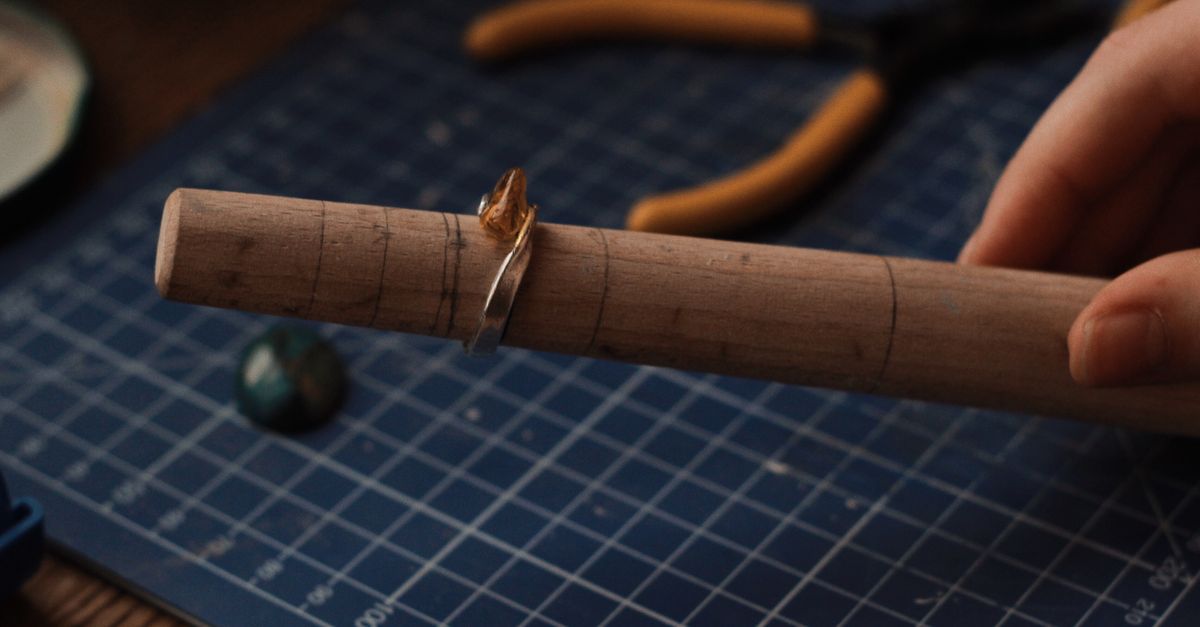
A ring size chart turns a single measurement — either the inner diameter of a ring you already own or the circumference of your finger — into the equivalent numeric or letter size used in the United States, United Kingdom, Europe, and Japan. The math behind the chart is straightforward: a ring's inner circumference always equals its inner diameter multiplied by pi, so a 17.3 mm diameter corresponds to about 54.4 mm of circumference, which is why the European ISO 8653 size number — essentially the circumference in millimeters — lines up so neatly with a US 7. A good chart keeps US numeric sizes, UK/Australian letter sizes, ISO millimeter sizes, and Japanese numeric sizes in a single cross-checked table, and lets you enter a measured millimeter value to find the nearest standard size automatically. That way you can shop across international sizing systems without translating each one by hand, and you do not need a jeweler's mandrel to start.
What a ring size chart actually converts
A ring size chart is built from a single physical truth: the inner edge of a ring is a circle, and every sizing system in the world is just a different way of labeling that circle. Some systems label it by the diameter in millimeters, some by the circumference in millimeters, some by an arbitrary numeric scale that runs through the same numbers, and some by letters that march through the alphabet. When those labels are aligned with a real measurement, any one can be converted into the others instantly. That is the entire job of a ring size chart: pick a label you already know — or a measurement you just took — and read off the matching label in every other system, plus the diameter and circumference that tie them all together. With the Ring Size Chart, the conversion happens in your browser as soon as you change an input, so you can flip between systems without retyping.
The four ring sizing systems compared
Ring sizing is fragmented by country, and the four systems in common use today do not even use the same underlying unit. Comparing what each one is actually doing makes the conversion logic much easier to follow.
| System | Region | Format | Typical range | Underlying unit |
|---|---|---|---|---|
| US/Canada | North America | Numeric (half steps) | 3 to 13.5 | Arbitrary numeric scale |
| UK/Australia | United Kingdom, Australia, New Zealand | Letters | A to Z and beyond | Arbitrary letter scale |
| EU/ISO 8653 | Mainland Europe | Numeric (millimeters) | ~40 to ~75 | Inner circumference in millimeters |
| Japan | Japan | Numeric | ~1 to ~28 | Tracks inner diameter in millimeters |
US and Canadian jewelers use a numeric scale that runs from roughly 3 to 13.5 in half steps, while UK and Australian jewelers use a letter scale that starts at A and continues past Z for the largest sizes. ISO 8653, which most of mainland Europe follows, is the cleanest of the four: the size number is defined as the inner circumference of the ring in millimeters, so an EU 54 is literally a ring with a 54 mm inner circumference. Japan uses its own numeric scale that closely tracks the inner diameter, which is why a Japan 14 lines up with a US 7. The two measurements that actually matter physically are the inner diameter and the inner circumference, both in millimeters — they describe the same circle, and a ruler or measuring tape gives them directly. A chart that shows both, and lets you enter either one, removes the need to translate every system by hand.
How to measure your ring size step by step
You have two reliable ways to get the number you need: measure a ring that already fits, or measure the finger you plan to fit. Both feed into the same chart.
- Pick the ring that fits the intended finger best. If you are shopping for someone else and you know which finger they wear it on, use a ring from that finger; otherwise use a similar band from their collection.
- Lay the ring flat on a table with the inner edge facing up. Hold a ruler or digital caliper straight across the inside of the ring, going from one inner edge to the other, not diagonally.
- Read the measurement in millimeters to one decimal place. That number is the inner diameter — it is the distance the ring must clear when it slides over the knuckle.
- Open the chart and switch the input mode to Inner diameter, then enter the value. If you measured in inches instead, type that with the unit; the converter accepts both.
- For a finger measurement, wrap a thin strip of paper or non-stretchy string around the base of the finger, mark where it overlaps, and measure the strip against a straight ruler. That length in millimeters is the inner circumference — the same number an EU size reports directly.
- Switch the input mode to Inner circumference and enter the value. The chart finds the nearest standard size for you.
- Repeat any measurement two or three times, ideally at the end of the day when fingers are at their most swollen, and average the readings.
Reading the conversion results
Once a value is entered, the results table fills in with the equivalent size in every system, the exact inner diameter, and the exact inner circumference. For a size you already know — say US 7 — you pick US/Canada from the first dropdown, choose 7, and the table reads back UK N½, EU 54, and Japan 14, with 17.3 mm of inner diameter and about 54.4 mm of inner circumference. For a measured value that does not sit exactly on a catalog row, the panel flags which standard size is the closest match, so you can round with confidence. The conversion rests on one formula: inner circumference = inner diameter × π. Working that out for a measured 17.3 mm ring gives 17.3 × π ≈ 54.35 mm, which rounds to 54 mm — the EU size you see in the chart. The same π relationship is what keeps the table accurate across jeweler charts that round half-sizes or quarter-sizes differently.
Variables that change the fit before you order
A ring size chart is a reliable starting point for comparison shopping, but it is not the last word on fit. Three real-world variables can shift the size you need once the conversion is done.
- Band width and profile. A wide band covers more of the finger and feels tighter than a thin band at the same labeled size, so most jewelers recommend going up a size for bands wider than about 6 mm, and especially for comfort-fit profiles.
- Temperature, time of day, and season. Fingers swell in warm weather, after exercise, and late in the day; they shrink in cold weather and first thing in the morning. Measure when the finger is at its largest, which for most people is the end of the day.
- Maker and country tolerances. Real ring sizes vary slightly between jewelers, between countries, and between styles from the same maker, because the manufacturing tolerance on the mandrel is rarely tighter than a tenth of a millimeter.
For an engagement ring, wedding band, or any expensive purchase, the chart gets you close and saves you from guessing, but the final size should be confirmed with a jeweler using a physical ring sizer or mandrel before you order. The Ring Size Chart handles the math locally in your browser, so you can flip between US, UK, EU and Japan values — or between a measured diameter and a measured circumference — without anything being uploaded and without needing an account. Once a value is in, the whole reference table updates, and it stays usable offline if the page has already loaded. Treat the equivalents here as a reliable launching point for international comparison shopping.
For a deeper look, see Determine TV Size Based on Your Viewing Distance.
For a deeper look, see Annulus Area Calculator for Beginners: Find Ring Area.