To measure an oval’s area, measure its longest and shortest full widths, halve each one, and calculate A = π × a × b, where a and b are the semi-major and semi-minor axes. This guide treats “oval” as a mathematical ellipse. The method is exact for an ideal ellipse with known axes; for an irregular physical outline, it estimates the area of an ellipse fitted to that outline.
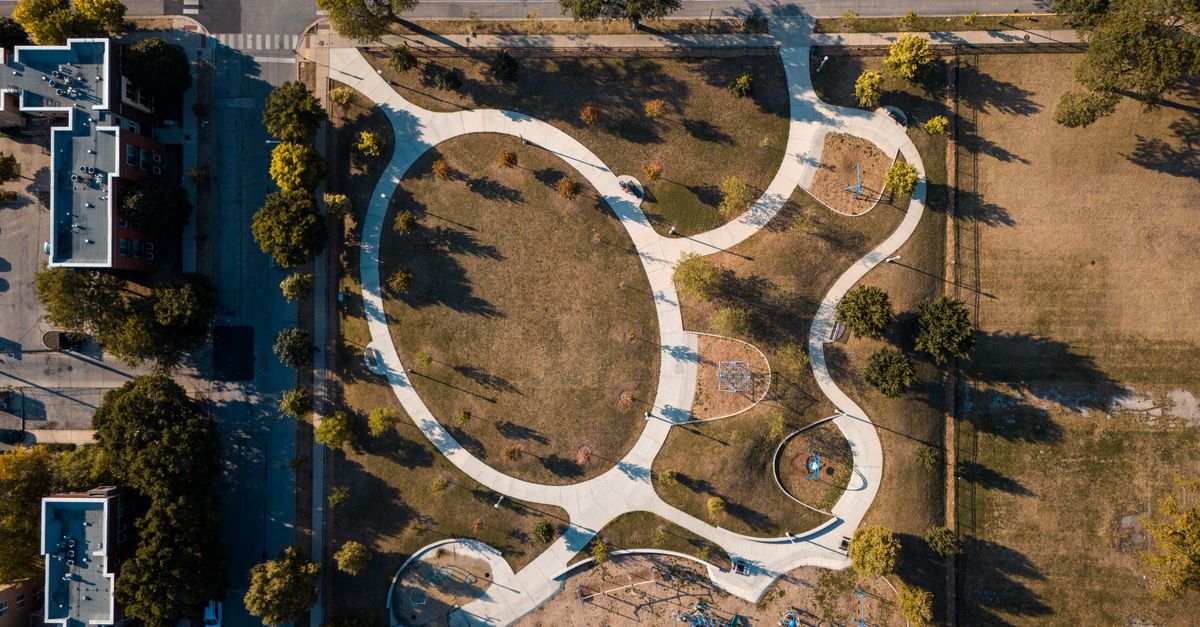
Take two measurements across the center
The two dimensions that define an ellipse are measured from the center to opposite edges. To measure a physical oval, find its greatest width and its least width across the perpendicular direction. These are the full major and minor axes; they are not yet the semi-axis values needed by the area formula.
- Longest full width: Measure from one edge to the opposite edge through the center, following the direction in which the oval is widest.
- Shortest full width: Measure across the narrowest part through the center, perpendicular to the long direction.
- Consistent units: Record both measurements in the same unit so the multiplication produces a meaningful result in square units.
- Straight placement: Keep the tape or ruler straight across the shape rather than letting it follow the curved edge.
Measure to the outside edges of the intended oval, not to an inner border or decorative trim unless that trim is the boundary you want to calculate. For an uneven outline, repeat the measurements and treat the final number as an estimate for a best-fit ellipse rather than an exact measurement of every irregularity.
Convert full widths into semi-axes
If D is the longest full width and d is the shortest full width, then a = D ÷ 2 and b = d ÷ 2. The area formula can therefore also be written as A = π × (D ÷ 2) × (d ÷ 2).
| Physical measurement | Ellipse term | Value to enter |
|---|---|---|
| Longest full width | Major axis | Half the measurement: a |
| Shortest full width | Minor axis | Half the measurement: b |
Enter the longer half-width as a and the shorter half-width as b. A measurement taken from the center to an edge is already a semi-axis, while a measurement taken all the way across is a full axis and must be halved. If the two widths are equal, the shape is a circle in this model. Keep both converted values in the same unit before continuing.
Calculate the area from your measurements
- Open the Ellipse Area Calculator and locate the two axis boxes.
- Enter the semi-major axis a in the first box. Use half of the oval’s longest full width; the field accepts a value in any unit.
- Enter the semi-minor axis b in the second box. Use half of the shortest full width and select the same unit as a.
- Read the ellipse area below the inputs. It appears as soon as both numbers are entered and is displayed with the worked A = π × a × b formula.
- Record the result in square units. The same pair of semi-axes also produces a perimeter estimate and an eccentricity value for describing the oval.
For an oval measuring 10 units at its widest point and 6 units at its narrowest point, the semi-axes are a = 10 ÷ 2 = 5 and b = 6 ÷ 2 = 3. Substitution gives A = π × 5 × 3 = 15π ≈ 47.12 square units.
The important check is that the two values entered are half-widths. The result is expressed in square units because area combines two length dimensions rather than one.
Read the area and related outputs
The calculator provides three related measurements from the same pair of semi-axes, but each answers a different question.
- Area: The enclosed planar area is calculated with A = π × a × b. The formula is applied directly to the entered dimensions, although the accuracy of the final measurement still depends on how accurately you measured the oval.
- Perimeter: The distance around the ellipse is reported using Ramanujan’s second approximation. An ellipse has no simple exact elementary formula for its perimeter; its true value is defined by an elliptic integral. The tool’s approximation is accurate to many decimal places for ordinary ovals but should still be understood as an approximation.
- Eccentricity: This dimensionless value uses the longer semi-axis as a in e = √(1 − (b/a)²). A value of 0 means the shape is a circle, while values approaching 1 indicate an increasingly long, thin ellipse.
Use the area for the space enclosed by the oval, the perimeter when you need the distance around its boundary, and eccentricity when you need to describe how far the shape departs from a circle.
Check the inputs before relying on the result
- Confirm that the values are half-widths. Entering the full major and minor axes produces an area four times too large because the calculation multiplies two diameters rather than two semi-axes.
- Check both units. The calculator does not convert units for you. Centimeters entered for both axes give square centimeters, meters give square meters, and inches give square inches. If the inputs use different units, convert them before calculating.
- Keep the longer axis in the a box. This follows the calculator’s definition of eccentricity and keeps the major and minor measurements clearly identified.
- Use a circle as a sanity check. When a = b, the area becomes πa² and the eccentricity becomes 0. The perimeter calculation also returns the exact circle value 2πa in this special case.
- Measure the true extremes. Use the widest and narrowest spans of the intended boundary rather than convenient dimensions taken at arbitrary points.
If the two results differ from a manual calculation, check the halving, the unit labels, and whether the longer measurement was placed in the first box. Most calculation errors arise from using full axes or mixing measurement units, rather than from the π × a × b formula itself.
Confirm the shape and intended use
This process calculates the flat area enclosed by an ideal ellipse. It is appropriate for an oval flower bed, rug, tabletop, mirror, or the cross-section of an elliptical duct or tank. It does not calculate the curved surface area of a three-dimensional object, and it cannot trace a non-elliptical outline from a picture or a set of points.
For a kidney-shaped, rectangular-with-rounded-corners, or otherwise irregular boundary, two axes cannot represent the outline exactly. The ellipse result is appropriate only when treating the shape as a best-fit oval is acceptable. If every bend and indentation must be included, the boundary needs to be evaluated with a different area method rather than summarized by its longest and shortest widths.
Where the measurement method is useful
Once the semi-axes are known, the same calculation supports many practical and academic tasks.
- Landscaping and building: Estimate the footprint of oval flower beds, patios, tables, mirrors, and rugs.
- Engineering: Find the cross-sectional area of elliptical ducts, tanks, and pipes.
- Sports: Measure the enclosed area of a standard running-track infield modeled as an ellipse.
- Science and education: Apply the same formula to elliptical orbits and to geometry, trigonometry, or calculus problems.
In each case, the essential habit is the same: measure the full major and minor axes, convert both to semi-axes, keep their units consistent, and then apply π × a × b.
For a deeper look, see How Does a Parallelogram Area Calculator Work?.
For a deeper look, see Rectangular Prism Calculator for Volume and Area.