To convert a speed from kilometers per hour (km/h) to meters per second (m/s), divide the kilometer-per-hour value by 3.6. Equivalently, you can multiply by the exact fraction 5/18, which is just 1/3.6 rewritten as a rational number. The conversion factor 3.6 comes from the SI definitions that 1 kilometer equals exactly 1,000 meters and 1 hour equals exactly 3,600 seconds, so 1 km/h = 1,000 m ÷ 3,600 s = 0.2777… m/s. For instance, 90 km/h reduces to 25 m/s once you divide 90 by 3.6, a common road-speed benchmark that physics textbooks use because it lands on a round number. The reverse conversion multiplies by 3.6, so 25 m/s becomes 90 km/h. Both directions use the same exact arithmetic because the SI definitions carry no rounding, and the Speed Converter applies the same factors when it routes every input through meters per second internally. Whether the number in front of you came from a road sign, a treadmill readout, or a physics problem, the same 3.6 divisor always applies when going from km/h down to m/s.
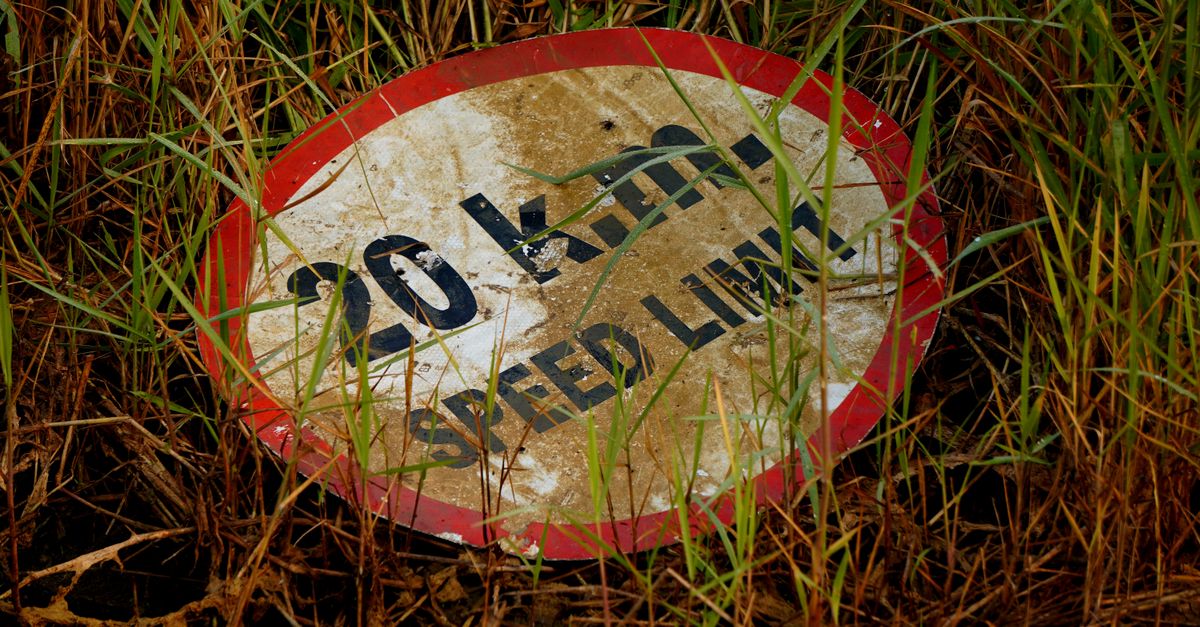
The conversion formula and where 3.6 comes from
The factor 3.6 isn't an arbitrary number to memorize; it falls out of the way SI units are defined. Start by rewriting any speed in km/h as a ratio of meters to seconds. One kilometer is 1,000 meters and one hour is 3,600 seconds, so:
1 km/h = (1 × 1,000 m) / (1 × 3,600 s) = 1,000 / 3,600 m/s = 0.2777… m/s
The reciprocal of 1,000 / 3,600 is 3,600 / 1,000 = 3.6, which is what you divide by when going from km/h to m/s. Because both 1,000 m and 3,600 s are exact SI definitions rather than measured quantities, this factor is exact to as many digits as your calculator or spreadsheet will hold. The NIST SP 811 unit conversion guide is the authoritative reference for these relationships and confirms both definitions.
The same logic produces a clean fraction: 5/18, since 1,000 ÷ 200 and 3,600 ÷ 200 simplify to 5 and 18 respectively. Multiplying by 5/18 gives exactly the same numerical result as dividing by 3.6, with no rounding either way. So if you find division awkward, the equivalent multiplication form is m/s = km/h × (5/18). Either route lands on the same answer because the underlying factors are the same exact SI quantities.
How to convert km/h to m/s using Speed Converter
The Speed Converter takes a value in one of five supported units — m/s, km/h, mph, knots, or ft/s — and returns the equivalent in any of the others, running the math through meters per second internally so that every factor stays exact. Here is the concrete workflow for the km/h to m/s direction:
- Enter a finite non-negative speed value. Type the number you want to convert. The tool accepts values from zero up to one billion and rejects empty entries, negative numbers, infinity, or anything that isn't a finite numeric input.
- Choose km/h as the source unit and m/s as the target. Use the unit selectors to pick km/h on the source side and m/s on the target side. You can also flip the direction (m/s back to km/h) or switch to mph, knots, or ft/s for related comparisons.
- Select Convert speed and round the displayed result to the precision appropriate for your source measurement. The tool computes the value, formats it to up to 12 significant digits, and shows it in your browser. Trim trailing digits to match the accuracy of the original measurement rather than quoting the full 12-digit display.
Because every conversion in the tool goes through meters per second using the exact standard factors listed below, you can convert km/h to m/s and then immediately convert that m/s result into knots or ft/s without re-entering any number. The output stays internally consistent across all five units, and the same 3.6 divisor shown above is the foundation for the km/h to m/s leg.
Standard speed unit definitions you can rely on
The Speed Converter uses a fixed set of exact relationships between units. These are not approximations; they are the official definitions published by standards bodies, and they are the same values NIST and NOAA reference in their technical guidance.
| Quantity | Exact definition | Source |
|---|---|---|
| Kilometer to meter | 1 km = 1,000 m exactly | SI (NIST) |
| Hour to second | 1 h = 3,600 s exactly | SI (NIST) |
| International mile to meter | 1 mi = 1,609.344 m exactly | International yard and pound agreement (NIST) |
| International foot to meter | 1 ft = 0.3048 m exactly | International yard and pound agreement (NIST) |
| Nautical mile to meter | 1 NM = 1,852 m exactly | NOAA |
| Knot to km/h | 1 kn = 1 NM/h = 1.852 km/h exactly | NOAA |
Because each of these definitions is exact, the conversion factors between any pair of supported units (1 km/h = 0.2777777… m/s, 1 mph = 0.44704 m/s exactly, 1 kn = 0.514444… m/s) are also exact rational numbers. Display precision is the only place approximation enters, and only because showing more digits than your source data warrants would be misleading rather than informative.
Going the other way: m/s back to km/h
To convert m/s to km/h, multiply by 3.6 instead of dividing. The math is symmetric: 1 m/s = 3,600 m / 1,000 h = 3.6 km/h. Using the same 90 km/h example in reverse, 25 m/s multiplied by 3.6 gives 90 km/h, confirming the conversion. The Speed Converter handles this direction with the same three steps; simply choose m/s as the source unit and km/h as the target.
This is a common need in physics, where most textbook problems give speeds in m/s but real-world vehicles, trains, and weather events are usually reported in km/h. The two numbers look similar at low speeds — a brisk walk at 1.4 m/s is about 5 km/h — but they diverge as the values grow. A 100 km/h highway speed is roughly 27.78 m/s, and a fast-moving car at 120 km/h sits at about 33.33 m/s. Once you internalize that 3.6 is just 1,000 meters per 3,600 seconds, the relationship between any pair of km/h and m/s values stops being a memorized constant and starts being a piece of arithmetic you can do in your head.
Where km/h to m/s actually shows up
Outside of textbooks, three situations make this conversion routine. First, drivers in countries that post speed limits in km/h sometimes need the m/s value for technical paperwork; vehicle dynamometer reports, engineering test procedures, and some insurance calculations work in m/s. Second, athletics and running pace calculations mix the units — 5-minute-kilometer pace equals 12 km/h, or about 3.333 m/s, which is the speed many runners carry into training plans. Third, weather reporting and aerodynamics frequently use m/s for wind speed while road signs and aviation forecasts use km/h or knots. Converting quickly and accurately between these units prevents the kind of error that happens when 30 m/s is misread as 30 km/h, about a 3.6× difference that matters for safety calculations.
Aviation brings a related complication: pilots work with knots rather than mph or km/h, and one knot is exactly 1.852 km/h by the NOAA definition. The Speed Converter covers knots directly, so a single entry lets you move between km/h, m/s, mph, knots, and ft/s without chaining multiple conversions by hand. This is most useful when a forecast gives wind in knots and a road sign or vehicle specification needs the value in km/h or m/s, since the conversion factors for each pair are baked into the tool's m/s-through routing.
Precision, limits, and what the converter won't do
Showing 12 significant digits is a deliberate choice. It preserves enough precision for engineering and scientific use while suppressing the long tail of digits that IEEE 754 double-precision arithmetic would otherwise display, which can confuse readers who mistake computational noise for measurement accuracy. The conversion itself is exact; the limit is what the source measurement can support. A vehicle speedometer reading of 87 km/h is accurate to perhaps ±2 km/h, so quoting 24.166666666666 m/s implies a level of certainty the original data does not have. Trim the result to the significant figures that match your input rather than copying the full display.
The tool accepts values from zero to one billion and rejects negative, empty, infinite, or non-numeric input. It does not calculate travel time, acceleration, velocity direction, pace per kilometer, wind chill, Mach number, relativistic effects, legal speed limits, vehicle calibration, GPS error, or measurement uncertainty. All math runs locally in the browser; no value leaves your device. For regulated work, retain the uncertainty band of the source data and verify the governing standard and instrument calibration separately — unit conversion cannot improve the accuracy of the sensor that produced the original number, no matter how many digits the tool displays.