The speed of sound in dry air is given by a = √(γRT), where γ is the ratio of specific heats, R is the specific gas constant for dry air, and T is the absolute temperature in kelvin — and that single variable is what makes altitude matter: temperature drops as elevation rises, and a smaller T produces a smaller sound speed. This is why a Mach number on a warm sea-level afternoon is numerically different from the same Mach number on a cold mountaintop, and why supersonic flight gets easier as aircraft climb into the colder layers of the upper troposphere. The Speed of Sound Calculator lets you enter a dry-air temperature from -100°C to 100°C and read the ideal-gas estimate in meters per second, kilometers per hour, miles per hour, and knots on the same screen. The page displays its constants — γ = 1.4 and R = 287.05 J/(kg·K) — together with the kelvin value used, so the number you get is auditable rather than coming from an unexplained lookup. To map that answer onto a real altitude, supply a temperature drawn from a standard atmosphere table or a local measurement; the tool then turns that temperature into a transparent propagation speed.
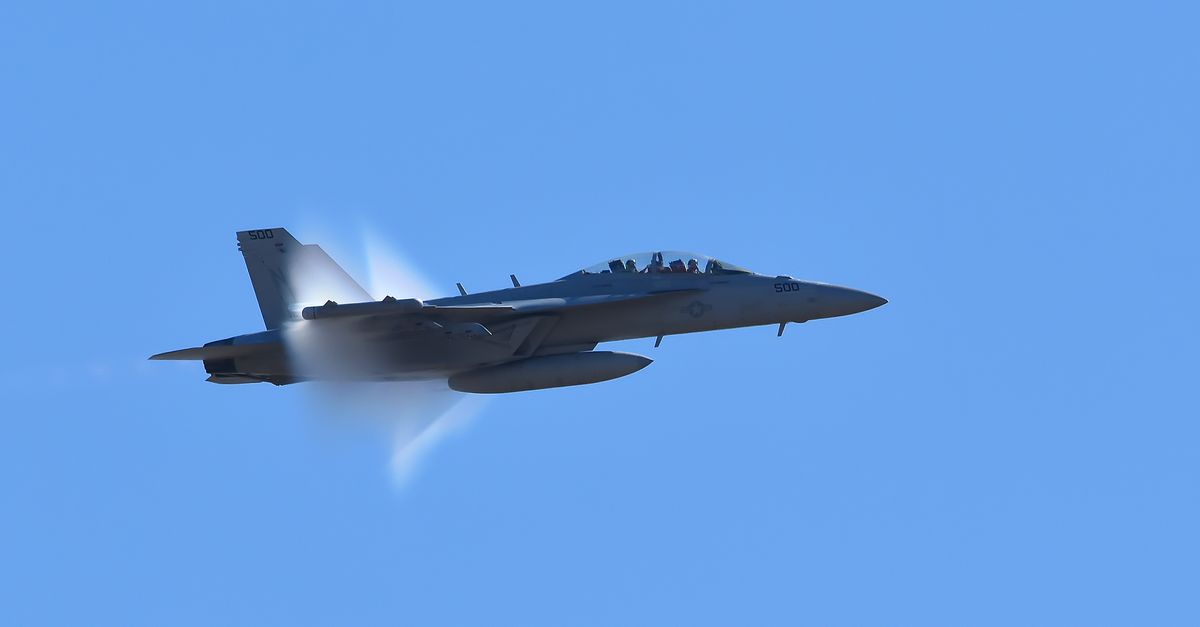
What Actually Sets the Speed of Sound
A pressure disturbance travels through a gas because molecules in the path of the disturbance collide with their neighbors and transfer momentum outward. Two properties decide how fast that handoff happens: how heavy each molecule is, captured in R, and how much thermal motion the molecules already have, captured in T. Heavier molecules transfer momentum more slowly; warmer molecules transfer it more quickly, because they are already moving faster. Pressure and humidity do change the result a little in the real atmosphere, but the dominant variable inside the everyday range is temperature, which is why an altitude change is essentially a temperature change for the purposes of this calculation. The OpenStax University Physics Volume 1 chapter on the speed of sound makes the same point: warmer gas produces a larger sound speed because its particles transfer the pressure disturbance more rapidly. For practical work — classroom exercises, first-pass acoustic checks, or quick engineering estimates — modeling dry air as a calorically perfect ideal gas with γ = 1.4 is enough to produce a useful number across most everyday temperatures.
The Ideal-Gas Formula and Its Constants
The relationship a = √(γRT) is the calorically perfect-gas speed-of-sound formula. Three quantities feed into it:
- a — the speed of a small pressure disturbance, in meters per second.
- γ — the ratio of specific heats, dimensionless. Dry air is treated as a diatomic ideal gas with γ = 1.4.
- R — the specific gas constant for dry air, 287.05 J/(kg·K).
- T — absolute temperature in kelvin. Because the formula demands an absolute scale, any Celsius input must be converted with T = °C + 273.15 before the square root is evaluated.
Substituting the dry-air constants gives a = √(1.4 × 287.05 × T), where T is the converted kelvin value. The square root is taken on the unrounded product, then the result is reported in meters per second and converted into the other three speed units. The Speed of Sound Calculator prints γ, R, and the kelvin value beside the answer so you can reproduce the arithmetic by hand. The same expression appears in the NASA Glenn research-center reference on the speed of sound, which also emphasizes that temperature must be absolute, not relative.
Mapping Altitude to Temperature
The calculator does not ask for an altitude in meters or feet — it asks for a temperature in Celsius — because altitude enters the formula only through that temperature. Standard atmospheric profiles give a useful rule of thumb: temperature generally decreases with elevation in the troposphere, levels off near the tropopause, and then changes sign in the stratosphere. The table below summarizes that qualitative pattern using widely cited approximate values; use a current sounding or a published standard-atmosphere table when you need a specific number for your location.
| Altitude band | Approximate temperature | Effect on sound speed |
|---|---|---|
| Sea level (ISA reference) | about 15°C | ~340 m/s reference |
| Mid-troposphere (~5 km) | roughly -17°C | slower than sea level |
| Tropopause (~10–11 km) | around -50 to -56°C | slowest in the lower atmosphere |
| Lower stratosphere (15–20 km) | near -56°C, relatively stable | near-constant with altitude |
The actual Celsius value for your situation depends on weather, season, and latitude. The safest approach is to take a local reading — a thermometer, a weather report, or a standard atmosphere lookup — and feed that number into the calculator.
How to Calculate Speed of Sound at Different Altitudes
The procedure below turns any altitude condition into a four-unit speed-of-sound estimate.
- Find the temperature that corresponds to your altitude. Use a standard-atmosphere table, a sounding from a nearby weather station, or a measured thermometer reading. Convert it to a Celsius value if it isn't already.
- Open the Speed of Sound Calculator and enter that Celsius temperature. The input is a finite number between -100°C and 100°C; blank fields and out-of-range values are rejected with an explicit error rather than silently clamped.
- Read the four speed values. The page reports the result in meters per second, kilometers per hour, miles per hour, and knots on the same screen, with γ, R, and the converted kelvin value shown for reference.
- Copy the meters-per-second figure for your record. A copy button pastes the unrounded m/s value into your worksheet, lab note, or engineering report, so the originating temperature and constants stay with the answer.
- Note the dry-air ideal-model assumption. Whenever you reuse the figure elsewhere, write down that it is a dry-air calorically-perfect estimate and that humidity, wind, refraction, and non-standard gas mixtures are not included.
Worked Example: A 15°C Sea-Level Day
Standard atmospheric conditions at sea level use 15°C as the reference temperature. Plugging that through the calculator's formula:
- Convert to kelvin: T = 15 + 273.15 = 288.15 K.
- Multiply by γ and R: 1.4 × 287.05 × 288.15 = 115,798.84 (unrounded).
- Take the square root: √115,798.84 ≈ 340.29 m/s.
That is the ideal-gas estimate for a 15°C sea-level day. The Speed of Sound Calculator would also return the same value expressed in kilometers per hour, miles per hour, and knots, all derived from the unrounded m/s figure rather than re-evaluated in each unit. To get the answer at, say, 5 km of altitude, take the corresponding standard-atmosphere temperature — about -17°C — and run the same procedure; the calculator does the kelvin conversion and the square root automatically.
Speed Units and the Conversions Behind Them
Once the meters-per-second value is known, the other three units come from fixed conversion factors. The factors used by the calculator are exact in the sense that they are the definitions of those units, so the table below is auditable in the same way as the formula:
| From 1 m/s | Multiply by | To obtain |
|---|---|---|
| 1 m/s | 3.6 | km/h |
| 1 m/s | 2.2369362920544 | mph |
| 1 m/s | 1.9438444924406 | knots |
Any mph or knots figure returned by the page is the modeled m/s speed expressed in another unit; it is not a Mach number adjusted for a separate local atmosphere, and it carries the same dry-air γ and R assumptions. If you need to compare a reading in a less common unit, a speed converter can take the same m/s figure and translate it into ft/s, ft/min, or m/min without re-doing the underlying acoustics.
When the Dry-Air Estimate Breaks Down
The calorically perfect ideal-gas model is a useful approximation, but it is an approximation. The calculator is deliberately bounded, and the bounds matter when you reuse the number.
- Humidity. Moist air has a slightly different γ and gas constant, so a humid reading can differ from this dry-air estimate by a small but real amount.
- Wind. The formula estimates propagation relative to the modeled air. Wind moving with or against the source shifts the observed speed over the ground.
- Strong temperature gradients. Real atmospheric layers refract sound; the single-temperature ideal model cannot describe that.
- Non-air media and reacting flows. Other gases, high-temperature reacting mixtures, underwater acoustics, and solids each need their own γ and R.
- Shock waves and supersonic aerodynamics. The linear small-disturbance assumption underlying a = √(γRT) is not valid across a shock or near a supersonic vehicle.
Outside the everyday dry-air range — for flight safety decisions, certified instrumentation, meteorology, or experimental work — rely on measured local conditions and a validated atmospheric or acoustic model rather than this single-temperature ideal-gas estimate. OpenStax's Speed of Sound chapter walks through the same caveats in detail.
Putting It All Together
For a quick altitude-aware sound speed, the workflow is straightforward: pick the temperature that corresponds to your altitude, hand it to the Speed of Sound Calculator, and read the four-unit answer next to the constants that produced it. The temperature-to-kelvin conversion and the square root are handled for you, the result is auditable, and the dry-air assumption is stated so you can judge whether the estimate fits the situation at hand. For classroom checks, unit comparisons, or a transparent first-pass engineering number, this approach is exactly enough. For anything safety-critical, swap in a measured local temperature, a sounding, or specialist acoustic software, and keep the dry-air model only as a sanity check.
Related reading: How to Calculate Speed of Sound Wave: Formula and Method.
Related reading: How a Speed of Sound Calculator Works Step by Step.