Paint needed for a house exterior equals the total wall area minus the openings you are not painting, multiplied by the number of coats and divided by the coverage printed on the tin. This single formula — (walls − openings) × coats ÷ coverage — produces an exterior paint estimate, from a small bungalow to a two-storey family home. Apply it to the painted body of the house first; trim, soffits, fascia and a separate primer coat each need their own calculation. The result is always rounded up to whole gallons or litres, because paint is sold by the tin and you cannot buy a fraction. A 1,200-square-foot wall area on a single-storey home — once openings are subtracted — comes out to roughly seven gallons for two coats at standard coverage. Larger elevations with gable ends, dormers or a full second storey push the body's paint requirement well above that figure, even before trim is added. Knowing the formula in advance prevents the two classic exterior paint mistakes: running back to the store mid-job because you under-bought, or being left with several half-used tins cluttering the garage because you over-bought.
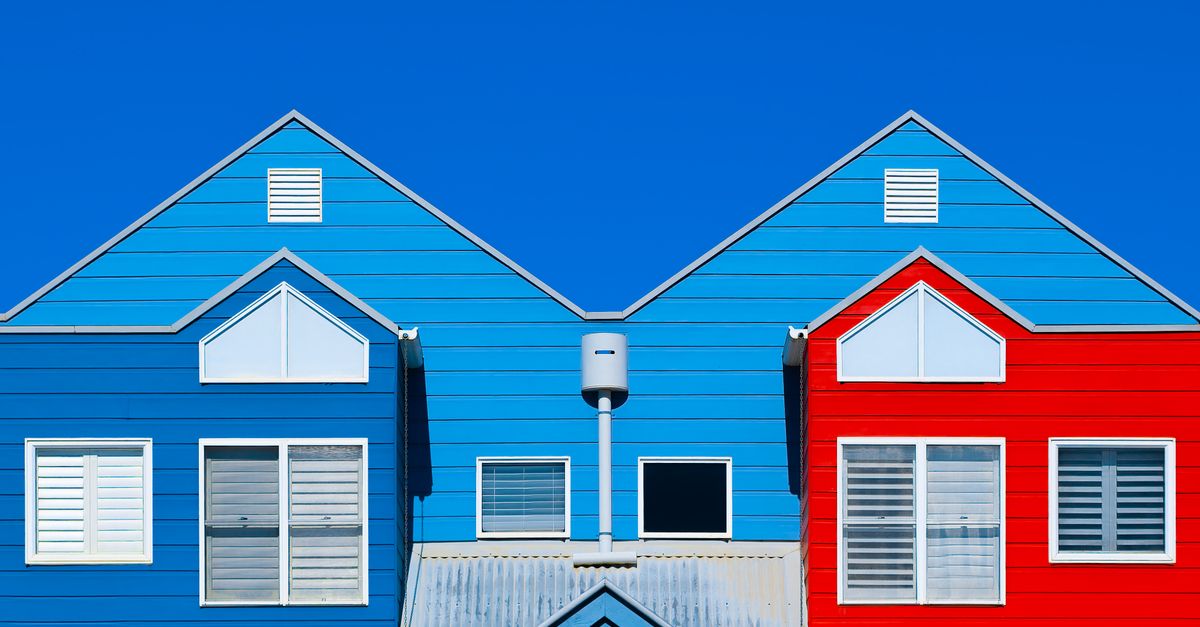
Measuring the Walls of a House Exterior
The Paint Calculator takes a single number for "wall area", which for a house exterior is the painted face of every outside wall added together. Each wall is its length times its height, exactly the same way the calculator handles one room. The exterior difference is that wall heights are not uniform: a ranch-style home may have one continuous 8 ft wall, a two-storey home has roughly 17 to 18 ft of wall on the front and back, and a gable end has a rectangular lower portion topped by a triangular peak.
For a rectangular wall, measure the length along the foundation (or where the wall meets the next wall) and multiply by the height from ground level to the eave. For a gable end, calculate the rectangular wall first — length times eave height — then add the triangle above it as 0.5 × base × peak-rise, where the peak-rise is the distance from the eave to the highest point of the roof. A simple laser distance meter speeds this up considerably on tall or multi-storey walls.
Walk the perimeter once and write each wall's length and height on a list, then add them. Keep every measurement in the same unit — feet with feet, metres with metres — so the calculator returns gallons for square feet and litres for square metres. The calculator does the running total for you the moment you type, but the on-paper list is what prevents missed or double-counted walls on a complex elevation.
The Paint Calculation Formula
The math behind every exterior estimate has four parts that line up with the four inputs in the Paint Calculator:
- Total wall area — the sum of length × height for every outside wall on the body of the house.
- Openings — the area of doors, windows and any garage doors you will not paint as wall.
- Coats — the number of finish coats over the primer; two is the typical default.
- Coverage — the square feet (or square metres) one gallon (or litre) covers in a single coat, as printed on the tin.
The full formula is: (wall area − openings) × coats ÷ coverage = tins to buy, rounded up. The calculator performs the same calculation live as each input changes, but writing it out this way makes it easy to sanity-check the result against your own arithmetic.
How to Calculate Paint Needed for a House Exterior
- Pick your units, then enter the total wall area. Measure the length of every outside wall and multiply it by its full height — including any gable peak above the eave — then add the walls together. Enter the total in square feet or square metres.
- Subtract the doors and windows you are not painting. Add up the rough area of every exterior opening on the body of the house and enter the total. Leave the field blank if you would rather round your estimate up and keep the difference as spare paint. The calculator keeps the openings total from reaching or exceeding the wall area, because at that point there is nothing left to paint.
- Set the number of coats. Two is the standard for an even, durable finish on most exterior surfaces. A same-colour refresh over sound, well-adhered paint may manage one; a light colour covering a dark wall, or bare and porous siding, often needs three.
- Enter the coverage printed on the tin and read the result. The calculator divides total area by your coverage figure and rounds up to whole gallons or litres. Use this as the quantity to take to the store.
A worked check on a single-storey exterior with 1,200 sq ft of wall and 80 sq ft of openings: 1,200 − 80 = 1,120 sq ft of net wall area; at two coats, that is 2,240 sq ft to cover; at 350 sq ft per gallon — the lower end of a smooth, primed figure — 2,240 ÷ 350 = 6.4, which rounds up to 7 gallons for the body. Trim is then bought separately using the same formula on the linear feet of fascia, soffit and window trim.
Real-World Coverage on Exterior Siding
Coverage printed on a tin is a smooth-wall, primed-surface figure, not an exterior reality. Once paint hits the outside of a house it meets siding, not drywall, and the rate the tin promises is rarely what you actually get. The reference values below help you pick a coverage figure that reflects your house.
| Surface type | Coverage per coat | Use when |
|---|---|---|
| Smooth, primed exterior siding (sq ft + US gallons) | ≈ 350–400 sq ft / gallon | Reference figure printed on the tin |
| Smooth, primed exterior siding (sq m + litres) | ≈ 10–12 sq m / litre | Reference figure printed on the tin |
| Rough, textured or unprimed exterior siding | 10–20% lower than the tin | Real-world adjustment on weathered wood, stucco or masonry |
The 10 to 20 percent rule of thumb is the safest shortcut when you do not want to weigh your siding against a chart: enter the tin's coverage figure, then mentally add 10 to 20 percent more paint to the calculator's whole-tin result. The calculator rounds up anyway, so on small jobs the safety margin is built in. On a multi-storey home with mostly rough or unprimed siding, the real-world figure can run nearer 20 percent lower than the tin, and adding extra at the store is cheaper than a second run across town.
What to Leave Out of the Estimate
The Paint Calculator is a straightforward wall-area tool, not a full paint schedule, and treating it as one is the most common cause of either over-buying or ending up short. Use it for the body of the house only and calculate the rest separately.
- Exclude from the wall total: the glass in every window, the face of every door (front, back, patio) and any garage door — even if the door is painted the same colour as the siding.
- Exclude the roof itself. Roof paint or coating is a different product with a different coverage rate and a different calculation.
- Run separately for fascia, soffit, eaves, window and door trim, corner boards and shutters. These read as linear feet, not square feet, and need their own paint quantity.
- Run separately for a primer coat on bare wood, masonry or patchy repairs. Primer usually costs less and covers more area, and adding it to the top-coat figure will mis-size the order.
Two final habits keep the project on track. First, buy one extra tin of finish colour from the same batch and label it for touch-ups — colours drift slightly between production runs, and a stored tin from the original batch is the only perfect match. Second, treat every figure from the calculator as an estimate, not a contract; measure twice, check the exact coverage on the tin you are actually buying, and round the final answer up. If you want the math done live rather than by hand, the Paint Calculator updates the moment you change any input and works in square feet with gallons or square metres with litres.
For a deeper look, see How Wall Area Translates Into the Paint Tins You Need.