A bra size is the combination of a band number and a cup letter, derived from two body measurements taken with a soft tape: the underbust (snug around the ribcage just under the breasts) and the bust (across the fullest part of the breasts, tape level). The band is calculated from the underbust, rounded to the nearest even number, and the cup letter comes from the difference between the bust and underbust — about 1 inch (2.5 cm) per cup step in most sizing systems. Once you have those two numbers, you can read your estimated size in US, UK and EU conventions, because each region applies its own band-numbering rule to the same underlying underbust value. The fastest way to apply those rules without memorizing them is the Bra Size Calculator, which takes your underbust and bust in inches or centimeters and returns the matching band-plus-cup size across all three systems at the same time.
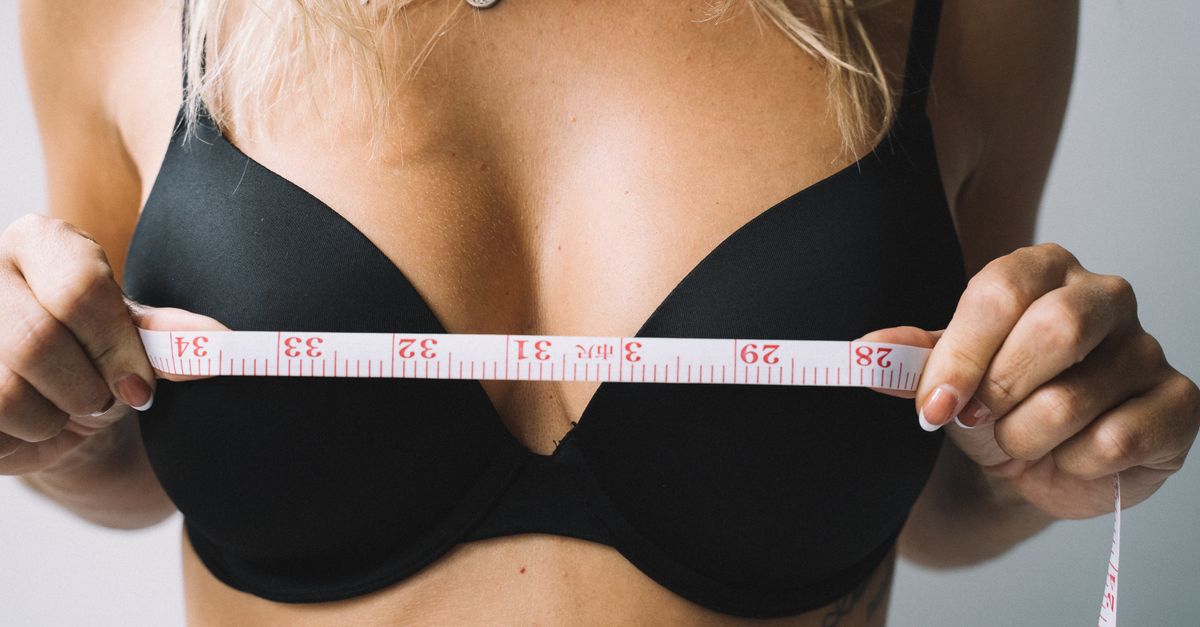
What a Bra Size Actually Means
A size like "34C" or "75C" is shorthand for two distinct decisions:
- Band number — the underbust rounded to an even number (or to the regional band convention) that corresponds to the elastic part of the bra.
- Cup letter — the volume of the cup, expressed as a difference between bust and underbust.
The cup letter does not stand alone. A 34C and a 38C hold different volumes, because the band length around the ribcage changes. This is why two people with the same cup letter but different band numbers cannot swap bras and expect the same fit.
The Two Measurements You Need
Everything in bra sizing flows from two tape-measure readings. Wear a non-padded bra or no bra, stand relaxed in front of a mirror, and breathe normally while you measure.
| Measurement | Where to place the tape | Tension |
|---|---|---|
| Underbust (band) | Directly under the breasts, level around the ribcage | Snug, flat against the skin |
| Bust (fullest) | Across the nipple line, around the fullest part of the breasts | Level, no compression |
Keep the tape parallel to the floor for both readings. A tape that angles up at the back will give a falsely low number, and a tape that sags at the front will give a falsely high number.
How to Calculate Your Bra Size Step by Step
- Choose inches or centimeters in the Bra Size Calculator input row.
- Wrap a soft tape snugly around your ribcage just under the breasts, keep it level, and read the underbust to the nearest quarter inch or half centimeter. Type the number into the first field.
- Measure around the fullest part of your bust with the tape level and not compressing the breast tissue. Enter that number into the second field.
- Read your estimated size instantly: the calculator returns a band number plus cup letter in US, UK and EU conventions side by side.
- If your measured underbust falls on an odd number, the calculator rounds to the nearest even band automatically — use that band as your starting point when trying on bras.
The same two inputs work regardless of where you shop, because the underlying measurements are universal; only the band-numbering rule differs between regions.
Why the Three Systems Give Different Band Numbers
US, UK and EU sizes are not interchangeable on the band, even though the cup letter is calculated the same way in all three. Knowing which system a brand uses prevents ordering a bra that looks right on paper but fits wrong on the body.
| System | Band rule (from underbust) | Typical band label |
|---|---|---|
| US | Round to nearest even number | 32, 34, 36, 38… |
| UK | Round to nearest even number (same as US for most adults) | 32, 34, 36, 38… |
| EU / FR | Underbust in cm + 0 (direct reading, no rounding to even) | 70, 75, 80, 85… |
This is why the same woman can be a US 34B, a UK 34B, and an EU 75B. The cup letter is identical because the difference between bust and underbust is identical — only the band label changes with the unit.
The Cup Letter in Plain Numbers
The cup letter is just a bucket for the bust-minus-underbust difference. While exact cut points vary by brand, the commonly cited step is roughly 1 inch (2.5 cm) per letter, so you can sanity-check any calculator result before buying.
| Difference (in) | Difference (cm) | Cup letter |
|---|---|---|
| Less than 1 | Less than 2.5 | AA |
| 1 | 2.5 | A |
| 2 | 5 | B |
| 3 | 7.5 | C |
| 4 | 10 | D |
| 5 | 12.5 | DD / E |
Beyond D, labeling diverges between US (DD, DDD, F) and UK (DD, E, F, FF). The Bra Size Calculator applies each region's labeling rule automatically so you do not have to memorize the letters.
Measuring Tips That Change the Result
Most "wrong size" complaints trace back to measurement technique rather than body shape. A few habits remove the most common errors:
- Measure on bare skin. Clothing adds 0.5–1 inch (1–2 cm) and can push you up a band and a cup.
- Keep the tape level. A mirror beside you catches any front-to-back sag immediately.
- Do not pull the bust tape tight. The bust number is a circumference of soft tissue, not a compression measurement.
- Measure at the end of the day if possible. Ribcage and breast volume shift slightly with posture and hydration.
- Take each measurement twice. If the two readings differ by more than about 0.25 in (0.5 cm), re-measure — tape placement drifted.
If you want a second opinion without leaving the house, the Bra Size Converter lets you re-label an existing size from US to UK to EU without re-measuring, which is useful when comparing brand size charts side by side.
Worked Example: One Calculation, Three Systems
To make the math concrete, here is a single end-to-end calculation for someone with an underbust of 30 inches and a bust of 33 inches.
- Bust − underbust = 33 − 30 = 3 inches.
- 3 inches corresponds to cup letter C.
- Band (US, UK) = underbust rounded to the nearest even number = 30 (already even, stays at 30).
- Result: US 30C and UK 30C.
- Convert underbust to centimeters: 30 in × 2.54 = 76.2 cm, which rounds to the nearest 5 cm band used in EU labeling = 75.
- Result: EU 75C.
Final answer for this person: US 30C, UK 30C, EU 75C. The cup letter is identical across regions; only the band label changes because the EU band is read directly from centimeters rather than rounded to an even inch. The calculator returns all three at once for any other input pair.
When to Trust the Number and When to Refit
A calculator gives a starting size, not a final verdict. Real-world fit depends on breast shape, strap style, and brand-specific grading, so even a perfect tape measurement can land on a bra that needs a sister size (same cup, one band up or down). A simple self-check after putting a bra on:
- The band sits level around the body and stays put when you raise your arms.
- The center gore (the piece between the cups) lies flat against the sternum.
- The wires sit behind the breast tissue, not on it.
- No spilling at the top, sides, or under the arms.
If three of those four are off, try the sister size. If the cup is right but the band rides up, go down a band and up a cup. If the band feels right but the cup overflows, go up a cup in the same band. The Bra Size Calculator gives you the anchor point; sister-sizing is the small adjustment around it.
Quick Reference for Common Inputs
For readers who already have their tape numbers and just want a sanity check, the table below lists what the calculator will return for a few typical input pairs. Use it as a rough map; for any pair outside this list, run the numbers through the tool directly.
| Underbust (in) | Bust (in) | US size | UK size | EU size |
|---|---|---|---|---|
| 28 | 30 | 28B | 28B | 70B |
| 30 | 33 | 30C | 30C | 75C |
| 32 | 35 | 32C | 32C | 80C |
| 34 | 38 | 34D | 34D | 85D |
| 36 | 40 | 36D | 36D | 90D |
The pattern is the same in every row: the cup letter is the bust-minus-underbust difference translated into a letter, and the EU band is the underbust converted to centimeters and rounded to the nearest 5. The calculator handles this for every other pair in the same way. For more on measuring at home without a fitter, the How to Calculate Bra Size Accurately at Home guide walks through the same process with extra detail on tape placement.
Putting It All Together
Two measurements — underbust and bust — drive the entire system. Measure them with a soft tape, keep it level, and plug them into the Bra Size Calculator to read your US, UK and EU sizes at once. Treat the result as a strong starting point, try the bra on, and adjust by sister size if the fit is almost-but-not-quite right. The same approach works whether you measure in inches or centimeters, and whether you are shopping US, UK or EU brands, because the underlying tape readings do not change — only the band label does.
Related reading: Calculate Brinell Hardness from Load, Ball and Indent Diameter.
Related reading: How to Calculate Business Days Between Dates in Excel.