The U.S. Navy circumference method estimates body-fat percentage from just four tape-measure numbers — height, neck, and waist for men, plus hip for women — using a base-10 logarithmic equation that returns your estimated body-fat percentage to one decimal place in your browser. Originally developed at the Naval Health Research Center (the Hodgdon–Beckett equations), the approach is calibrated against large populations and works because certain circumferences track the ratio of fat to lean mass well enough for a fast screening estimate. The whole point is speed and privacy: no calipers, no scale, no gym appointment, no DEXA scan. The Body Fat Calculator runs the equation locally, so your numbers never leave your device.
Body-fat percentage and skeletal muscle are linked but distinct signals. Body-fat percentage tells you how much of your total mass is fat tissue, while skeletal muscle is the lean tissue attached to your bones that drives strength and resting metabolism. Tape-based formulas don't measure skeletal muscle directly — they infer body composition from circumferences that correlate with the fat-to-lean ratio across populations. For a dedicated walkthrough that connects both signals, see how to calculate body fat and muscle mass percentage.
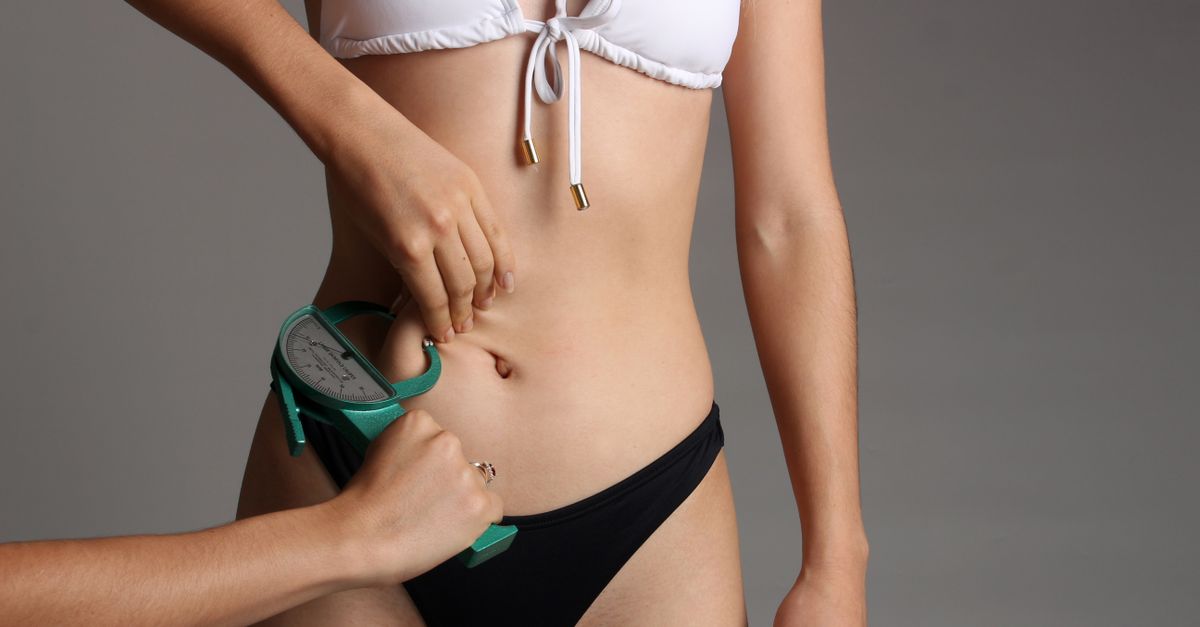
What the U.S. Navy body-fat formula actually measures
The formula doesn't peek inside your body. Instead, it uses a few tape measurements that, across large groups, correlate strongly with how much of someone's mass is fat versus lean tissue. For men the equation is:
BF% = 495 / (1.0324 − 0.19077·log10(waist − neck) + 0.15456·log10(height)) − 450
For women it adds a hip measurement to account for the way female fat distribution shifts lower-body shape:
BF% = 495 / (1.29579 − 0.35004·log10(waist + hip − neck) + 0.22100·log10(height)) − 450
All inputs are in centimetres. The log10 functions smooth the values so the result lands on a sensible percentage scale. Because the formulas were calibrated on population averages, they work best for average adults and lose precision at the extremes — very lean, very muscular, or older people often see numbers that diverge further from gold-standard methods like DEXA scans or hydrostatic weighing.
Take your tape measurements the right way
Measurement error is the single biggest reason a Navy-method result misses the mark. A one-centimetre slip on the waist can shift your final percentage by roughly a percentage point. Treat the tape like a precision instrument.
- Neck. Measure just below the larynx (Adam's apple) with the tape sloping slightly downward at the front. Don't flex the neck or tighten the tape against the skin.
- Waist (men). Measure at the navel, on bare skin, after a normal exhale, with the tape level and parallel to the floor.
- Waist (women). Measure at the narrowest point of the torso — usually between the navel and the ribcage — not at the navel itself.
- Hip (women only). Measure at the widest point around the buttocks, with the tape level all the way around.
- Height. Stand barefoot against a wall, mark the crown, and measure from the floor to the mark with the tape held straight.
Take every measurement two or three times and average the readings. Keep the tape snug but never compressing the skin, and stand relaxed rather than sucking in or flexing. Morning measurements before eating tend to be the most repeatable because hydration, food volume, and bloating are at their lowest.
Calculate your body-fat percentage with the tape method
- Open the Body Fat Calculator in your browser and select your sex.
- Measure your height, neck, and waist in centimetres. If you're female, also measure your hips at the widest point.
- Type each measurement into its field — the estimated body-fat percentage updates instantly as you type, so you can re-measure and re-enter if a number looks off.
- Read your body-fat percentage to one decimal place along with the fitness band the tool assigns to that value.
- Take the set of measurements two or three times across the same morning and use the average — that's your most reliable reading.
Here is the math on a single set of numbers. A man who is 180 cm tall with a 40 cm neck and a 90 cm waist plugs in:
BF% = 495 / (1.0324 − 0.19077·log10(90 − 40) + 0.15456·log10(180)) − 450
BF% = 495 / (1.0324 − 0.19077 × 1.6990 + 0.15456 × 2.2553) − 450
BF% = 495 / (1.0324 − 0.3241 + 0.3486) − 450
BF% = 495 / 1.0569 − 450
BF% = 468.4 − 450 = 18.4%
Plug the same shape into the calculator and you'll see the same number to one decimal place. Try a few other measurements and you'll quickly see how a couple of centimetres of waist change the result, which is why averaging two or three careful measurements matters more than chasing the formula itself.
Reading your result: fitness bands and trend tracking
The calculator returns two things: a percentage and a simple fitness-band label. The label is a coarse bucket — essential fat, athletes, fitness, average, or high — so use it as orientation, not judgment. The far more useful number is the trend across weeks and months.
Two people at the same body weight can carry dramatically different amounts of fat and muscle. A rising body-fat estimate while your weight holds steady is a flag that you may be losing muscle, even when nothing else seems to be changing. A falling body-fat estimate during resistance training, on the same trend, usually signals recomposition — losing fat and gaining lean tissue at the same time, even when the scale barely moves. The tape method's real strength is that it's repeatable enough to expose those patterns quickly.
Why body-fat percentage beats BMI for tracking progress
BMI is just weight divided by height squared. Two athletes with identical BMI can have very different body-fat percentages depending on how much lean mass they carry. Body-fat percentage, even an estimate, is a more informative body-composition signal because it separates the two tissues the scale can't distinguish. According to the Wikipedia overview of body-fat percentage, healthy ranges for adults typically fall between roughly 10–20% for men and 18–25% for women, though the right number for any individual depends on age, training, and genetics.
| Method | What you need | Where you do it | What kind of result it gives |
|---|---|---|---|
| U.S. Navy tape method | Flexible tape measure | At home, in private | Statistical estimate of body-fat % from circumferences |
| Skin-fold calipers | Caliper, practiced technique | Home or gym | Estimate based on subcutaneous fat thickness at sites |
| Smart scale (BIA) | Special bathroom scale | At home | Body-fat % from electrical impedance through the body |
| DEXA scan | Medical imaging scanner | Clinic or hospital | Bone, fat, and lean tissue measured separately |
| Hydrostatic weighing | Underwater weighing tank | Specialist lab | Body-fat % derived from body density in water |
Each method trades accuracy for cost, time, and access. The tape method sits at the cheap, fast, private end of the spectrum — and that's exactly why it earns its place as a first-pass screen before anyone books a scan.
Limits of the tape estimate and when to see a pro
The Navy circumference method is a screening estimate, not a measurement. For average adults it usually lands within about 3–4 percentage points of gold-standard techniques such as DEXA scans and hydrostatic weighing, but it can drift further from the true value for very lean, very muscular, or older individuals. It also doesn't tell you where the fat sits, which matters because visceral (abdominal) fat carries a different cardiovascular risk profile than the subcutaneous fat stored just under the skin.
The estimate is also sensitive to hydration, the tape's snugness, and whether you exhaled normally. That's why the calculator encourages you to re-measure and average rather than trust any single reading. For clinical questions about body composition, cardiovascular risk, or any underlying health condition, the calculator is not a substitute for a qualified healthcare professional using validated equipment and interpreting the result in the context of your full medical picture.
Used as a quick, private screening tool — taken consistently under the same conditions at the same time of day — the U.S. Navy method gives most people a useful signal at a fraction of the cost and effort of a lab visit, and a much clearer view of progress than a bathroom scale alone can offer.
For a deeper look, see How to Convert Density to Mass in Any Unit.